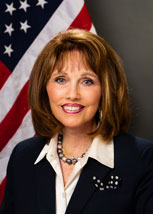
Photo of Patricia C. Bates
R California Senate · District 36

Sen. Patricia C. Bates

Compare
Total votes
46,261
all sessions
Attendance
93%
1,864 missed
Lower than 78% of chamber peers
With party
98%
of cast votes
Near the chamber average
Bipartisan score
2%
crosses aisle rarely
Higher than 81% of chamber peers
Sponsored
1,957
bills & resolutions
Near the chamber average
Committees
0
assignments
1,957 bills and resolutions

Sponsored bills

Total
1,957
Primary
271
Co-sponsor
1,686
This page
1,957
matching current filters
Co-sponsor ACR 162
Signed into law · California Assembly · Co-sponsor
Relative to the Officer Nicholas Vella Memorial Highway.

This measure would designate a specified portion of State Highway Route 39 in the City of Huntington Beach as the Officer Nicholas Vella Memorial Highway. The measure would request that the Department of Transportation determine the cost of appropriate signs showing this special designation and, upon receiving donations from nonstate sources covering that cost, erect those signs.

Signed into law Aug 19, 2022 1 co-sponsor
Primary SB 904
Passed · California Senate · Lead sponsor
Controlled substances: treatment.

Existing law, as added by the Substance Abuse and Crime Prevention Act of 2000, adopted by voters as Proposition 36 at the November 7, 2000, statewide general election, requires that persons convicted of certain nonviolent drug possession offenses be granted probation and participate in and complete an appropriate drug treatment program as a condition of that probation. After completion of drug treatment and the terms of probation, the act requires the court to conduct a hearing, set aside the conviction, and dismiss the complaint if the court finds, among other requirements, that the defendant successfully completed drug treatment. For purposes of the act, a defendant has successfully completed treatment if they have completed the prescribed course of drug treatment and, as a result, there is reasonable cause to believe that they will not abuse controlled substances in the future. The act allows its amendment by a statute passed by 2/3 of both houses of the Legislature and requires that all amendments further the act and be consistent with its purposes. This bill would amend the act by removing the requirement that there be reasonable cause to believe that the defendant will not abuse controlled substances in the future in order to be considered as having successfully completed treatment. Existing law requires the court, when granting probation after conviction of any controlled substance offense, as specified, to order as a condition of probation that the defendant secure education or treatment from a local community agency designated by the court. Existing law requires a juvenile court to order a minor, found to have been in possession of any controlled substance, to receive education or treatment from a local community agency, as specified, and to order the minor's parents or guardian to participate in the education or treatment if beneficial to the minor. Existing law provides that a defendant's willful failure to complete a court-ordered education or treatment program shall be a circumstance in aggravation for purposes of sentencing in any subsequent prosecution for specified controlled substance violations. This bill would allow the court to order the defendant, and a juvenile court to order a minor, to complete a controlled substance education or treatment program, as specified, if available. The bill would require the court or probation department to refer defendants to controlled substance education or treatment programs that adhere to specified standards. The bill would require the county drug program administrator and representatives of the court and county probation department, with input from substance use treatment providers, to design and implement an approval and renewal process for controlled substance education and treatment programs. The bill would require the court, upon conviction of a controlled substance offense resulting in imprisonment, to recommend that the defendant attend a controlled substance education or treatment program while imprisoned. By imposing additional duties on local entities, the bill would impose a state-mandated local program. Existing law requires every county drug program administrator, in consultation with representatives of the court and the county probation department, to establish minimum requirements, criteria, and fees for the successful completion of drug diversion programs, including a minimum of 20 hours of education, counseling, or any combination of both for each divertee. This bill would clarify that the 20 hours or more of education or counseling shall include education about, among other things, how the use of controlled substances affects the body and the dangers of using controlled substances, as specified. The California Constitution requires the state to reimburse local agencies and school districts for certain costs mandated by the state. Statutory provisions establish procedures for making that reimbursement. This bill would provide that, if the Commission on State Mandates determines that the bill contains costs mandated by the state, reimbursement for those costs shall be made pursuant to the statutory provisions noted above.

Passed Aug 11, 2022 0 co-sponsors
Co-sponsor SB 21
Passed · California Senate · Co-sponsor
Specialized license plates: mental health awareness.

Under existing law, a state agency is authorized to apply to the Department of Motor Vehicles (DMV) to sponsor a specialized license plate program, and the DMV is required to issue those license plates if the agency meets certain requirements. Existing law also requires the DMV to charge specified fees for certain services related to the issuance of those plates. This bill would require the State Department of Education to apply to the DMV to sponsor a mental health awareness license plate program, and would require the DMV to issue the license plates if the State Department of Education meets certain requirements. The bill would also establish the Mental Health Awareness Fund in the State Treasury and would require the revenue generated from the license plates to be deposited in the fund for use, upon appropriation by the Legislature to the State Department of Education, for mental health services in public schools.

Passed Aug 11, 2022 1 co-sponsor
Co-sponsor SB 1135
Passed · California Senate · Co-sponsor
The California Youth Cardiac Screening Pilot Program.

The Eric Paredes Sudden Cardiac Arrest Prevention Act requires the State Department of Education to post on its internet website guidelines, videos, and an information sheet on sudden cardiac arrest symptoms and warning signs, and other relevant materials relating to sudden cardiac arrest. The act also places certain duties on schools related to sudden cardiac arrest and requires athletic directors, coaches, athletic trainers, or authorized persons, as defined, to remove from participation a pupil who passes out or faints while participating in or immediately following an athletic activity. This bill would require the department, upon appropriation by the Legislature, to establish the California Youth Cardiac Screening Pilot Program to provide, among other things, free cardiac screening for pupils in grades 5 to 12, inclusive, for the 2022–23 to 2024–25 school years, inclusive, as specified. The bill would allow the department to administer the program itself or to contract with a nonprofit organization to administer the program and certain funding, as specified. The bill would authorize the department to receive voluntary or reduced-cost services from medical providers and other individuals related to the program. The bill would require the department to annually report certain information to the Department of Finance and to the appropriate policy and fiscal committees of the Legislature, and would repeal these provisions on January 1, 2026.

Passed Aug 11, 2022 1 co-sponsor
Primary SB 1077
Passed · California Senate · Lead sponsor
Coastal resources: Climate Ready Program: grants: nonnative and invasive plants: removal and restoration.

Existing law establishes in the Natural Resources Agency the State Coastal Conservancy. Existing law establishes the Climate Ready Program, administered by the conservancy, in order to address the impacts and potential impacts of climate change on resources within the conservancy's jurisdiction. As part of the program, existing law authorizes the conservancy to award grants to public agencies and nonprofit organizations for specified activities, including those that reduce greenhouse gas emissions. Existing law requires the conservancy, in awarding the grants, to prioritize projects that maximize public benefits and that accomplish certain things, including that the project reduces emissions of greenhouse gases, reduces hazards to harbors and ports, preserves and enhance coastal wetlands and natural lands, conserves biodiversity, and provides recreational opportunities. This bill would specifically authorize the conservancy to award grants to public agencies and nonprofit organizations that increase resilience of habitat and natural lands. The bill would require the conservancy, in awarding grants, as part of the prioritization of projects described above, to include those projects that accomplish the removal of nonnative and invasive plants from coastal features, habitats, and ecosystems, and their replacement with native plant species, upon appropriation. The bill would authorize the conservancy to consult, as needed, with the Department of Fish and Wildlife, the Invasive Species Council of California, and other entities in determining the invasive status of any species.

Passed Aug 11, 2022 0 co-sponsors
Primary SB 473
Passed · California Senate · Lead sponsor
Health care coverage: insulin cost sharing.

Existing law, the Knox-Keene Health Care Service Plan Act of 1975, provides for the licensure and regulation of health care service plans by the Department of Managed Health Care and makes a willful violation of the act's requirements a crime. Existing law provides for the regulation of health insurers by the Department of Insurance. Existing law requires a health care service plan contract or health insurance policy issued, amended, delivered, or renewed on or after January 1, 2000, to include coverage for equipment, supplies, and, if the contract or policy covers prescription benefits, prescriptive medications for the management and treatment of insulin-using diabetes, non-insulin-using diabetes, and gestational diabetes, as medically necessary. This bill would require a health care service plan contract or a health insurance policy that is issued, amended, delivered, or renewed on or after January 1, 2023, to cover all available dosage forms and concentrations of at least one insulin product of each insulin type for a copayment not to exceed $35 for a monthly supply, or a multiple of $35 for a multimonth supply, and would prohibit a policy or contract from imposing other cost-sharing requirements. The bill would also prohibit a health care service plan contract or health insurance policy that is issued, amended, delivered, or renewed on or after January 1, 2023, from imposing a deductible requirement on benefits related to managing and treating diabetes, as specified. Because a willful violation of these provisions by a health care service plan would be a crime, the bill would impose a state-mandated local program. The California Constitution requires the state to reimburse local agencies and school districts for certain costs mandated by the state. Statutory provisions establish procedures for making that reimbursement. This bill would provide that no reimbursement is required by this act for a specified reason.

Passed Aug 11, 2022 0 co-sponsors
Co-sponsor SCR 68
Signed into law · California Senate · Co-sponsor
Relative to the First Lady Pat Nixon Memorial Highway.

This measure would designate the portion of State Route 91, from the Pioneer Boulevard undercrossing to the Carmenita Road overcrossing, as the First Lady Pat Nixon Memorial Highway. This measure would request the Department of Transportation to determine the cost of appropriate signs showing this special designation and, upon receiving donations from non-state sources covering that cost, to erect those signs.

Signed into law Aug 1, 2022 1 co-sponsor
Co-sponsor AB 1732
Signed into law · California Assembly · Co-sponsor
Emergency services: hit-and-run incidents: Yellow Alert.

Existing law authorizes use of the Emergency Alert System to inform the public of local, state, and national emergencies. Existing law requires a law enforcement agency to activate the Emergency Alert System within the appropriate area if that agency determines that a child 17 years of age or younger, or an individual with a proven mental or physical disability, has been abducted and is in imminent danger of serious bodily injury or death, and there is information available that, if disseminated to the general public, could assist in the safe recovery of that person. Existing law also authorizes the issuance and coordination of a Blue Alert following an attack upon a law enforcement officer or a Silver Alert relating to a person who is 65 years of age or older who is reported missing. This bill would authorize a law enforcement agency to request the Department of the California Highway Patrol to activate a Yellow Alert if a person has been killed due to a hit-and-run incident and the law enforcement agency has specified information concerning the suspect or the suspect's vehicle. The bill would authorize the Department of the California Highway Patrol to activate a Yellow Alert within the requested geographic area upon request of the law enforcement agency if it concurs with the law enforcement agency that specified requirements are met. This bill would also require the Department of the California Highway Patrol to track the number of Yellow Alert requests it receives from law enforcement agencies. The bill would require the Department of the California Highway Patrol to submit a final report to the Legislature of the efficacy, the advantages, and the disadvantages of the Yellow Alert System by January 1, 2026. On January 1, 2026, the provisions of this bill would be repealed.

Signed into law Jul 19, 2022 1 co-sponsor
Co-sponsor SB 387
Passed · California Senate · Co-sponsor
Pupil health: school employee and pupil training: youth mental and behavioral health.

Existing law, contingent on an appropriation made for these purposes, requires the State Department of Education, on or before January 1, 2023, to recommend best practices and identify training programs for use by local educational agencies to address youth behavioral health, including, but not necessarily limited to, staff and pupil training, as specified. Existing law requires the department to ensure that each identified training program, among other requirements, provides instruction on how school staff can best provide referrals to youth behavioral health services or other support to individuals in the early stages of developing a youth behavioral health disorder. Existing law defines a local educational agency for purposes of these provisions to mean a county office of education, school district, state special school, or charter school that serves pupils in any of grades 7 to 12, inclusive. This bill would include referrals to special education services in that instruction requirement for identified training programs. The bill would require, on or before January 1, 2025, those local educational agencies to certify to the department that 75% of both its classified and certificated employees have received that youth behavioral health training, as specified. The bill would prohibit the training in youth behavioral health to be a condition of employment or hiring. By imposing training certification duties on local educational agencies, the bill would impose a state-mandated local program. The California Constitution requires the state to reimburse local agencies and school districts for certain costs mandated by the state. Statutory provisions establish procedures for making that reimbursement. This bill would provide that, if the Commission on State Mandates determines that the bill contains costs mandated by the state, reimbursement for those costs shall be made pursuant to the statutory provisions noted above.
Passed Jun 28, 2022 1 co-sponsor
Co-sponsor AB 1657
Failed · California Assembly · Co-sponsor
Oil spills: reporting: waters of the state.

The Lempert-Keene-Seastrand Oil Spill Prevention and Response Act generally requires the administrator for oil spill response, acting at the direction of the Governor, to implement activities relating to oil spill response, including drills and preparedness, and oil spill containment and cleanup. The act requires, without regard to intent or negligence, any party responsible for the discharge or threatened discharge of oil in waters of the state to report the discharge immediately to the Office of Emergency Services. The act makes it a crime to fail to notify the office in violation of that requirement. This bill would define "threatened discharge of oil in waters of the state" to mean a discharge by an offshore facility, as defined, including an offshore pipeline, located where an oil spill may impact state waters. The bill would require an offshore facility to be presumed to be located where an oil spill may impact state waters if certain circumstances apply, including that any portion of an offshore pipeline that services the offshore facility transports oil to, from, or through state waters. By expanding the scope of a crime, the bill would impose a state-mandated local program. The California Constitution requires the state to reimburse local agencies and school districts for certain costs mandated by the state. Statutory provisions establish procedures for making that reimbursement. This bill would provide that no reimbursement is required by this act for a specified reason.

Failed Jun 28, 2022 1 co-sponsor
Showing 21 to 30 of 1,957 bills
Previous 1 … 2 3 4 … 196 Next