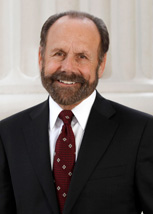
Photo of Jerry Hill
D California Senate · District 13

Sen. Jerry Hill

Compare
Total votes
34,484
all sessions
Attendance
99%
121 missed
Higher than 95% of chamber peers
With party
99%
of cast votes
Near the chamber average
Bipartisan score
0%
crosses aisle rarely
Near the chamber average
Sponsored
1,209
bills & resolutions
Near the chamber average
Committees
0
assignments
1,209 bills and resolutions

Sponsored bills

Total
1,209
Primary
295
Co-sponsor
914
This page
1,209
matching current filters
Primary SB 1339
In committee · California Senate · Lead sponsor
Vehicles: equipment.

Existing law requires all vehicles subject to registration to be equipped with a muffler, as specified, to prevent excessive or unusual noise. This bill would specify that electric vehicles are exempt from this requirement.

In committee Mar 12, 2020 0 co-sponsors
Co-sponsor AB 2063
In committee · California Assembly · Co-sponsor
Property taxation: welfare exemption: low-income housing.

The California Constitution authorizes the Legislature to exempt from taxation, in whole or in part, property that is used exclusively for religious, hospital, or charitable purposes, and is owned or held in trust by a nonprofit entity. Pursuant to this constitutional authority, existing law partially exempts from property taxation property used exclusively for rental housing and related facilities, if specified criteria are met, including, except in the case of a limited partnership in which the managing general partner is a nonprofit corporation eligible for the exemption, that 90% or more of the occupants of the property are lower income households whose rents do not exceed the rent limits prescribed by a specified law. Existing law limits the total exemption amount allowed to a taxpayer, with respect to a single property or multiple properties for any fiscal year on the sole basis of the application of this criterion, to $20,000,000 of tax. This bill, for claims filed for fiscal years 2020–21 to 2030–31, inclusive, would decrease the percentage of occupants that are lower income households required to qualify for exemption under these provisions from 90% to 50%. The bill, with respect to lien dates occurring on and after January 1, 2020, would also increase the total exemption amount allowed from $20,000,000 to $100,000,000 in assessed value. The bill would require any outstanding qualified ad valorem property tax in excess of the $20,000,000 limitation, and related interest or penalty, which was levied or imposed on and after January 1, 2019, and before January 1, 2020, with respect to qualified property for which a qualified claim was filed, to be canceled to the extent that the amount canceled does not result in a total assessed value exemption amount in excess of $100,000,000 being allowed to a qualified taxpayer with respect to a single property or multiple properties for any fiscal year. The bill would, on and after January 1, 2020, prohibit an escape assessment from being levied on qualified property if that amount would be subject to cancellation pursuant to this bill. By adding to the duties of local tax officials, this bill would impose a state-mandated local program. The California Constitution requires the state to reimburse local agencies and school districts for certain costs mandated by the state. Statutory provisions establish procedures for making that reimbursement. This bill would provide that, if the Commission on State Mandates determines that the bill contains costs mandated by the state, reimbursement for those costs shall be made pursuant to the statutory provisions noted above. Existing law requires the state to reimburse local agencies annually for certain property tax revenues lost as a result of any exemption or classification of property for purposes of ad valorem property taxation. This bill would provide that, notwithstanding those provisions, no appropriation is made and the state shall not reimburse local agencies for property tax revenues lost by them pursuant to the bill. This bill would declare that it is to take effect immediately as an urgency statute.

In committee Mar 9, 2020 1 co-sponsor
Co-sponsor AB 3067
In committee · California Assembly · Co-sponsor
Driver's licenses: instruction permits and provisional licenses.

(1) Existing law, the Brady-Jared Teen Driver Safety Act of 1997, establishes a provisional licensing program and generally requires that a driver's license issued to a person at least 16 years of age but under 18 years of age be issued pursuant to that provisional licensing program. Existing law requires a person to hold an instruction permit for not less than 6 months prior to applying for a provisional license. During the first 12 months after issuance of a provisional license, existing law prohibits the licensee from driving between the hours of 11 p.m. and 5 a.m. and transporting passengers who are under 20 years of age, as specified. Existing law provides limited exceptions to these restrictions under which a licensee is authorized to drive under specified circumstances. A violation of these provisions is punishable as an infraction. This bill would, commencing July 1, 2022, expand the scope of the provisional licensing program by expanding the applicable age range for the program to persons at least 16 years of age, but under 21 years of age. The restrictions on provisional licensees described above would apply during the first 6 months after issuance of a provisional license to a licensee who is 18, 19, or 20 years of age, subject to specified exemptions. The bill would, commencing July 1, 2022, require a person at least 18 years of age, but under 21 years of age, to hold an instruction permit for at least 60 days before applying for a provisional license. By expanding the scope of the provisional licensing program, the violation of which constitutes an infraction, the bill would impose a state-mandated local program. The bill would, commencing July 1, 2022, make other technical and conforming changes. The bill would also include specified findings and declarations. (2) Existing law generally authorizes the Department of Motor Vehicles, for good cause, to issue an instruction permit to any physically and mentally qualified person who applies to the department for an instruction permit and who meets any one of 5 specified requirements, including that the person is 17 years and 6 months of age or older. The bill would, commencing July 1, 2022, raise the age for the above requirement to 20 years and 6 months. Existing law provides that a person, while having in the person's immediate possession a valid permit issued pursuant to the above provisions, may operate a motor vehicle, other than a motorcycle or a motorized bicycle, when accompanied by, and under the immediate supervision of, a California-licensed driver with a valid license of the appropriate class, 18 years of age or over whose driving privilege is not on probation, as specified. A violation of this provision is punishable as an infraction. The bill would, commencing July 1, 2022, for purposes of supervising a person issued a valid permit as described above, raise the required age of the California-licensed driver to 21 years of age. By changing the definition of an existing infraction, the bill would impose a state-mandated local program. (3) Existing law prohibits a person from owning or operating a driving school or giving driving instruction for compensation without a license issued by the Department of Motor Vehicles. The bill would require an owner or operator of a driving school or an independent driving instructor, as a condition of obtaining a new license or renewed license from the department on and after July 1, 2022, to offer and accept installment payments, as specified, for the compensation to provide the instruction required by the Brady-Jared Teen Driver Safety Act of 1997. The bill would also authorize the Department of Motor Vehicles, on or after January 1, 2021, to charge a driving school, as specified, a fee not to exceed $1 for each driver education or driver training certificate of completion furnished by the department and issued to a person who has demonstrated satisfactory completion of a certified driver education and driver training course, in order to recover the department's reasonable costs in administering the provisional licensing program, including covering the department's costs in implementing the program. The bill would prohibit a driving school from charging an applicant a fee for a certificate of completion that exceeds the fee the department charges the school. (4) The California Constitution requires the state to reimburse local agencies and school districts for certain costs mandated by the state. Statutory provisions establish procedures for making that reimbursement. The bill would provide that no reimbursement is required by this act for a specified reason.

In committee Mar 5, 2020 1 co-sponsor
Primary SB 1077
In committee · California Senate · Lead sponsor
Electrical restructuring: Electricity Oversight Board.

Existing law, enacted as part of the restructuring of the electrical industry, provides for the establishment an Electricity Oversight Board to perform specified functions, including overseeing the Independent System Operator and the Power Exchange and to investigate any matter related to the wholesale market for electricity to ensure that the interests of California's citizens and consumers are served, protected, and represented in relation to the availability of electric transmission and generation and related costs during periods of peak demand. This bill would make nonsubstantive revisions to certain legislative findings and declarations relative to electrical restructuring.

In committee Feb 27, 2020 0 co-sponsors
Primary SB 1104
In committee · California Senate · Lead sponsor
Community colleges: statewide baccalaureate degree pilot program.

Existing law establishes the California Community Colleges, under the administration of the Board of Governors of the California Community Colleges, as one of the segments of public postsecondary education in this state. Existing law, until July 1, 2026, authorizes the board of governors, in consultation with the California State University and the University of California, to establish a statewide baccalaureate degree pilot program. Existing law requires a community college district baccalaureate degree pilot program to commence no later than the 2017–18 academic year, and requires students participating in a baccalaureate degree pilot program to commence their degrees by the beginning of the 2022–23 academic year. This bill would make a nonsubstantive change in a provision related to the statewide baccalaureate degree pilot program.

In committee Feb 27, 2020 0 co-sponsors
Primary SB 1002
In committee · California Senate · Lead sponsor
Public insurance adjusters.

Existing law, the Public Insurance Adjusters Act, governs the regulation, licensing, and registration of public insurance adjusters, as defined, and requires the Insurance Commissioner to administer the act. The act prohibits a licensee from acting within this state as a public insurance adjuster without having first entered into a written contract, and governs the form and content of the contract. The act requires the contract terms to prohibit a public adjuster's fee, commission, or other valuable consideration from causing the insured to receive less than any amount paid to the insured by the insurer prior to the date of the written contract. The act also requires the contract to include a description of the services to be provided to the insured and a statement of the compensation to the licensee. The act prohibits the contract terms from allowing a licensee to collect the entire fee from the first payment issued by an insurer, rather than as a percentage of each payment issued by an insurer. A person who violates these provisions is guilty of a misdemeanor. This bill would instead prohibit the contract terms from allowing a licensee's fee, commission, or other valuable consideration to be for, or be based upon, (1) any amount paid to the insured by the insurer prior to the date of the written contract or (2) an insurer's payment for a specific claim or coverage to which the services do not apply. The bill would revise the description of the services to be provided to the insured and the statement of the compensation to the licensee, to include the specific claim and coverage to which the services or the compensation, respectively, apply. The bill would also make technical and clarifying changes. Because a violation of these provisions would be a crime, the bill would impose a state-mandated local program. The California Constitution requires the state to reimburse local agencies and school districts for certain costs mandated by the state. Statutory provisions establish procedures for making that reimbursement. This bill would provide that no reimbursement is required by this act for a specified reason.
In committee Feb 27, 2020 0 co-sponsors
Primary SB 1139
In committee · California Senate · Lead sponsor
Corporation taxes: deduction: electrical and gas corporations.

Under existing law, the Public Utilities Commission has regulatory authority over public utilities, including electrical and gas corporations. The Corporation Tax Law, in modified conformity with federal income tax laws, allows various deductions from gross income in computing adjusted gross income for purposes of that law, and provides that no deduction is allowed for any fine or similar penalty paid to a government for the violation of any law, as provided. This bill, for the taxable years beginning on and after January 1, 2020, would not allow a deduction for expenses or expenditures by an electrical corporation or a gas corporation that the Public Utilities Commission identified in a decision to penalize the electrical or gas corporation for a safety violation. For any taxable year for which those expenses or expenditures are paid or incurred, the bill would require an electrical corporation or a gas corporation to provide with the return a certification, under penalty of perjury, that none of those expenses or expenditures were taken into account, directly or indirectly, in determining the amount of income of the electrical or gas corporation, or any other related taxpayer, for purposes of the Corporation Tax Law for that taxable year. The bill, if the electrical or gas corporation seeks to recover moneys for those taxes, would require the electrical or gas corporation to recover those moneys from shareholders and not the ratepayers. By expanding the scope of the crime of perjury, this bill would impose a state-mandated local program. The California Constitution requires the state to reimburse local agencies and school districts for certain costs mandated by the state. Statutory provisions establish procedures for making that reimbursement. This bill would provide that no reimbursement is required by this act for a specified reason. This bill would declare that it is to take effect immediately as an urgency statute.

In committee Feb 27, 2020 0 co-sponsors
Co-sponsor SB 944
In committee · California Senate · Co-sponsor
Personal income taxes: Fire Safe Home Tax Credits Act.

The Personal Income Tax Law allows various credits against the tax imposed by that law. Existing law requires any bill authorizing a new tax credit to contain, among other things, specific goals, purposes, and objectives that the tax credit will achieve, detailed performance indicators, and data collection requirements. This bill would allow credits against the tax imposed by the Personal Income Tax Law for each taxable year beginning on or after January 1, 2021, and before January 1, 2026, to a qualified taxpayer for qualified costs relating to qualified home hardening, as defined, and for qualified costs relating to qualified vegetation management, as defined, in specified amounts, not to exceed an aggregate amount of $500,000,000 per taxable year. This bill would authorize a qualified taxpayer to reserve a credit for qualified costs relating to qualified home hardening or qualified vegetation management prior to incurring those costs, as specified. The bill would require a qualified taxpayer that reserved a credit to submit a copy of the receipts showing the total qualified costs incurred and a certification by the qualified taxpayer, signed under penalty of perjury, that the qualified taxpayer incurred the qualified costs claimed, as specified. By requiring qualified taxpayers to submit a certification under penalty of perjury, the bill would expand the crime of perjury and impose a state-mandated local program. The bill also would include additional information required for any bill authorizing a new income tax credit and would require the Legislative Analyst's Office to prepare a written report regarding the credits, as provided. The California Constitution requires the state to reimburse local agencies and school districts for certain costs mandated by the state. Statutory provisions establish procedures for making that reimbursement. This bill would provide that no reimbursement is required by this act for a specified reason. This bill would take effect immediately as a tax levy.

In committee Feb 20, 2020 1 co-sponsor
Co-sponsor SB 925
In committee · California Senate · Co-sponsor
Mobile telephony service base transceiver station towers: performance reliability standards.

Under existing law, the Public Utilities Commission has regulatory authority over public utilities, including telephone corporations. Existing law requires the commission to develop and implement performance reliability standards for backup power systems installed on the property of residential and small commercial customers by a facilities-based provider of telephony services upon determining that the benefits of the standards exceed the costs. This bill would require the commission, in consultation with the Office of Emergency Services, to develop and implement performance reliability standards, as specified, for all mobile telephony service base transceiver station towers, commonly known as "cell towers." Under existing law, a violation of the Public Utilities Act or any order, decision, rule, direction, demand, or requirement of the commission is a crime. Because the provisions of this bill would be a part of the act and because a violation of an order or decision of the commission implementing its requirements would be a crime, the bill would impose a state-mandated local program by creating a new crime. The California Constitution requires the state to reimburse local agencies and school districts for certain costs mandated by the state. Statutory provisions establish procedures for making that reimbursement. This bill would provide that no reimbursement is required by this act for a specified reason.

In committee Feb 12, 2020 1 co-sponsor
Showing 51 to 60 of 1,209 bills
Previous 1 … 5 6 7 … 121 Next