Maddy summaryThis bill temporarily suspends the federal debt ceiling from enactment until December 31, 2024, allowing the government to borrow without restriction during this period. It directly affects the U.S. Treasury's ability to issue new debt to fund existing government obligations. The key mechanism is a temporary pause on the debt limit, with a special rule ensuring that debt issued before January 1, 2025, to cover commitments due before that date is counted toward the new limit. This avoids a potential default on existing financial obligations without changing the debt limit permanently.
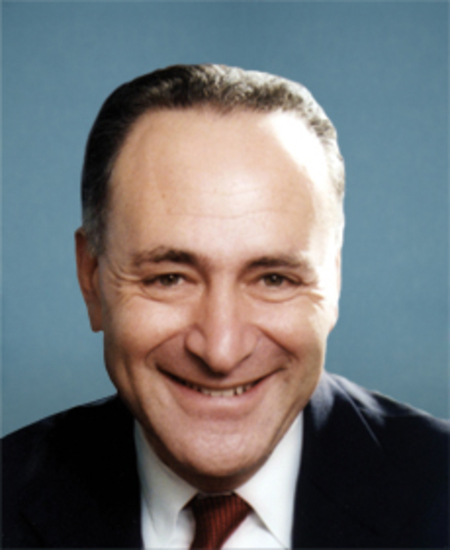
Sen. Charles E. Schumer
Sponsored bills
Maddy summarySJRES 4 is a joint resolution that removes the 1972 deadline for states to ratify the Equal Rights Amendment (ERA), which was originally proposed in House Joint Resolution 208. It declares that the ERA is valid as part of the U.S. Constitution if ratified by three-fourths of states (38), regardless of the expired deadline. The resolution directly affects the ERA ratification process, making it possible for states to complete ratification without time constraints. As of 2023, 38 states had already ratified the ERA, and this resolution would finalize its inclusion in the Constitution if enacted.
Maddy summaryThe New York-New Jersey Watershed Protection Act establishes a federal grant program to fund local restoration projects protecting water quality and wildlife habitats across the New York-New Jersey Harbor watershed. It provides competitive matching grants (up to 90% federal funding for small/rural/disadvantaged communities) to state/local governments, nonprofits, and tribal entities for activities like habitat restoration, stormwater management, and climate resilience projects. The program requires coordination with existing regional plans (such as the Hudson River Estuary Program) and prioritizes projects benefiting communities facing environmental injustice. Funding is authorized at $20 million annually (2024-2029), with at least 75% dedicated to grants, and mandates annual progress reports to Congress.
Maddy summaryThe Child Care for Working Families Act establishes a new federal program to provide affordable, high-quality child care for working families with children under age 6. It requires states to implement a sliding fee scale (with no copayment for families earning up to 85% of state median income) and develop a tiered quality system for child care providers, with payment rates that support staff wages comparable to elementary educators. The bill prioritizes access for underserved populations including children with disabilities, children experiencing homelessness, children in foster care, and children from low-income families, while requiring states to improve child care quality and supply through dedicated funding streams. States must submit detailed plans demonstrating how they will meet these requirements to receive federal funding, which will be provided through a combination of direct child care assistance and quality improvement activities.
This resolution authorizes (1) Daniel Schwager, a former employee of the Office of the Secretary of the Senate, to provide relevant testimony in the case of United States v. Kelly , except concerning matters for which a privilege should be asserted; and (2) the Senate Legal Counsel to represent Mr. Schwager and any current or former officer or employee of his office in connection with this case.
This resolution authorizes (1) Daniel Schwager, a former employee of the Office of the Secretary of the Senate, to provide relevant testimony in the case of United States v. Powell , except concerning matters for which a privilege should be asserted; and (2) the Senate Legal Counsel to represent Mr. Schwager and any current or former officer or employee of his office in connection with this case.
Resident Physician Shortage Reduction Act of 2023 This bill increases the number of residency positions eligible for graduate medical education payments under Medicare for qualifying hospitals, including hospitals in rural areas and health professional shortage areas. Current law provides for an increase of up to 200 positions per fiscal year beginning in FY2023, with a total increase of 1,000 positions; each hospital may receive up to 25 additional positions. Current law also provides for an additional increase of up to 200 positions for FY2026, with at least 100 of these positions for psychiatry or related specialties; each hospital may receive up to 10 additional positions. The bill provides for an additional increase of 2,000 positions per fiscal year from FY2025-FY2031; during this period, each hospital may receive up to 75 additional positions in total under the bill and current law. The bill also requires the Government Accountability Office to report on strategies to increase the diversity of the health professional workforce, including with respect to representation from rural, low-income, and minority communities.
Maddy summarySRES 165 is a 2023 Senate resolution recognizing federal law enforcement agencies (specifically the Department of Justice and FBI) for their work, condemning calls to "defund" these agencies, and rejecting partisan efforts to undermine public trust in them. It directly addresses the actions of former President Trump and his allies who advocated limiting DOJ/FBI funding. The resolution cites FY2022 statistics showing these agencies prosecuted over 20,000 defendants for violent crime, terrorism, and other offenses. As a symbolic resolution (not a law), it has no legal effect but expresses the Senate's position on supporting federal law enforcement.
Maddy summaryThe Latonya Reeves Freedom Act of 2023 establishes a federally protected right for individuals with disabilities who require long-term services and supports (LTSS) to live in community-based settings rather than institutions. The bill defines specific requirements for "community-based" settings, including housing options that allow individuals to live in their own homes or shared residences with privacy rights, choice, and control over their services. It requires states to develop transition plans with measurable goals to move people from institutional settings to community-based supports within 12 years, along with annual reporting on progress. The Department of Justice and Department of Health and Human Services will enforce the law through investigations, compliance reviews, and the ability to seek injunctive relief for violations.
Maddy summaryS 1098, the Global Health, Empowerment and Rights Act, changes U.S. aid rules for foreign nongovernmental organizations (NGOs) receiving funding under the Foreign Assistance Act. It removes eligibility barriers for these NGOs if they provide health services (like counseling) using their own funds, as long as those services comply with local laws and would be legal in the U.S. It also eliminates extra restrictions on how foreign NGOs can use non-U.S. government funds for advocacy or lobbying, making these rules the same as those applied to U.S. NGOs receiving similar aid. This directly affects foreign health-focused NGOs working in international development and rights advocacy.