Maddy summaryHR 764, the Global Health, Empowerment and Rights Act, removes two barriers for foreign nongovernmental organizations (NGOs) seeking U.S. foreign assistance. It ensures these organizations cannot be denied funding solely because they provide health services (like counseling and referrals) using non-U.S. government funds, as long as those services comply with local laws. The bill also requires that foreign NGOs face the same rules on using non-U.S. funds for advocacy and lobbying as U.S. NGOs receiving similar aid. This directly affects international health-focused NGOs working in countries where U.S. aid is provided.
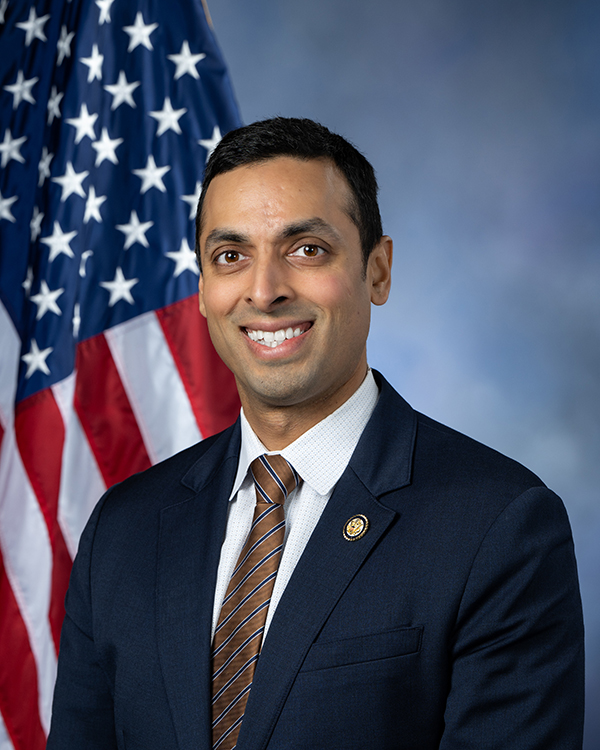
Rep. Suhas Subramanyam
Sponsored bills
Maddy summaryThis resolution celebrates the historical and ongoing contributions of Hindu Americans to the U.S. economy, culture, and society, including their roles in fields like Ayurveda, yoga, and the arts. It specifically condemns Hinduphobia, anti-Hindu bigotry, hate, and intolerance, addressing rising hate crimes against Hindu places of worship (mandirs) and individuals. As a non-binding symbolic resolution, it does not create new laws or policies but serves to affirm support for Hindu Americans' religious freedom and community.
Maddy summaryHRES 68 is a non-binding House resolution expressing strong disapproval of the President’s announcement to withdraw the U.S. from the Paris Agreement. It commends states, businesses, and citizens supporting the Agreement, urges the President to reverse the withdrawal decision, and calls for Congress to prioritize U.S. climate leadership. The resolution does not create new laws or affect specific groups but formally states the House’s position against withdrawing from the international climate accord. It was introduced by 115 co-sponsors and reflects broad congressional concern about reversing U.S. climate commitments.
Supporting Accurate Views of Emergency Services Act of 2025 or the 911 SAVES Act This bill requires the Office of Management and Budget to categorize public safety telecommunicators as a protective service occupation under the Standard Occupational Classification system no later than 30 days after the enactment of this bill. (The Standard Occupational Classification system is a federal statistical standard used by federal agencies to classify workers into occupational categories for the purpose of collecting, calculating, or disseminating data.)
Maddy summaryHR 507, the Veterans Member Business Loan Act, amends the Federal Credit Union Act to explicitly include loans made to veterans as qualifying "member business loans" under credit unions. This change directly affects veterans seeking business financing through federal credit unions, allowing them to access these loans under the same framework as other small business borrowers. The key mechanism is adding a new definition category ("made to a veteran") to the existing eligibility criteria for business loans, using the standard military definition of "veteran" from Title 38, U.S. Code. The bill does not create new funding or programs but expands existing credit union lending options to include veterans. This definition change takes effect six months after the bill's enactment.
Maddy summaryThe Prevent Tariff Abuse Act amends the International Emergency Economic Powers Act to prohibit the President from using emergency powers to impose tariffs or import quotas on goods entering the U.S. It adds a specific provision stating the President cannot impose duties, tariffs, or quotas under this law. This directly limits the executive branch's authority during emergencies, preventing the use of emergency powers for trade restrictions. The bill does not affect other trade policies or the President's other emergency authorities.
Maddy summaryHR 433, the Department of Education Protection Act, prohibits the use of federal funds to reorganize the Department of Education. Specifically, it blocks any spending from current fiscal year appropriations on activities that would decentralize the department, reduce staffing, or alter its structure, responsibilities, or authority relative to its organization as of January 1, 2025. The bill directly affects the Department of Education by preventing structural changes to its existing offices and operations. This is a procedural measure focused solely on preserving the current departmental framework, not on changing education policy or funding.
Maddy summaryHRES 41 is a symbolic resolution introduced in the U.S. House of Representatives to express support for designating January as "Tamil Language and Heritage Month." It does not create new laws or policies but formally recognizes the cultural significance of Tamil language, history, and contributions. The resolution highlights Tamil's 2,600-year history, the presence of 360,000 Tamil speakers in the U.S., and the Pongal harvest festival celebrated by Tamil communities. It aims to encourage Americans to learn about Tamil heritage and aligns with existing state-level recognitions in places like Michigan and Massachusetts. As a non-binding resolution, it directly affects public awareness and cultural celebration, not legal obligations.
Maddy summaryThis resolution expresses the House's support for Korean American Day, commemorating January 13, 1903 - the arrival of the first large wave of Korean immigrants to the U.S. It urges all Americans to observe the day to recognize Korean Americans' contributions to U.S. society, including their economic, cultural, and military service. The resolution honors the 122nd anniversary of this historical arrival, acknowledging the resilience of early Korean immigrants and their descendants. As a symbolic gesture, it does not create new laws or affect any specific group directly.
Maddy summaryThe Proxy Voting for New Parents Resolution (HRES 23) would allow U.S. House Members who have given birth or whose spouse has given birth to appoint another Member as a proxy to cast their vote or record their presence in the House and committees for up to 12 weeks after childbirth. To use this, the new parent must submit a signed letter to the Clerk detailing the birth or medical condition and naming the proxy; the proxy must vote exactly as instructed and announce the vote as "by proxy." The proxy vote does not count toward quorum, and the new parent can revoke the proxy at any time by submitting a new letter or casting their own vote. This resolution applies to all House Members, including Delegates and the Resident Commissioner, though they cannot cast votes for the House itself.