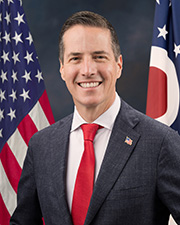
Photo of Bernie Moreno
R United States Senate · Ohio

Sen. Bernie Moreno

Compare
Total votes
447
all sessions
Attendance
100%
2 missed
Higher than 75% of chamber peers
With party
98%
of cast votes
Higher than 77% of chamber peers
Bipartisan score
1%
crosses aisle rarely
Lower than 79% of chamber peers
Sponsored
240
bills & resolutions
Lower than 86% of chamber peers
Committees
14
assignments
240 bills and resolutions

Sponsored bills

Total
240
Primary
29
Co-sponsor
211
This page
240
matching current filters
Co-sponsor S 3618
In committee · Wisconsin Senate · Co-sponsor
No Fentanyl on Social Media Act of 2026

Maddy summaryThis bill requires the Federal Trade Commission (FTC) to produce a report within one year of enactment, analyzing how minors access fentanyl (including fake pills) through social media platforms. The report must cover the prevalence of this access, health and safety risks to minors, how sellers use platform features to market drugs, and current measures by platforms and law enforcement. It also mandates consultation with stakeholders like parents, platforms, and medical experts before publishing. The bill does not create new laws or penalties but focuses on gathering data to inform future policy decisions.

In committee Sep 14, 2026 1 co-sponsor
Co-sponsor S 3296
In committee · Wisconsin Senate · Co-sponsor
Improving Access to Workers’ Compensation for Injured Federal Workers Act of 2025

Maddy summaryThis bill expands access to workers' compensation for injured federal employees by adding nurse practitioners and physician assistants to the list of healthcare providers eligible to treat them under the Federal Employees' Compensation Act. It amends the law to define "other eligible provider" as these professionals practicing within their state-authorized scope, replacing outdated references to "physician" with "physician or other eligible provider" throughout the relevant sections. The changes ensure injured federal workers can receive care from these providers without requiring a physician referral, streamlining access to treatment. The Secretary of Labor must finalize implementing regulations within six months of the bill's enactment.

In committee Sep 14, 2026 1 co-sponsor
Co-sponsor S 289
Passed · Wisconsin Senate · Co-sponsor
Youth Poisoning Protection Act

Maddy summaryS 289, the Youth Poisoning Protection Act, bans consumer products containing 10% or more sodium nitrite by classifying them as hazardous under existing safety law. This directly affects manufacturers and sellers of non-food consumer items (like certain dyes or chemicals) marketed to the public, but excludes food, drugs, and industrial uses. Key provisions prohibit sales of these high-concentration products while explicitly exempting regulated food items (such as processed meats), pharmaceuticals, and cosmetics. The law takes effect 90 days after enactment.

Passed Aug 10, 2026 1 co-sponsor
Primary S 5383
In committee · Wisconsin Senate · Lead sponsor
End Gas Station Heroin Act

Maddy summaryThe End Gas Station Heroin Act adds two specific kratom compounds, 7-hydroxymitragynine and mitragynine pseudoindoxyl, to the federal list of Schedule I controlled substances. However, it includes an exemption for these compounds when they occur naturally in finished kratom products that meet strict concentration limits, while explicitly excluding synthetically produced or chemically concentrated versions from this protection. The bill also creates a new enforcement mechanism that treats any emerging synthetic opioid with greater potency than morphine as a Schedule I controlled substance if it is manufactured or distributed for commercial sale. This provision targets the production and distribution of these substances but explicitly prohibits criminal or civil penalties for simple possession or personal use by consumers.

In committee Aug 8, 2026 0 co-sponsors
Primary SJRES 210
In committee · Wisconsin Senate · Lead sponsor
A joint resolution providing for congressional disapproval under chapter 8 of title 5, United States Code, of the rule submitted by the Environmental Protection Agency relating "California State Nonroad Engine Pollution Control Standards; Commercial Harbor Craft Regulations; Notice of Decision".

Maddy summaryThis joint resolution seeks to block a specific rule issued by the Environmental Protection Agency that sets pollution control standards for nonroad engines used in commercial harbor craft. If passed, the measure would prevent the rule from taking effect, meaning the new regulations for these vessels would not be enforced. The bill directly impacts the EPA and the maritime industry by stopping the implementation of the stated pollution limits. It functions as a legislative veto, using existing federal law to disapprove the agency's decision without creating new policies itself.

In committee Aug 6, 2026 0 co-sponsors
Co-sponsor S 5336
In committee · Wisconsin Senate · Co-sponsor
Uniform Vehicle Safety Standards Act of 2026

Maddy summaryThe Uniform Vehicle Safety Standards Act of 2026 amends federal law to ensure that motor vehicle safety standards set by the National Highway Traffic Safety Administration are applied uniformly across all states. The bill directly affects manufacturers and consumers involved in interstate commerce by prohibiting lawsuits based on claims that a vehicle failed to exceed, rather than meet, these established federal safety standards. By changing the legal language from "does not exempt" to "shall exempt," the legislation creates a definitive shield against common law liability for meeting minimum federal requirements. This change aims to reduce the regulatory burden on interstate commerce by preventing state-level litigation from overriding national safety guidelines.

In committee Aug 6, 2026 1 co-sponsor
Co-sponsor S 4505
In committee · Wisconsin Senate · Co-sponsor
A bill to require the United States Postal Service to designate ZIP Codes for certain communities.

Maddy summaryThis legislation directs the United States Postal Service to create unique ZIP Codes for 75 specific communities located across multiple states. The bill requires the Postal Service to finalize these designations within one year after the law is enacted. Communities affected by this requirement include towns and neighborhoods in states such as California, Colorado, Florida, and others. Ultimately, the measure ensures that each listed location has its own distinct postal code for mailing purposes.

In committee Aug 6, 2026 1 co-sponsor
Co-sponsor SJRES 208
In committee · Wisconsin Senate · Co-sponsor
A joint resolution providing for congressional disapproval under chapter 8 of title 5, United States Code, of the rule submitted by the Environmental Protection Agency relating to "California State Motor Vehicle Pollution Control Standards; Advanced Clean Car Program; Reconsideration of a Previous Withdrawal of a Waiver of Preemption; Notice of Decision".

Maddy summaryThis bill allows Congress to reject a specific rule issued by the Environmental Protection Agency that concerns vehicle pollution standards in California. The measure would effectively cancel the EPA's decision to reinstate a waiver that previously let California set its own stricter air quality rules for cars. If passed, the rule would have no legal force, meaning California would lose the ability to enforce its Advanced Clean Car Program under the current framework. The legislation directly impacts the relationship between federal environmental regulations and state-level automotive policies.

In committee Aug 5, 2026 1 co-sponsor
Co-sponsor SJRES 207
In committee · Wisconsin Senate · Co-sponsor
A joint resolution providing for congressional disapproval under chapter 8 of title 5, United States Code, of the rule submitted by the Environmental Protection Agency relating to "California State Motor Vehicle Pollution Control Standards; Notice of Decision Granting a Waiver of Clean Air Act Preemption for California's Advanced Clean Car Program and a Within the Scope Conformation for California's Zero Emission Vehicle Amendments for 2017 and Earlier Model Years".

Maddy summaryThis joint resolution seeks to overturn a specific rule issued by the Environmental Protection Agency that allowed California to set its own stricter vehicle emission standards. By using a congressional disapproval mechanism, the bill aims to nullify this waiver, which would otherwise let California enforce unique pollution control requirements for cars and trucks. If passed, the measure would require all states to follow the federal government's uniform vehicle emission rules instead of California's separate standards. The legislation directly impacts automakers, state regulators, and consumers by ensuring a single set of national rules applies to motor vehicle pollution.

In committee Aug 5, 2026 1 co-sponsor
Co-sponsor SJRES 206
In committee · Wisconsin Senate · Co-sponsor
A joint resolution providing for congressional disapproval under chapter 8 of title 5, United States Code, of the rule submitted by the Environmental Protection Agency relating to "California State Motor Vehicle Pollution Control Standards; Notice of Decision Granting a Waiver of Clean Air Act Preemption for California's 2009 and Subsequent Model Year Greenhouse Gas Emission Standards for New Motor Vehicles".

Maddy summaryThis joint resolution seeks to overturn a specific rule issued by the Environmental Protection Agency that allowed California to set its own stricter greenhouse gas emission standards for new vehicles. By disapproving this waiver, the bill aims to restore federal preemption, ensuring that all states must follow the same national emission rules rather than California's unique requirements. If passed, the measure would effectively cancel the EPA's decision, forcing automakers to comply with uniform federal standards for vehicle pollution control.

In committee Aug 5, 2026 1 co-sponsor
Showing 11 to 20 of 240 bills