Maddy summaryS 808, the Stop Russian Market Manipulation Act, prohibits U.S. imports of specific minerals from Russia or entities evading the ban, starting 90 days after enactment. It directly affects U.S. importers and Russian exporters of platinum group metals (like palladium and rhodium), nickel, and copper ores. The bill bans these imports unless the President certifies Russia has ended hostilities against Ukraine, with the ban lasting one year post-certification but resuming immediately if Russia restarts attacks. The President cannot waive this prohibition, and the law explicitly targets minerals obtained through evasion tactics like swaps or exchanges.
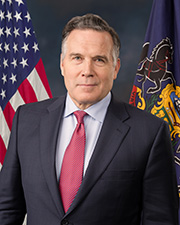
Sen. David McCormick
Sponsored bills
Maddy summaryThe SCREEN Act requires online platforms that create, host, or make available pornographic content for profit to implement age verification technology that prevents minors from accessing such content. Covered platforms must use technology to verify users' age and block access to content defined as "harmful to minors" - material that appeals to prurient interest, depicts sexual acts in a patently offensive way, and lacks serious value for minors. The Federal Trade Commission will enforce the law, requiring platforms to conduct regular audits, maintain reasonable data security for age verification information, and make their verification processes public. Platforms must comply with these requirements within one year of the bill's enactment, with the goal of protecting minors from exposure to online pornography.
Maddy summaryThis bill establishes the Agricultural Trade Enforcement Task Force to address foreign trade barriers harming U.S. agricultural exports, with immediate focus on India’s WTO-violating price supports for rice, wheat, and other crops. The Task Force, to be created within 30 days, identifies systemic trade barriers, develops enforcement strategies, and collaborates with like-minded countries to file WTO disputes. It requires quarterly reports to Congress on progress, including specific plans for consulting with India on its price supports (which exceeded WTO limits by 80-90% for key commodities). The bill directly affects U.S. farmers and exporters by targeting barriers that reduce market access and competitiveness, particularly in rice and wheat markets dominated by India. It mandates concrete action through the WTO dispute process rather than new trade rules.
Maddy summaryThis bill amends the Federal Crop Insurance Act to require the Federal Crop Insurance Corporation to research insurance options for mushroom production or revenue. It mandates the Corporation to conduct or contract research on developing mushroom-specific insurance policies and submit a report to Congress within one year. The research would directly affect mushroom farmers by exploring pathways to access crop insurance similar to other agricultural producers. The bill focuses on initiating this study, not creating immediate insurance coverage.
Maddy summaryThe Improper Payments Transparency Act (S 747) requires U.S. executive agencies to include detailed explanations in the President’s annual budget about improper payments in their programs. It mandates agencies to provide narrative descriptions explaining why improper payment rates increased, decreased, or stayed stable over the past three years for each affected program, along with status updates on incomplete corrective actions. This directly affects agencies already required to submit improper payment reports under existing law (Section 3351). The bill aims to increase transparency by making budget submissions more informative about payment error trends and agency efforts to address them.
Farm and Food Cybersecurity Act of 2025 This bill directs the Department of Agriculture (USDA) to (1) assess cybersecurity threats in the agriculture and food critical infrastructure sector, and (2) conduct annual crisis simulation exercises for food-related emergencies or disruptions. The agriculture and food critical infrastructure sector includes (1) any activity relating to the production, processing, distribution, storage, transportation, consumption, or disposal of agricultural or food products; and (2) any entity involved in any of these activities. Specifically, USDA, in coordination with the Department of Homeland Security (DHS) Cybersecurity and Infrastructure Security Agency, must conduct a risk assessment every two years on the cybersecurity threats to, and security vulnerabilities in, this sector. The risk assessment must include any recommendations for federal legislative or administrative actions to address related threats and vulnerabilities. USDA must also conduct an annual simulation exercise relating to a food-related emergency or disruption in coordination with DHS, the Department of Health and Human Services (HHS), and the Office of the Director of National Intelligence (ODNI). Among other things, the exercise must (1) involve a realistic and plausible scenario that simulates a food-related emergency or disruption that affects multiple sectors and jurisdictions, and (2) incorporate input from experts and stakeholders from various disciplines and sectors (e.g., agriculture, public health, emergency management, transportation, and energy). USDA, in consultation with DHS, HHS, and ODNI, must submit a report to Congress on each simulation exercise, including recommendations to enhance the cybersecurity and resilience of the agriculture and food critical infrastructure sector.
Maddy summaryThis bill creates a streamlined process for out-of-state healthcare providers to enroll in Medicaid or CHIP (Children's Health Insurance Program) in a state. It directly affects children under 21 enrolled in these programs and healthcare providers located in other states who already meet low fraud risk standards. The key provision requires states to adopt a simplified enrollment process using only basic provider information (like name and National Provider Identifier), granting eligible providers a 5-year enrollment period without repeated screening. This reduces administrative barriers for providers serving out-of-state children under 21 who qualify for Medicaid or CHIP coverage.
Maddy summaryThis bill updates the fund supporting victims of state-sponsored terrorism by directing specific funds into the compensation pool. It requires $898 million from the Binance forfeiture case and annual transfers of 50% of excess balances from DOJ and Treasury forfeiture funds to the Victims of State Sponsored Terrorism Fund. Payments to eligible claimants must be distributed by March 14, 2025, for the fifth round, with future annual payments starting in 2026. The bill mandates detailed annual reports on fund activity from the Attorney General and a GAO report on forfeiture proceeds, focusing on transparency and accountability for victims.
Maddy summaryThe Leveling the Playing Field 2.0 Act establishes special rules for handling successive antidumping and countervailing duty investigations, requiring the Department of Commerce to consider prior injury determinations when making new findings. It addresses market distortions from foreign government subsidies and currency undervaluation by expanding how the U.S. calculates fair trade values for imported goods. The bill also creates new procedures to prevent circumvention of existing duties (such as by changing product descriptions to avoid tariffs) and requires importers to certify that merchandise isn't subject to existing duties. These changes primarily affect U.S. Customs and Border Protection, the Department of Commerce, and importers of goods from countries that may be engaging in trade-distorting practices.
Maddy summaryS 655, the Stop Tax Penalties on American Hostages Act of 2025, prevents U.S. citizens wrongfully detained or held hostage abroad from facing tax penalties during their detention. It postpones tax deadlines and refunds penalties paid for tax years during detention (starting January 2021), directly affecting individuals identified under the Robert Levinson Hostage Recovery Act. Key mechanisms include requiring the State Department and Attorney General to provide Treasury with lists of affected individuals by January 2026, and enabling refunds for penalties paid during detention via a new Treasury program. The law applies to tax years ending before the bill's enactment, with refunds processed like standard overpayment refunds.