Maddy summaryThis bill, the Tax Cut for Workers Act of 2025, expands the Earned Income Credit (EIC) to make it more accessible and generous for low-income workers without children. It lowers the minimum age for the credit from 25 to 19 (with exceptions for students, former foster youth, and homeless youth), removes the maximum age limit, and increases the credit amount and income thresholds. The bill also adjusts these amounts for inflation and allows taxpayers to use their prior year’s earned income if it was higher, applying to taxable years starting after 2025. These changes extend the credit to U.S. territories like Puerto Rico and American Samoa without prior time limits.
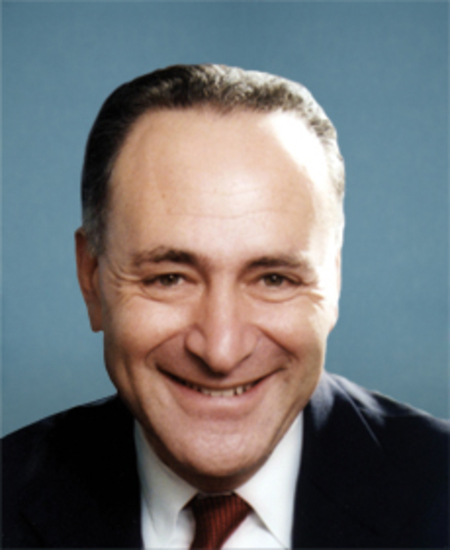
Sen. Charles E. Schumer
Sponsored bills
Maddy summaryThe American Family Act creates a new monthly child tax credit that would provide $300 per month for each child under age 6 and $300 per month for each child age 6 and older, with income-based eligibility limits. The credit would be refundable, meaning it could be paid even if a family owes no income tax, and would replace the current annual child tax credit. The bill establishes income thresholds ($150,000 for joint filers) above which the credit begins to phase out, with full phase-out at $400,000 for joint filers. It also includes provisions for "presumptive eligibility" to allow for advance payments based on previous tax returns or government program data. The bill would terminate the existing annual child tax credit after 2024, replacing it with this monthly payment system.
Maddy summaryThe Public Service Freedom to Negotiate Act of 2025 establishes federal minimum standards for collective bargaining rights for public employees and supervisory employees. The Federal Labor Relations Authority will determine if states' laws "substantially provide" these rights, and if not, the federal standards will apply to affected workers. The bill guarantees rights like forming labor organizations, negotiating wages and working conditions, and resolving disputes through mediation or arbitration, while prohibiting strikes that would disrupt emergency services. Existing collective bargaining agreements and units are protected from the bill's implementation.
Maddy summaryThis resolution (SRES 159) is a ceremonial Senate measure honoring the late Senator John Bennett Johnston, Jr. (1932-2024), who represented Louisiana in the U.S. Senate from 1972 to 1997. It commemorates his career, including his work on energy policy, flood control, and Louisiana conservation efforts, and requests the Senate adjourn in his memory while sending condolences to his family. As a non-binding resolution, it has no policy impact or direct effect on any individuals or laws.
Maddy summaryS 1289 authorizes the U.S. Mint to produce and sell commemorative $5 gold and $1 silver coins to mark the 25th anniversary of the September 11, 2001, terrorist attacks. The bill specifies coin specifications (e.g., 90% gold/silver content, design requirements including "Never Forget"), sets a one-year issuance window (January 1, 2027-2028), and requires surcharges of $35 per gold coin and $10 per silver coin. These surcharges will be paid directly to the National September 11 Memorial and Museum to support its operations and maintenance, with coins sold at a price covering face value, surcharge, and production costs. The legislation does not impose new regulations or affect public policy but focuses on commemoration and funding for the museum.
Maddy summaryS 1303, the Smithsonian American Women’s History Museum Act, establishes a new Smithsonian museum dedicated to American women's history on the National Mall. The bill authorizes the museum to be located within the National Mall's Reserve area (overriding prior restrictions) and requires the Smithsonian to coordinate with other federal agencies if land under their jurisdiction is selected, including transferring administrative control. It mandates that exhibits and programs must accurately represent diverse women's experiences by seeking input from a broad range of sources reflecting varied political viewpoints, cultures, and lived experiences. The Smithsonian must submit annual reports to Congress detailing compliance with these requirements, including updates on exhibit revisions and planning.
Maddy summaryThis bill authorizes the establishment of the Smithsonian National Museum of the American Latino within the National Mall's Reserve area, directly affecting the Smithsonian Institution and Latino communities whose history the museum will showcase. It modifies existing law to allow the museum's location in the Reserve (overriding prior restrictions) and requires the Smithsonian Board to transfer land from other federal agencies if needed, with specific notification procedures. The bill mandates that exhibits and programs accurately represent the diverse cultures, histories, and viewpoints within Hispanic and Latino communities, seeking input from a broad range of community experts. It also requires annual reports to Congress on compliance with these representation standards, beginning 120 days after enactment.
Maddy summaryThis bill authorizes the Pines Foundation to establish a memorial within Fire Island National Seashore to honor residents of Fire Island Pines and Cherry Grove, New York, who died from AIDS. The memorial must be approved by the Secretary of the Interior for design and location but cannot use any federal funds for its design, installation, or maintenance. Its purpose is to remember those affected by the AIDS epidemic and educate future generations about its impact on these specific communities.
Maddy summaryS 1263, the Operational Security Act of 2025, creates a new Office of Security Training and Counterintelligence within the Executive Office of the President. The office, led by a presidentially appointed Director with Top Secret clearance, will provide security training, counterintelligence support, and guidance on protecting classified information - including restrictions on using consumer messaging apps for official communications. It also establishes a bipartisan Security Training and Counterintelligence Advisory Board (appointed by congressional leaders) to recommend improvements, which must submit annual reports to congressional intelligence committees. The bill directly affects Executive Office of the President staff and their security protocols, focusing on concrete operational changes without altering existing classified information handling laws.
Maddy summaryThe Sanctioning Russia Act of 2025 establishes a framework for imposing comprehensive sanctions on Russia if the President determines Russia is engaging in actions that undermine peace with Ukraine, such as refusing to negotiate a peace agreement, violating peace agreements, or planning another military invasion. If such a determination is made, the bill mandates blocking property of Russian officials and entities, prohibiting transactions with Russian financial institutions, increasing tariffs on Russian goods to at least 500% ad valorem, banning energy exports to Russia, and prohibiting purchases of Russian sovereign debt. It also imposes sanctions on countries that purchase Russian oil, uranium, or petroleum products, with duties of at least 500% on such goods. The bill requires the President to make determinations every 90 days and allows for termination of sanctions if Russia ceases harmful actions and enters a peace agreement with Ukraine, with immediate reimposition if Russia resumes those actions.