

Maddy summaryHR 178 requires the U.S. Forest Service (under the Secretary of Agriculture) to put out wildfires on specific National Forest lands within 24 hours of detection. It directly affects National Forest System lands in areas experiencing severe drought (D2-D4 ratings), high fire risk (National Wildland Fire Preparedness Level 5), or in the top 10% of wildfire exposure risk. Key provisions mandate using all available resources for rapid suppression, prohibiting interference with state/local firefighting efforts, and strictly limiting the use of planned controlled burns or backfires (only allowed under specific safety orders or to protect personnel). The bill does not create new funding but sets operational requirements for wildfire response on defined high-risk lands.
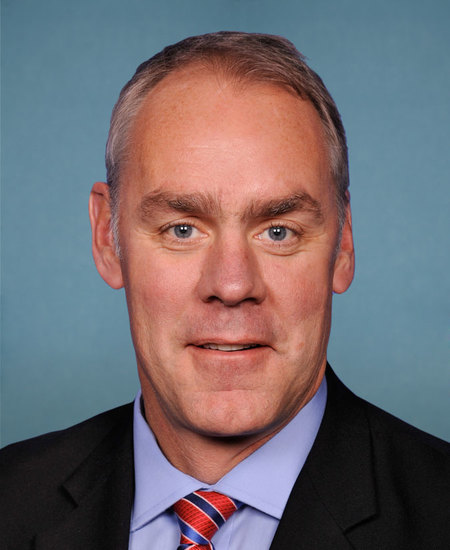
Rep. Ryan K. Zinke
Sponsored bills
Miracle on Ice Congressional Gold Medal Act This act provides for the award of Congressional Gold Medals to the members of the 1980 U.S. Olympic men's ice hockey team in recognition of the team's achievement at the 1980 Winter Olympic Games.
Maddy summaryThis resolution disapproves a Bureau of Land Management (BLM) rule that amended resource management plans for Montana's Miles City Field Office. It formally cancels the rule's legal effect, preventing the BLM from implementing the specific management plan changes. The action directly affects public land management decisions at the Miles City Field Office in Montana. This is a procedural disapproval under federal law, not a new policy.
Maddy summaryHRES 932 is a symbolic resolution passed by the House of Representatives that condemns six specific members of Congress (including Senators Kelly and Slotkin and Representatives Crow, Deluzio, Goodlander, and Houlahan) for allegedly making statements that encouraged military and intelligence personnel to disobey orders from the President. The resolution claims these lawmakers falsely suggested the administration issued "illegal orders" and undermined the military chain of command, violating the Uniform Code of Military Justice (UCMJ). It does not create new laws or policies but formally denounces the lawmakers' statements as "dangerous and seditious rhetoric." As a procedural resolution, it has no binding effect on military conduct or policy.
Maddy summaryThis bill amends federal labeling rules for beef products sold in the U.S. It requires clear country-of-origin labeling for beef (including ground beef), expanding existing rules that previously covered lamb and venison. The key change increases penalties for non-compliance: $5,000 per pound of beef sold without required labeling, compared to $1,000 per violation for other meats. These rules directly affect meat producers, processors, and retailers selling beef products. The bill also ensures U.S. labeling authority cannot be overridden by international trade rulings.
Give Kids a Chance Act of 2025 This bill expands the Food and Drug Administration’s (FDA’s) authority with respect to research on rare pediatric diseases, including by permitting the FDA to take enforcement action against drug sponsors that fail to satisfy pediatric study requirements and by reauthorizing programs that support pediatric research. Specifically, the bill modifies requirements relating to molecularly targeted pediatric cancer investigations to permit research on new drugs in combination with active ingredients that have already been approved, provided certain conditions are met; permits the FDA to take enforcement action against drug sponsors that fail to comply with pediatric study requirements, if such sponsors demonstrated a lack of due diligence in satisfying the requirement; renews the FDA’s authority to award priority review vouchers to sponsors of new products intended to treat rare pediatric diseases through September 30, 2029; and reauthorizes through FY2027 certain funding for the National Institutes of Health to support priority pediatric research. The bill also provides statutory authority for the FDA’s interpretation of the orphan drug exclusivity period. The bill specifies, consistent with FDA regulations, that the seven-year market exclusivity period for drugs for rare diseases or conditions (i.e., orphan drugs) prohibits the approval of the same drug for the same approved use or indication with respect to the disease or condition. (In Catalyst Pharmaceuticals, Inc. v. Becerra , a court rejected the FDA’s interpretation and held that orphan drug exclusivity extends to all uses or indications for the disease or condition.)
Maddy summaryThis bill reauthorizes and permanently funds the Wildlife Road Crossings Program through fiscal years 2026-2031, allocating $200 million annually for projects that build wildlife crossings (like overpasses or underpasses) to reduce animal-vehicle collisions. It directly affects state and tribal governments, local agencies, and conservation groups that design and build these crossings, with specific provisions ensuring 100% federal cost coverage for tribal projects. Key mechanisms include dedicated annual funding, streamlined application assistance for tribes, and rules allowing unobligated funds to roll over for future use. The bill removes "pilot" language from prior law, making the program permanent and expanding tribal participation.
Maddy summaryHR 6120, the SROS Act, exempts retirement income from taxable income for qualifying school resource officers. It directly affects retired military members or law enforcement officers who later work as school resource officers, provided they meet background checks and state training requirements. The bill excludes pension, annuity, or retirement plan payments from taxable income during their employment as school resource officers. Additionally, officers with 10+ years of service in this role receive a lifetime exemption for all retirement income after leaving the position. The tax change applies to taxable years beginning after the bill's enactment.
Maddy summaryHR 5993, the MACV-SOG Congressional Gold Medal Act, authorizes a single gold medal to be awarded by Congress to members of the Military Assistance Command Vietnam-Studies and Observations Group (MACV-SOG), a covert special operations unit active during the Vietnam War (1964-1972). The bill directs the Treasury Secretary to strike the medal, which will be presented by congressional leaders to honor MACV-SOG service members' "bravery and outstanding service" in Vietnam, Laos, and Cambodia, and then donated to the Smithsonian Institution for display. The medal commemorates the unit's high-risk missions, including reconnaissance and sabotage, and acknowledges the 1,579 U.S. personnel missing or killed while serving with MACV-SOG. Bronze duplicates may be sold to cover costs, but the act has no policy implications beyond this ceremonial recognition.
Maddy summaryThis bill ensures that critical firearm-related government operations continue during federal shutdowns. It designates background checks (via the FBI's National Instant Criminal Background Check System), Bureau of Alcohol, Tobacco, Firearms and Explosives enforcement, and firearm export licensing (handled by Commerce and State Departments) as essential services that must remain operational. These functions would be treated as "excepted" under federal law, meaning their employees would continue working even if other government services halt. The bill affects how background checks and firearm export licenses are processed during shutdowns but does not change gun ownership laws or eligibility.