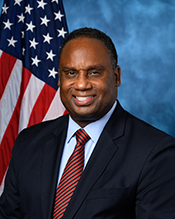
Photo of Jonathan L. Jackson
D United States House · District 1 · Illinois On the 2026 ballot

Rep. Jonathan L. Jackson

Compare
Total votes
1,879
all sessions
Attendance
96%
75 missed
Lower than 90% of chamber peers
With party
96%
of cast votes
Near the chamber average
Bipartisan score
2%
crosses aisle rarely
Near the chamber average
Sponsored
1,138
bills & resolutions
Higher than 88% of chamber peers
Committees
6
assignments
1,138 bills and resolutions

Sponsored bills

Total
1,138
Primary
14
Co-sponsor
1,124
This page
1,138
matching current filters
Co-sponsor HR 2802
In committee · Washington House · Co-sponsor
Improving Mental Health Access for Students Act

Maddy summaryHR 2802, the Improving Mental Health Access for Students Act, requires colleges and universities to include suicide prevention contact information on student identification cards. Specifically, institutions must list the National Suicide Prevention Lifeline, Crisis Text Line, and their campus mental health center on new ID cards. Schools that don't issue ID cards must post this information on their websites instead. The requirement takes effect one year after the bill's enactment.

In committee Apr 24, 2023 1 co-sponsor
Co-sponsor HR 2760
In committee · Washington House · Co-sponsor
Dignity for Detained Immigrants Act

Maddy summaryThe Dignity for Detained Immigrants Act establishes new standards for Department of Homeland Security detention facilities, requiring them to meet or exceed the American Bar Association's Civil Immigration Detention Standards. The bill mandates annual, unannounced inspections by the DHS Inspector General, public reporting on facility compliance, and a phased-out timeline for private detention facilities (phasing out by 3 years after enactment). It prohibits solitary confinement for all detainees, requires community-based alternatives to detention for vulnerable individuals, and mandates detailed public reporting on facility conditions, staffing, and detainee demographics. The legislation directly affects all immigrants held in DHS custody, including children, vulnerable persons, and primary caregivers, with specific protections for these groups in detention procedures.

In committee Apr 20, 2023 1 co-sponsor
Co-sponsor HR 2748
In committee · Washington House · Co-sponsor
Contact Lens Prescription Verification Modernization Act

Contact Lens Prescription Verification Modernization Act This bill revises the requirements for the verification of prescriptions related to the purchase of contact lenses. Specifically, online sellers of prescription contact lenses must provide consumers with a method to transmit a digital copy of their prescriptions to such sellers. Online sellers also must encrypt protected health information they send by email. Additionally, the bill prohibits any seller of prescription contact lenses from using telephone calls with an artificial or prerecorded voice (i.e., robocalls) to verify a consumer's prescription.

In committee Apr 20, 2023 1 co-sponsor
Co-sponsor HR 2728
In committee · Washington House · Co-sponsor
Young Farmer Success Act

Maddy summaryHR 2728, the Young Farmer Success Act, expands student loan forgiveness eligibility under the Higher Education Act to include full-time farm and ranch workers. It directly affects young agricultural workers employed as employees or managers at farms meeting specific revenue thresholds. The key provision adds "full-time job engaged in farm work" as a qualifying employment type for loan forgiveness, requiring farms to earn at least $35,000 in gross revenue from agricultural sales in 2023 (with annual inflation adjustments based on the Consumer Price Index). This amendment modifies existing loan forgiveness rules without creating new programs, applying to workers meeting the farm revenue criteria.

In committee Apr 19, 2023 1 co-sponsor
Co-sponsor HR 2708
In committee · Washington House · Co-sponsor
Latonya Reeves Freedom Act of 2023

Maddy summaryThe Latonya Reeves Freedom Act of 2023 strengthens the Americans with Disabilities Act's requirement that individuals with disabilities receive long-term services and supports in community settings rather than institutions. It defines "community-based" services to include specific housing options where individuals with disabilities can live independently with maximum control over their lives, including access to integrated housing, employment, and community participation. The bill requires states to develop transition plans to move people from institutional settings to community-based services within 12 years, with measurable annual targets for reducing institutionalization. It establishes enforcement mechanisms through the Department of Justice and Department of Health and Human Services to ensure compliance with these requirements.

In committee Apr 19, 2023 1 co-sponsor
Co-sponsor HR 1624
In committee · Washington House · Co-sponsor
Puppy Protection Act of 2023

Maddy summaryThe Puppy Protection Act of 2023 sets new standards for businesses that sell dogs (dealers), directly affecting pet stores and breeders operating under the Animal Welfare Act. It requires specific housing with space allowances based on dog size (e.g., 12-30 square feet per dog), temperature control (45-85°F), clean food twice daily, and daily exercise or socialization with humans/dogs for at least 30 minutes. The bill also mandates annual veterinary exams including dental care, strict breeding limits (e.g., age restrictions, maximum 2 litters in 18 months), and efforts to place retired breeding dogs in homes instead of selling them to other breeders. Regulations must be finalized within 18 months of enactment.

In committee Apr 19, 2023 1 co-sponsor
Co-sponsor HR 2669
In committee · Washington House · Co-sponsor
Ensuring Work Opportunities in Correctional Facilities Act of 2023

Maddy summaryThis bill authorizes $210 million annually (2024-2029) for the Bureau of Prisons to expand vocational training and occupational education programs for incarcerated individuals. It also allocates $10 million, $70 million, and $20 million annually for related programs under the Omnibus Crime Control Act, Second Chance Act, and new vocational grants. The law requires annual public reports starting in 2026 to evaluate program effectiveness in teaching job skills and improving post-release employment prospects. It directly affects incarcerated people in federal facilities by increasing access to work-based training programs.

In committee Apr 18, 2023 1 co-sponsor
Co-sponsor HR 2665
In committee · Washington House · Co-sponsor
Supporting Safety Net Hospitals Act

Maddy summaryHR 2665 delays Medicaid payment reductions for safety net hospitals by two years, changing the effective date from 2024 to 2026 under Section 1923(f)(7)(A) of the Social Security Act. This bill directly affects hospitals that serve high numbers of low-income and uninsured patients, providing them with additional time before facing reduced federal Medicaid payments. The key mechanism is a technical amendment to existing law, postponing an already scheduled payment adjustment without altering funding levels or eligibility. As a procedural bill, it does not create new programs or change hospital requirements.

In committee Apr 18, 2023 1 co-sponsor
Co-sponsor HR 2413
In committee · Washington House · Co-sponsor
Dental Care for Veterans Act

Maddy summaryHR 2413, the Dental Care for Veterans Act, reclassifies dental care as standard medical services under the VA's existing benefits structure, eliminating prior restrictions that treated dental care separately. It modifies how dental appliances are procured and establishes a phased eligibility timeline: veterans already eligible for dental benefits gain immediate access, while others qualify over 1-4 years based on their current benefit status. The bill affects all veterans currently covered under VA dental programs, changing their access to care without creating new funding. Key provisions streamline dental service delivery under Title 38, aligning it with other medical benefits.

In committee Apr 14, 2023 1 co-sponsor
Co-sponsor HR 2584
In committee · Washington House · Co-sponsor
SAVE Act

Maddy summaryHR 2584, the SAVE Act, creates a new federal criminal offense for assaulting or intimidating hospital employees while they're performing their duties, punishable by up to 10 years in prison, with enhanced penalties for using weapons, causing injury, or during public emergencies. The bill authorizes $25 million annually in federal grants to hospitals for violence prevention programs, including staff training, security technologies like panic buttons and video surveillance, and coordination with law enforcement. It defines "hospital" broadly to include various medical facilities such as long-term care hospitals, rehabilitation facilities, and critical access hospitals. The legislation directly affects hospital workers and medical facilities by establishing federal criminal penalties for violence against employees and providing funding to improve workplace safety. The law aims to address the rising problem of workplace violence against healthcare workers, which the bill states has increased since 2011.

In committee Apr 13, 2023 1 co-sponsor
Showing 1,051 to 1,060 of 1,138 bills