

Maddy summaryThis Senate resolution designates January 1 to February 1, 2026, as "National Trafficking and Modern Slavery Prevention Month" to raise public awareness about human trafficking and modern slavery. It does not create new laws or policies but formally supports observance through educational programs and community activities during this period. The resolution emphasizes collaboration between government agencies, victim advocates, and nonprofits to address trafficking, linking the timeframe to the Emancipation Proclamation anniversary (January 1) and National Freedom Day (February 1). It is a symbolic, non-binding measure intended to highlight ongoing efforts to combat trafficking, referencing existing federal anti-trafficking laws like the Trafficking Victims Protection Act.
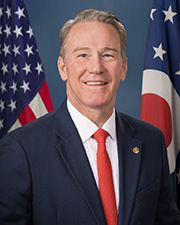
Sen. Jon Husted
Sponsored bills
Maddy summaryThis bill amends the Build America, Buy America Act to require that all yellow organic pigments used in road, highway, and airport surface marking paints be classified as "construction materials" for federal procurement purposes. Starting immediately upon enactment, these pigments count as construction materials for water-based paints, with full coverage for all paint formulas taking effect two years later. The bill mandates that such pigments must be "produced in the United States," meaning all manufacturing steps - from initial material combination through chemical synthesis - must occur domestically. This directly affects paint manufacturers and government agencies purchasing road-marking materials, requiring them to source pigments made entirely within U.S. borders.
Maddy summaryThe CLOSE Act terminates temporary pandemic unemployment benefit programs established under the CARES Act, including Pandemic Unemployment Assistance and Federal Pandemic Unemployment Compensation, after a 30-day grace period following enactment. It also cancels (rescinds) unused federal funds that were allocated for these programs but not yet spent. This directly affects states administering these benefits and individuals who received pandemic-era unemployment support. The bill stops future payments and returns unobligated funds to the Treasury without altering benefits already paid.
Maddy summarySRES 593 is a Senate resolution honoring the 67 victims of the January 29, 2025 mid-air collision between a U.S. Army Black Hawk helicopter and American Airlines Flight 5342 over the Potomac River. It specifically recognizes the lives of all victims, including 11 U.S. figure skating athletes, their families, and 3 Army soldiers, as well as the 1,700+ first responders who assisted in the recovery efforts. The resolution offers condolences to affected families, acknowledges the bravery of emergency personnel, and commits the Senate to using safety lessons from the crash to prevent future incidents. As a commemorative resolution, it does not create new laws or provide direct benefits but serves to formally memorialize the tragedy and honor those impacted.
Safeguard American Voter Eligibility Act or the SAVE America Act This bill requires individuals to provide documentary proof of U.S. citizenship when registering to vote, and requires photo identification to vote, in federal elections. Specifically, the bill prohibits states from accepting and processing an application to register to vote in a federal election unless the applicant presents documentary proof of U.S. citizenship. The bill specifies what documents are considered acceptable proof of U.S. citizenship, such as identification that complies with the REAL ID Act of 2005 that indicates U.S. citizenship. Further, the bill (1) prohibits states from registering an individual to vote in a federal election unless, at the time the individual applies to register to vote, the individual provides documentary proof of U.S. citizenship; and (2) requires states to establish an alternative process to demonstrate U.S. citizenship. Each state must take affirmative steps on an ongoing basis to ensure that only U.S. citizens are registered to vote, which shall include establishing a program to identify individuals who are not U.S. citizens using information supplied by certain sources. Additionally, states must remove noncitizens from their official lists of eligible voters. The bill (1) provides for a private right of action for certain violations, and (2) establishes criminal penalties for certain offenses. Individuals voting in federal elections must present an eligible photo identification document. An individual who votes by absentee ballot must submit a copy of their identification document with both the request for, and the submission of, the absentee ballot.
Maddy summaryThe Delivering for Rural Seniors Act of 2026 creates a pilot program to provide home delivery of food commodities from the Commodity Supplemental Food Program (CSFP) to low-income seniors in rural areas. It authorizes $10 million annually for fiscal years 2027-2029 to fund competitive grants to state agencies, which must use funds for transportation, staffing, and outreach related to home delivery services - with priority for rural communities. State agencies must report annually on program outcomes, including delivery numbers, cost per delivery, and effectiveness evaluations. The bill directly affects low-income seniors enrolled in CSFP who live in rural areas, aiming to improve their access to food assistance through home delivery.
Maddy summaryThis resolution designates the week of January 25-31, 2026, as "National School Choice Week" to recognize educational options for K-12 students. It encourages parents to learn about school choices and urges the public to host events raising awareness about diverse education environments, including public schools, charter schools, private schools, and homeschooling. The resolution has no policy or funding impact - it is a ceremonial designation acknowledging existing annual events celebrating educational choice.
Maddy summaryThis bill expands access to VA disability examinations for rural veterans by allowing a broader range of health care professionals to conduct these exams under temporary contracts. It revises eligibility requirements to include any licensed health care professional (replacing specific titles like "physicians assistants" with a general category) who meets state licensing standards and is contracted by the VA. The bill extends the temporary authority for these contracts until September 30, 2031, and requires the VA to report on exam volume, costs, and accuracy within 15 months of enactment. These changes aim to improve timely benefit access in rural areas where specialized examiners may be scarce.
Maddy summaryS 3627, the Pregnant Students’ Rights Act, requires colleges and universities participating in federal student aid programs to provide clear information about pregnancy-related resources and accommodations to all enrolled students. The bill mandates annual email notifications, inclusion in student handbooks and orientations, and availability at health centers and websites, detailing campus/community resources, available accommodations, and how to file Title IX complaints. It specifically covers students planning to or currently pregnant who wish to carry a baby to term. The law focuses solely on disseminating existing information and does not create new rights or accommodations. (Bill text amended under Section 485 of the Higher Education Act.)
Maddy summarySRES 585 is a commemorative resolution honoring Ben Nighthorse Campbell, a former U.S. Senator from Colorado and the first Native American to chair the Senate Committee on Indian Affairs. It recognizes his military service, Olympic judo career, legislative work (including authoring the National Museum of the American Indian Act), and advocacy for tribal communities. The resolution has no policy impact - it formally expresses the Senate’s respect for his legacy, requests transmission to his family, and directs a moment of silence. It directly affects Campbell’s legacy and family, not any current policy or population. (Note: This is a procedural resolution, not a bill with legislative provisions.)