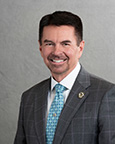
Photo of Jeff Burton
R Utah House · District 64

Rep. Jeff Burton

Compare
Total votes
4,718
all sessions
Attendance
94%
236 missed
Near the chamber average
With party
97%
of cast votes
Near the chamber average
Bipartisan score
2%
crosses aisle rarely
Near the chamber average
Sponsored
79
bills & resolutions
Near the chamber average
Committees
4
assignments
79 bills and resolutions

Sponsored bills

Total
79
Primary
46
Co-sponsor
33
This page
79
matching current filters
Primary HB 554
Passed · Utah House · Lead sponsor
State Debt Collection Amendments

Maddy summaryHB 554 modifies Utah's debt collection rules to streamline how government entities recover unpaid amounts. It directs the State Tax Commission to apply corporate tax overpayments toward debts under the Crime Victims Restitution Act, allows collections without a court judgment, and standardizes definitions for "accounts receivable" (including fines, restitution, and taxes). The bill also permits the State Debt Collection Fund to retain up to one year's expenses annually and makes technical updates to multiple statutes. These changes primarily affect taxpayers with outstanding debts and government agencies collecting public funds, with no new state funding required.

Passed Mar 7, 2026 0 co-sponsors
Primary HB 479
Passed · Utah House · Lead sponsor
Election Code Modifications

Maddy summaryHB 479 modifies Utah's election code to change how mail ballots are handled and accessed. Starting in 2029, voters must actively request mail ballot delivery and return by mail every eight years - otherwise, they will not automatically receive mail ballots. The bill also requires two poll workers to be present at ballot drop boxes, mandates ID verification at drop boxes, and extends emergency ballot access to voters with disabilities who cannot travel. These changes affect all Utah voters who use mail ballots or drop boxes, with the key policy shift being the requirement for periodic voter confirmation of mail ballot preferences.

Passed Mar 7, 2026 0 co-sponsors
Primary HB 322
Introduced · Utah House · Lead sponsor
Highway Recognition Amendments

Maddy summaryHB 322 designates a specific stretch of SR-198 in Utah County as the "Gail S. Halvorsen Memorial Highway," running from SR-164 in Spanish Fork south to the boundary between Spanish Fork and Salem cities. The bill requires the Utah Department of Transportation to update highway maps and install signage to reflect this new name. It does not involve funding, regulations, or changes to traffic laws, making it a purely commemorative designation. The change takes effect on May 6, 2026, honoring Gail S. Halvorsen through the highway name. This bill affects no specific individuals or entities beyond the highway signage and map updates.

Introduced Mar 7, 2026 0 co-sponsors
Co-sponsor SB 102
Passed · Utah Senate · Co-sponsor
Animal Control First Responder Amendments

Maddy summarySB 102 classifies animal control officers as "first responders" under Utah law, expanding their inclusion in existing definitions within statutes related to substance use referrals, workers' compensation, and driver's license procedures. This change directly affects animal control officers in Utah by extending the same legal protections and procedural frameworks currently applied to law enforcement, EMTs, firefighters, and dispatchers. The bill does not create new duties or funding requirements but updates specific code sections to ensure animal control officers are recognized in contexts like offering substance use service referrals or workers' compensation claims. It focuses solely on reclassifying personnel within existing legal frameworks, with no additional financial or procedural obligations.

Passed Mar 7, 2026 1 co-sponsor
Co-sponsor SB 2002
Signed into law · Utah Senate · Co-sponsor
Appellate Court Jurisdiction Amendments

Maddy summarySB 2002 clarifies and updates the jurisdiction of Utah's appellate courts, specifically the Supreme Court and Court of Appeals. It establishes the Supreme Court's exclusive authority in certain cases (like capital felony appeals, election disputes, and lawyer discipline), allows appeals to proceed even if attorney fee motions are unresolved in district court, and updates jurisdiction descriptions for agency decisions. This affects legal proceedings involving those specific cases, as well as litigants and courts navigating appellate pathways. The bill makes technical changes to court procedures without creating new policies or appropriating funds.

Signed into law Dec 11, 2025 1 co-sponsor
Co-sponsor SJR 201
Passed · Utah Senate · Co-sponsor
Joint Resolution Amending Court Rules of Procedure

Maddy summarySJR 201 is a procedural resolution amending Utah's court rules to specifically address election-related appeals. It adjusts deadlines for filing appeals in election cases (amending Rules 4, 6, and 30 of the Appellate Rules) and clarifies procedures for filing cost bonds and attorney fee motions in those cases (amending Rules 58A and 73 of Civil Procedure). The changes streamline timelines for parties appealing election judgments and ensure appeals from election-related rulings follow distinct procedures from general cases. No new funding or substantive policy changes are introduced - this resolution only modifies existing court rule language for technical accuracy and consistency.

Passed Dec 10, 2025 1 co-sponsor
Primary HB 163
Signed into law · Utah House · Lead sponsor
Adult Probation and Parole Amendments

Maddy summaryHB 163 creates a formal Division of Adult Probation and Parole within Utah's Department of Corrections, replacing previous administrative arrangements. The bill updates statutes to clarify the Department's responsibility for supervising individuals on probation or parole and establishes new requirements for residential programs that serve these individuals. Key provisions include mandating written disclosures for participants in residential programs about program details, voluntary participation, and contact with the Division. The bill directly affects the Department of Corrections, probation/parole supervision operations, and individuals under community supervision in Utah. It is an administrative restructuring measure with no new funding or significant operational changes beyond codifying existing practices.

Signed into law Mar 26, 2025 0 co-sponsors
Primary HB 323
Signed into law · Utah House · Lead sponsor
Correctional Drug Enforcement Amendments

Maddy summaryHB 323 requires Utah's Department of Corrections to establish a dedicated drug abuse and trafficking unit. This unit must develop strategies to combat drug use and trafficking among inmates in correctional facilities, individuals working with offenders, and those on probation or parole. It also mandates enhanced coordination and information sharing between the Department and state law enforcement agencies. The bill takes effect on May 7, 2025, and does not appropriate new funding. This directly affects correctional facilities, probation/parole systems, and law enforcement agencies working with offenders.

Signed into law Mar 26, 2025 0 co-sponsors
Primary HB 376
Signed into law · Utah House · Lead sponsor
National Guard Amendments

Maddy summaryHB 376 amends Utah's National Guard laws to clarify leadership appointments, update management procedures, and add new benefits. It establishes a 2027 start date for four-year terms for the adjutant general (top National Guard commander), allows current funds to repay student loans for active Guard members, and clarifies how the State Armory Board can conduct meetings electronically. The bill also defines terms, adjusts responsibilities for judge advocates, and specifies use-of-force protocols for Guard members. These changes directly affect Utah National Guard members, leadership, and the State Armory Board, with no new state funds required.

Signed into law Mar 26, 2025 0 co-sponsors
Co-sponsor SB 77
Signed into law · Utah Senate · Co-sponsor
Public Safety Animal Amendments

Maddy summarySB 77 expands legal protections for animals used by public safety organizations (such as police, fire, and search and rescue teams) by redefining "public safety animal" to include any animal used for these duties, not just police dogs. It updates penalties: causing death to such an animal becomes a second-degree felony, causing injury or likely injury becomes a third-degree felony, and actions like taunting, interfering, or placing hazards near the animal become class A misdemeanors. The bill also exempts public safety animals from quarantine if they bite under supervision and requires organizations to notify health officials of abnormal behavior. These changes take effect on May 7, 2025, with no new funding required.

Signed into law Mar 26, 2025 1 co-sponsor
Showing 11 to 20 of 79 bills
Previous 1 2 3 8 Next