Traveler's Gun Rights Act This bill allows an individual who does not have a physical residence in a state to use the address for a private mailbox or post office box maintained by that individual for purposes of obtaining a firearm from a federally licensed dealer.
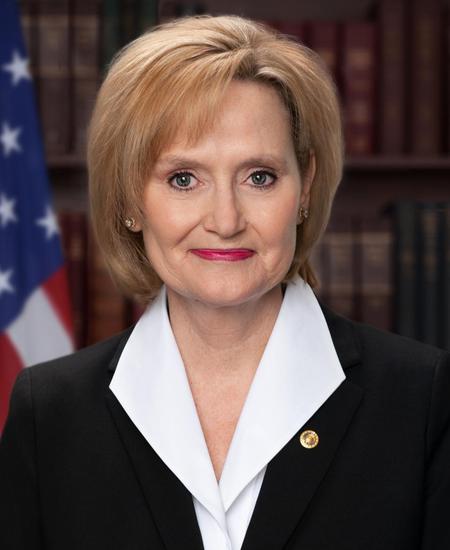
Sen. Cindy Hyde-Smith
Sponsored bills
Maddy summarySRES 565 is a ceremonial Senate resolution honoring the late Representative Don Young (R-AK), who served 49 years in the U.S. House of Representatives - the longest tenure of any Alaska representative and the 45th Dean of the House. The resolution commemorates his life, service, and legacy, including his work on landmark legislation like the Trans-Alaska Pipeline authorization and the Alaska Native Claims Settlement Act. It contains no policy changes or new laws; instead, it directs the Senate to mourn his passing, honor his bipartisan service, and transmit a copy to his family. This is a purely symbolic resolution with no direct impact on constituents or legislation.
Continuing Emergency Support for Restaurants Act This bill provides an additional $48 billion in FY2021 for the Restaurant Revitalization Fund and designates specified amounts for fund administrative expenses and audits of grants made from the fund. The fund was established in response to COVID-19 to make grants to eligible food and beverage purveyors for covering specified costs such as payroll, operational expenses, and paid sick leave. The bill designates the funding as emergency spending, which is exempt from discretionary spending limits.
This resolution designates March 24, 2022, as National Women in Agriculture Day. It also recognizes the important role of women in agriculture as producers, educators, leaders, mentors, and more
Homeowner Flood Insurance Transparency and Protection Act This bill allows National Flood Insurance Program policyholders to elect to pay premiums at the rate in effect prior to the implementation of Risk Rating 2.0. Risk Rating 2.0 bases premium rates on an individual property's specific flood risk instead of the flood risk of a general location and property type. Policyholders may elect to pay the previous rate until the Federal Emergency Management Agency performs several actions regarding Risk Rating 2.0, including publishing all data and methods used to calculate premium rates under Risk Rating 2.0, creating an online database where policyholders can see premium rates for their property using specified calculations, and publishing an assessment of the economic and social impacts of Risk Rating 2.0.
This joint resolution nullifies the rule titled Patient Protection and Affordable Care Act; Updating Payment Parameters, Section 1332 Waiver Implementing Regulations, and Improving Health Insurance Markets for 2022 and Beyond , which was issued by the Centers for Medicare & Medicaid Services and the Department of the Treasury on September 27, 2021. The rule expands the open enrollment period for individual health coverage and rescinds the previous interpretation of certain requirements relating to Section 1332 waivers (also known as State Innovation Waivers or State Relief and Empowerment Waivers).
Military Spouse Hiring Act This bill expands the Work Opportunity Tax Credit (WOTC) to include the hiring of a qualified military spouse. (The WOTC permits employers who hire individuals who are members of a targeted group such as qualified veterans, ex-felons, or long-term unemployment recipients to claim a tax credit equal to a portion of the wages paid to those individuals.) A qualified military spouse is any individual who is certified by the designated local agency as being (as of the hiring date) a spouse of a member of the Armed Forces.
This concurrent resolution expresses the sense of Congress that (1) it opposes the establishment of a new Palestinian consulate in Jerusalem, (2) any establishment of a new consulate or diplomatic mission in Jerusalem should not move forward without congressional approval through the passage of new legislation, and (3) the presence of a United States diplomatic mission devoted to a non-state actor in Israel's sovereign capital would be an affront to the territorial integrity of a long-standing U.S. partner and ally.
Prohibiting Religious Exemption and Accommodations Databases Act This bill prohibits federal agencies from disclosing to other agencies or organizations any information relating to the religious beliefs, identity, or affiliation of an individual with a religious accommodation, including with respect to a COVID-19 vaccine requirement. The bill specifically incorporates such information into the Privacy Act of 1974 (which restricts how agencies may disclose or share records that identify individuals in the absence of written consent) and exempts related records from disclosure under the Freedom of Information Act (which provides the public a right to access federal agency information).
Employee Rights Act This bill makes various changes with respect to the collective bargaining process and labor relations. For example, the bill permits an employer to refuse to collectively bargain with a union within 90 days prior to the expiration of a collective bargaining agreement if the employer receives evidence that the majority of the employees in the bargaining unit do not support the union. The bill requires support from a majority of the employees in the bargaining unit (not just a majority of the employees voting) when electing union representation. The bill also requires unions to provide bargaining unit employees with the right to vote by secret ballot, including when voting whether to engage in a strike or refusal to work. Further, union dues, fees, assessments, and other contributions may be used for only collective bargaining or contract administrative functions. Additionally, the bill establishes a process for nullifying executive orders that the Office of Management and Budget determines are likely to result in an employer ordering a plant closure or mass layoff.