

Supporting Made in America Energy Act This bill requires oil and natural gas lease sales that include certain public land and waters, prohibits lease sales in other areas, and establishes related requirements. Beginning in FY2025, the Department of the Interior must conduct a minimum of four onshore lease sales annually in each state that has federal land available for oil and natural gas leasing. If a lease sale is canceled, delayed, or deferred, Interior must conduct a replacement sale during the same year. Beginning in FY2026, Interior must conduct a minimum of two offshore, region-wide lease sales annually in the Gulf of Mexico Region of the Outer Continental Shelf (OCS) by specified dates. The sales must include the Central Gulf of Mexico Planning Area and the Western Gulf of Mexico Planning Area. Interior must also conduct a minimum of six offshore lease sales of at least 1 million acres each over a 10-year period in the Cook Inlet Planning Area. The bill sets a 12.5% royalty rate for such leases. Interior must plan and approve the subsequent OCS oil and gas leasing programs by specified deadlines. The bill extends through 2035 a moratorium on oil and gas leasing in certain eastern and central portions of the Gulf of Mexico and expands the moratorium to include the South Atlantic Planning Area and the Straits of Florida Planning Area. The bill also requires the President to obtain congressional approval before impeding or circumventing certain federal energy mineral leasing processes.
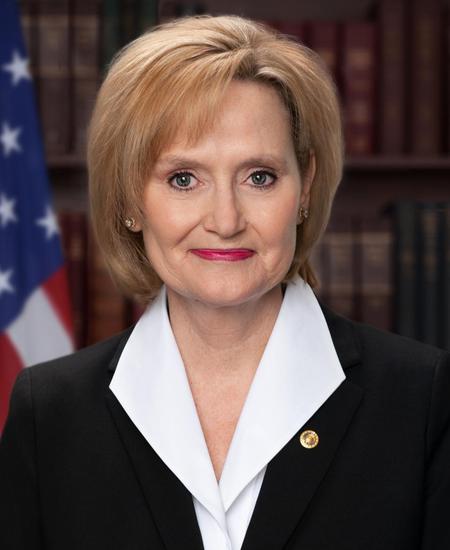
Sen. Cindy Hyde-Smith
Sponsored bills
Maddy summaryThis bill amends the CARES Act by removing subsection (c) of Section 4024. It does not create new policies or directly affect any specific group; it only modifies an existing provision in federal law. The change is purely procedural, eliminating a specific subsection without altering the law's overall structure or requirements. No new rules or impacts on housing are introduced. (1 sentence, as it is a procedural amendment).
Maddy summaryThis bill permanently extends the New Markets Tax Credit (NMTC) program, which incentivizes private investment in low-income communities. It modifies the tax code to keep the credit available beyond 2025 (replacing "2020 through 2025" with "2020 and each calendar year thereafter") and adds automatic annual inflation adjustments to the credit amount starting in 2026. The bill also provides tax relief by allowing NMTC credits to offset the alternative minimum tax, specifically for investments made after December 2024. This directly affects community development financial institutions (CDFIs) and investors who fund projects in designated low-income areas.
Maddy summaryS 475, the Alternatives to PAIN Act, changes Medicare Part D coverage to make non-opioid pain management drugs more accessible and affordable for beneficiaries. It requires Medicare plans to cover qualifying non-opioid pain drugs without deductibles and place them on the lowest cost-sharing tier (meaning patients pay the least out-of-pocket) starting in 2026. The bill also prohibits plans from requiring step therapy (forcing patients to try opioids first) or prior authorization for these specific drugs. Qualifying drugs must treat acute pain (like post-surgery), not work on opioid receptors, have no equivalent alternatives, and meet cost thresholds. This directly affects Medicare Part D beneficiaries needing pain management and the plans that cover them.
Maddy summaryThe Rural Health Focus Act (S 403) creates a new Office of Rural Health within the CDC, headed by a director appointed by the CDC Director. This office will directly serve rural communities by coordinating CDC research on rural health challenges, developing policies to improve care (including telehealth), and awarding grants to support rural health initiatives. Key mechanisms include acting as the CDC’s main contact for rural health issues, identifying healthcare disparities in rural areas, and collaborating with other federal health offices to avoid duplication. The bill aims to address specific health access and outcomes gaps faced by people living in rural populations through targeted federal coordination and support.
Maddy summaryThis bill requires mandatory country of origin labeling for beef products, including ground beef, so consumers can see where their beef comes from. It updates existing labeling rules under the Agricultural Marketing Act of 1946 to specifically include beef (and ground beef) alongside other meats. The law directs the U.S. Trade Representative and Agriculture Secretary to find a World Trade Organization-compliant way to reinstate this labeling within a year of enactment. It directly affects beef producers, retailers, and consumers by changing how beef packaging must identify its country of origin.
Maddy summaryS 383 (the JOBS Act of 2025) expands Federal Pell Grant eligibility to students enrolled in certain short-term job training programs at eligible institutions of higher education. The bill creates a "job training Federal Pell Grant" for programs meeting specific criteria: 150-600 clock hours over 8-15 weeks, aligned with high-demand industry sectors, and leading to recognized postsecondary credentials that meet employer hiring requirements or licensure prerequisites. It also lowers the minimum Pell Grant award from 10% to 5% of the full annual amount. This directly affects students seeking career-focused training and institutions offering qualifying programs that validate industry partnerships.
Maddy summaryThis bill amends federal law to increase penalties for obstructing justice through picketing or parading near judicial buildings. Specifically, it raises the maximum prison sentence for such offenses under 18 U.S.C. § 1507 from one year to five years. The law directly affects individuals who engage in protests or demonstrations that interfere with court operations near the Supreme Court or other judicial facilities. The key change is a stricter criminal penalty for obstructing justice, not a new policy or program.
Maddy summaryThe Fair Access to Banking Act (S 401) prohibits large financial institutions ($10 billion+ in assets) and payment networks from denying services to lawful businesses based on political or reputational factors, such as the type of legal business they operate. It requires banks to justify denials using objective, risk-based standards instead of category-based decisions, and mandates written explanations for denials. The law enables lawsuits against violators with treble damages and civil penalties up to 10% of service value (capped at $10,000 per violation). It directly affects major banks, payment processors, and credit unions that serve large-scale customers, ensuring fair access for businesses operating within federal law.
Maddy summaryThis bill would eliminate diversity, equity, and inclusion (DEI) programs across federal agencies by requiring the closure of DEI offices, rescinding related executive orders (including those on racial equity and LGBTQ+ inclusion), and prohibiting federal funds from being used for DEI-related activities. It defines "prohibited diversity, equity, or inclusion practice" as including training that asserts certain groups are inherently superior or inferior, or requiring employees to sign statements about such concepts. The bill affects all federal agencies, personnel, contractors, and grantees by banning DEI training, offices, and related activities while exempting Equal Employment Opportunity offices and disability-related programs. It also creates a private cause of action allowing individuals to sue for violations with penalties of $1,000 per violation per day.