

Real Time Transparency Act This bill revises the notification requirement for campaign contributions of $1,000 or more. Specifically, the bill applies this requirement to (1) any political committee, not just a candidate's principal campaign committee; and (2) cumulative contributions of $1,000 or more during a calendar year, instead of only single contributions that are received by a committee less than 20 days but more than 48 hours before the day of an election. Only the Federal Election Commission (FEC) must be notified within 48 hours of receiving these contributions, instead of the FEC and others. Any amount transferred by a joint fundraising committee established by a candidate's authorized committee to any other authorized committee of that candidate shall be treated as a contribution.
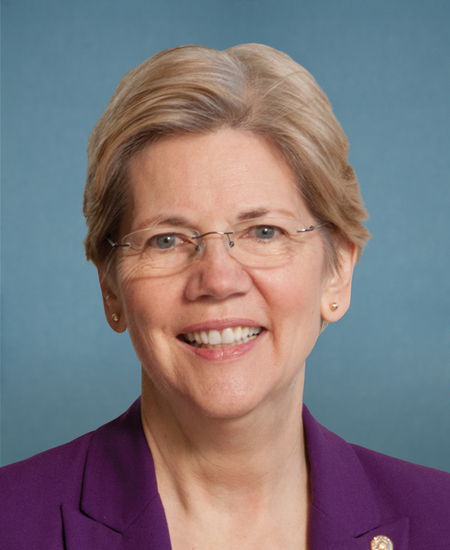
Sen. Elizabeth Warren
Sponsored bills
College Transparency Act This bill requires the National Center for Education Statistics to establish a secure and privacy-protected data system that contains information about postsecondary students. Specifically, the data system must evaluate student enrollment patterns, progression, completion, and postcollegiate outcomes, and higher education costs and financial aid; provide complete and customizable information for students and families making decisions about postsecondary education; reduce the requirements for reporting by institutions of higher education; and periodically match with other federal systems of data. The bill also establishes a postsecondary student data system advisory committee.
Huntington's Disease Disability Insurance Access Act of 2021 This bill expedites payment of Social Security Disability Insurance (SSDI) benefits and eligibility for Medicare coverage for those with Huntington's disease. This is an inherited disorder that causes brain cells to die, including in areas of the brain that help to control voluntary movement. Specifically, the bill eliminates the 5-month waiting period for SSDI benefits and the subsequent 24-month waiting period for Medicare coverage for individuals with Huntington's disease. Under current law, individuals generally must wait five months after the onset of disability to begin receiving SSDI benefits and an additional 24 months to become eligible for Medicare.
Student Loan Tax Elimination Act This bill eliminates the origination fee on federal student loans. Origination fees are the fees lenders charge for processing new loan applications.
Protect DREAMer Confidentiality Act of 2021 This bill directs the Department of Homeland Security (DHS) to prevent disclosing information from applications to the Deferred Action for Childhood Arrivals (DACA) program to U.S. Immigration and Customs Enforcement (ICE) or U.S. Customs and Border Protection (CBP), except to implement the program. Application information may be shared only to identify or prevent fraudulent claims, for particularized national security purposes relating to the applicant, or to investigate or prosecute a felony not related to immigration status. The bill also prohibits DHS from referring any individual with deferred action status to ICE, CBP, the Department of Justice, or any law enforcement agency.
Wall Street Tax Act of 2021 This bill imposes a 0.1% excise tax on certain purchases of stocks, bonds, and derivatives. The tax applies to the purchase of a security if (1) such purchase occurs on, or is subject to the rules of, a qualified board or exchange located in the United States; or (2) the purchaser or seller is a U.S. person. The tax applies to transactions with respect to a derivative if (1) the derivative is traded on, or is subject to the rules of, a qualified board or exchange located in the United States; or (2) any party with rights under the derivative is a U.S. person. The bill exempts from such tax (1) initial issues of securities; and (2) any note, bond, debenture, or other evidence of indebtedness which is traded on or is subject to the rules of, a qualified board or exchange located in the United States, and has a fixed maturity of not more than 100 days. The tax applies to transactions by a controlled foreign corporation and must be paid by its U.S. shareholders.
Environmental Justice For All Act This bill establishes several environmental justice requirements, advisory bodies, and programs to address the disproportionate adverse human health or environmental effects of federal laws or programs on communities of color, low-income communities, or tribal and indigenous communities. Specifically, the bill prohibits disparate impacts on the basis of race, color, or national origin as discrimination. Aggrieved persons may seek legal remedy when faced with such discrimination. In addition, the bill directs agencies to follow certain requirements concerning environmental justice. For example, agencies must prepare community impact reports that assess the potential impacts of their actions on environmental justice communities under certain circumstances. Further, it creates a variety of advisory bodies and positions, such as the White House Environmental Justice Interagency Council. Among other things, the council must issue an environmental justice strategy. It also establishes requirements and programs concerning chemicals or toxic ingredients in certain products. For example, the bill (1) requires certain products (e.g., cosmetics) to include a list of ingredients or warnings; and (2) provides grants for research on designing safer alternatives to chemicals in certain consumer, cleaning, toy, or baby products that have an inherent toxicity or that are associated with chronic adverse health effects. Finally, it creates a variety of funding programs, such as a grant program to enhance access to park and recreational opportunities in an urban areas.
Puerto Rico Self-Determination Act of 2021 This bill establishes a process for the people of Puerto Rico to vote on the political status (e.g., statehood) of the territory. Congress may ratify the decision through a joint resolution. The bill declares that the legislature of Puerto Rico has the authority to call a status convention regarding the political status of the territory. The bill provides for public financing of delegate elections to the status convention and establishes a Congressional Bilateral Negotiating Commission to provide advice and consultation to delegates of the status convention. The status convention must provide self-determination options for a referendum of the people of Puerto Rico. Ranked-choice voting is a permitted format for the referendum. Delegates shall carry out an educational campaign through traditional paid media related to the referendum. The bill provides for congressional consideration of a joint resolution to ratify the self-determination option selected through the referendum.
TRICARE Fairness for National Guard and Reserve Retirees Act This bill aligns eligibility for TRICARE health coverage with the age at which personnel of the Retired Reserve (former National Guard and Reserve members) begin receiving retired pay. Specifically, personnel of the Retired Reserve who are not yet age 60 but are receiving their retirement pay may purchase TRICARE health coverage for retired military personnel, rather than the presently allowed TRICARE Retired Reserve. Under current law, Reserve Component personnel may retire below age 60, but not below 50, based on active duty performance.
Empowering Medicare Seniors to Negotiate Drug Prices Act of 2021 This bill allows the Centers for Medicare & Medicaid Services to negotiate drug prices under the Medicare prescription drug benefit and to institute a price structure for the reimbursement of drugs covered under the benefit.