

Maddy summaryThe Insurrection Act of 2025 establishes specific conditions under which the President may deploy military forces domestically to address insurrections, rebellions, or widespread violence that overwhelm state and local authorities. It requires the President to consult Congress, issue a proclamation ordering lawbreakers to disperse, and submit a detailed report before deployment, with congressional approval needed within 7 days. The bill specifically protects voting rights by requiring that military deployment to address voting rights violations must comply with the Voting Rights Act of 1965. It also prohibits using National Guard members on training or other duty for domestic deployments. This legislation directly affects the President, Congress, state authorities, and military operations.
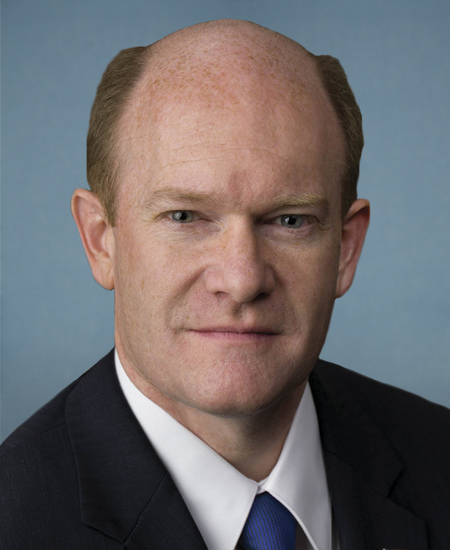
Sen. Christopher A. Coons
Sponsored bills
Maddy summaryThe HCBS Relief Act of 2025 increases federal funding for Medicaid home and community-based services (HCBS) by 10 percentage points (capped at 95%) for participating states during fiscal years 2026-2027. It directly affects states that submit approved applications, Medicaid beneficiaries receiving HCBS, and home health workers by requiring states to use funds to raise wages/benefits for HCBS workers, reduce waiting lists, support family caregivers, and improve service quality. Key provisions mandate that states detail specific activities (like wage increases, paid leave, and equipment purchases) in applications, ensure funds supplement rather than replace state spending, and report on outcomes by 2029. The bill aims to strengthen HCBS access and workforce stability without changing Medicaid eligibility rules.
Maddy summaryThis resolution designates June 11, 2025, as "World Franchise Day" to recognize the franchise business model. It acknowledges franchising's historical roots (tracing to Benjamin Franklin and Isaac Singer) and its current role in supporting 830,876 U.S. franchise establishments, 8.8 million jobs, and 3% of GDP. The Senate resolution is purely commemorative - it does not create new laws or policies but formally honors franchising's contributions to entrepreneurship and economic activity. It directly affects no specific individuals or entities beyond symbolic recognition.
Maddy summaryThe My Body, My Data Act of 2025 requires companies and services handling personal reproductive or sexual health information - such as health apps, clinics, or digital platforms - to only collect, retain, or share this data when strictly necessary for a service a person has requested. It gives individuals the right to access, correct, or delete their data easily (within 15 days, without fees), and mandates clear privacy policies explaining how data is used. The bill also prohibits companies from retaliating against people who exercise these rights, such as by charging higher prices or denying services. Enforcement will be handled by the Federal Trade Commission, with individuals able to sue for violations and seek penalties of up to $1,000 per violation per day.
Maddy summaryS 2035, the "Protect IVF Act," establishes federal rights to access and provide fertility treatment, including IVF, under widely accepted medical standards defined by the American Society for Reproductive Medicine. It directly affects patients seeking fertility care, health care providers offering IVF services, health insurance issuers covering such care, and manufacturers of fertility-related drugs or devices. The bill preempts state laws that restrict IVF access in ways inconsistent with medical standards - such as mandating unnecessary procedures, limiting telemedicine, or imposing discriminatory barriers - and allows federal court enforcement against violating state actions. This focuses on protecting existing access rather than creating new benefits or altering insurance coverage requirements.
Maddy summaryS 2006, the Fit to Serve Act, prohibits the U.S. military from discriminating against service members or applicants based on gender identity. It directly affects all current and prospective members of the Armed Forces by banning specific discriminatory actions, including denying medically necessary health care, requiring service in a sex assigned at birth, or separating members due to gender identity (including gender dysphoria diagnosis). The bill amends Title 10 of the U.S. Code to add new protections, explicitly stating that the military cannot deny service, reenlistment, or health coverage based on gender identity. These changes apply uniformly across all branches and service statuses, ensuring equal treatment under military policy.
Maddy summaryThis bill creates federal grant programs to support runaway and homeless youth aged 15-26, with priority for those under 22. It establishes Basic Center Grants for temporary shelter and services, Transitional Living Grants for longer-term housing with support services, and Prevention Services Grants to help youth at risk of homelessness. The bill requires all services to be trauma-informed, culturally appropriate, and tailored to youth's age, gender, and developmental needs, with specific attention to vulnerable populations including LGBTQ youth, youth of color, and those in child welfare or justice systems. It also mandates data collection on trafficking incidents and services provided to youth victims, while requiring coordination with education, health, and social service systems.
Maddy summaryThis bill reauthorizes the NIH's Institutional Development Award (IDeA) program, formally naming it as such and defining eligible states. It targets research institutions in states receiving below-median NIH grant funding (referred to as "IDeA States"), directly affecting those institutions and their ability to compete for NIH funding. Key provisions include requiring NIH to annually report on program strategy, specific awards made, integration efforts with non-IDeA states, and measurable outcomes like research quality improvements over five years. The bill clarifies program administration and mandates transparency through public reporting, without creating new funding or altering eligibility criteria.
Maddy summaryThis bill expands Medicare coverage to include audiology services (hearing and balance assessments, and treatment starting in 2027) for beneficiaries. It allows qualified audiologists to provide these services directly without requiring a physician referral or supervision, beginning January 1, 2027. Medicare will pay 80% of the lesser of the actual charge or the fee schedule amount for these services, and audiologists will be recognized as eligible providers in certain clinics. The changes apply to services furnished on or after January 1, 2027.
Maddy summarySRES 266 is a symbolic Senate resolution designating May 2025 as "ALS Awareness Month" to highlight amyotrophic lateral sclerosis (ALS), a progressive neurodegenerative disease with no cure. It does not create new laws or funding but aims to raise public awareness about ALS, which affects nerve cells and leads to muscle weakness, paralysis, and respiratory failure. The resolution affirms the Senate’s commitment to supporting access to treatments, advancing research to identify causes, and reducing burdens on individuals with ALS and their caregivers. It specifically commends family members, researchers, and organizations working to improve care and find cures for the estimated 10,000+ people living with ALS in the U.S. at any given time. This resolution has no direct impact on policy or resources but serves as a formal recognition of ALS awareness efforts.