Maddy summaryS 3275, the Humanoid ROBOT Act of 2025, prohibits U.S. federal agencies and their contractors from purchasing or using humanoid robots developed by entities linked to specific countries of concern (like China). The bill directly affects government agencies, defense contractors, and foreign entities designated as "covered entities" under the law. Key mechanisms include a ban on government contracts for such robots, mandatory review of foreign investments in humanoid robot technology via CFIUS, and a requirement for a national security report on risks posed by these robots. The prohibitions take effect 180 days after enactment, with limited waivers allowed for national security or research purposes.
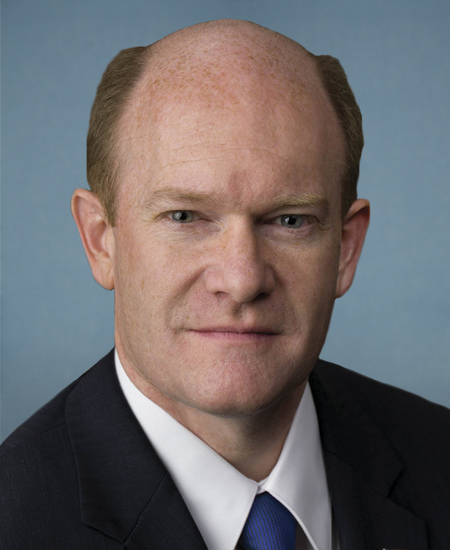
Sen. Christopher A. Coons
Sponsored bills
Maddy summaryS 2379, the "Countering Threats and Attacks on Our Judges Act," creates a new program to improve safety for state and local judges and court staff. It authorizes the State Justice Institute to fund eligible national nonprofits (with specific expertise in judicial security, courthouse design, and court operations) to establish State Judicial Threat Intelligence and Resource Centers. These centers will provide safety training, monitor threats, coordinate with law enforcement, develop standardized reporting systems, and create a national database for sharing threat information. The bill also requires an annual report to Congress on the number and types of threats faced by judges and court staff.
Maddy summaryThis resolution designates October 16, 2025, and October 16, 2026, as "World Food Day" for the United States. It encourages Americans to observe these dates with activities raising awareness about global hunger and malnutrition. The resolution reaffirms U.S. commitment to combating food insecurity through humanitarian aid and investment in resilient agriculture. It does not create new laws or funding, serving only as a symbolic observance.
Maddy summaryThe Background Check Expansion Act requires most private firearm transfers between unlicensed individuals to go through a licensed dealer, who must conduct a background check as if the dealer were selling the firearm. Exceptions include transfers between close family members (like parents and children), law enforcement, temporary safety-related transfers (e.g., preventing domestic violence), and transfers for hunting or target shooting with specific safeguards. Licensed dealers must provide a notice about the background check requirement and have the buyer sign a certification form. The bill does not create a national gun registry and preserves states' authority to enact stricter firearm laws. It takes effect 180 days after enactment.
Maddy summaryThe Biomanufacturing Excellence Act of 2025 establishes a National Biopharmaceutical Manufacturing Center of Excellence under the National Institute of Standards and Technology (NIST). It directly affects U.S. biopharmaceutical manufacturers, research institutions, and workers by funding a competitive grant program to create a center focused on advancing biomanufacturing technologies. Key provisions include improving manufacturing processes, reducing reliance on foreign supply chains, supporting workforce training, and requiring annual progress reports to Congress. The bill authorizes $120 million for fiscal year 2026 to build facilities, conduct collaborative research, and develop training programs, with the center required to prioritize national security, health security, and economic security needs.
Maddy summaryThis bill (S 3195) repeals a specific section (Section 213) from the 2026 appropriations law and restores an older provision (Section 10 of the 2005 Legislative Branch Appropriations Act) as if the repealed section had never existed. It directly affects how legislative branch funding is administered, correcting a technical error in the appropriations process. The bill makes no new policy changes but restores the original funding mechanism that was inadvertently altered by the 2026 law. It is purely procedural, with no direct impact on public programs or citizens' daily lives.
Maddy summarySRES 498 is a Senate resolution designating April 3, 2025, and April 3, 2026, as "Jane Goodall Day" to commemorate the birth of Dr. Jane Goodall and honor her work as a pioneering ethologist, conservationist, and activist. The resolution formally recognizes her contributions through the Jane Goodall Institute, her Roots & Shoots youth program, and her global environmental advocacy, without creating new laws or altering policies. It is purely commemorative, with no direct impact on legislation or affected parties.
Maddy summaryThis Senate resolution (SRES 463) expresses symbolic condemnation of China's persecution of religious minorities, specifically highlighting the detention of Pastor Ezra Jin Mingri and Zion Church leaders following a reported October 10, 2025, abduction. It directly addresses the Chinese Communist Party (CCP) government, calling on it to release detained religious leaders and end violence against Christians, Muslims, and Buddhists. The resolution reaffirms U.S. policy commitments under the International Religious Freedom Act of 1998 and the Frank R. Wolf Act, emphasizing the U.S. global role in promoting religious freedom. It does not create new laws or funding but serves as a diplomatic statement urging China to respect internationally recognized religious freedom rights.
Maddy summarySJRES 90 is a joint resolution directing the removal of U.S. military forces from Venezuela when their actions lack congressional authorization. It requires the President to withdraw troops unless Congress has declared war or passed a specific authorization for military force against Venezuela. The resolution applies to all current military operations in Venezuela not covered by existing congressional approval. It includes an exception allowing military action for self-defense against imminent attacks.
Maddy summaryThis resolution expresses the Senate's support for the European Union's progress in reducing dependence on Russian energy since 2022, including a 90% cut in Russian oil imports and efforts to end all Russian gas imports by 2027 under the REPowerEU initiative. It specifically highlights Hungary's increased reliance on Russian energy (adding $6.7 billion in revenue to Russia since 2022) and calls on Hungary to comply with the EU's timeline. The resolution urges U.S. allies to terminate contracts with Russian energy firms Rosneft and Lukoil, following recent U.S. sanctions. It also reaffirms opposition to the Nord Stream pipelines but does not create new legal requirements or affect any entities directly.