Constitution education Is Valuable In Community Schools Act of 2021 or the CIVICS Act of 2021 This bill requires national activities supported by American History and Civics Education grants to include programs that educate students about the history and principles of the Constitution, including the Bill of Rights.
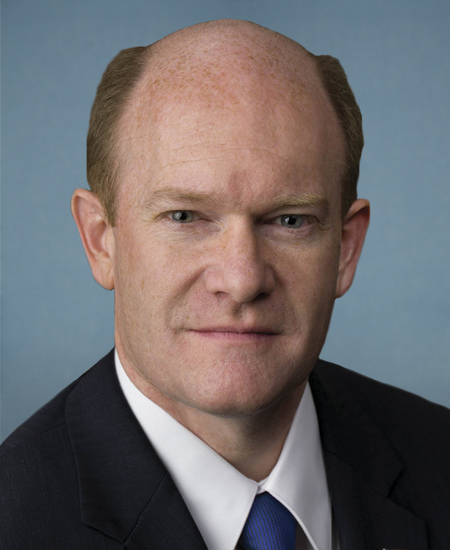
Sen. Christopher A. Coons
Sponsored bills
Comprehensive Mental Health in Schools Pilot Program Act of 2021 This bill requires the Department of Education to establish a pilot program to award grants to local educational agencies for establishing comprehensive mental and behavioral health services programs in elementary and secondary schools.
For the People Act of 2021 This bill addresses voter access, election integrity and security, campaign finance, and ethics for the three branches of government. Specifically, the bill expands voter registration (e.g., automatic and same-day registration) and voting access (e.g., vote-by-mail and early voting). It also limits removing voters from voter rolls. The bill requires states to establish independent redistricting commissions to carry out congressional redistricting. Additionally, the bill sets forth provisions related to election security, including sharing intelligence information with state election officials, supporting states in securing their election systems, developing a national strategy to protect U.S. democratic institutions, establishing in the legislative branch the National Commission to Protect United States Democratic Institutions, and other provisions to improve the cybersecurity of election systems. Further, the bill addresses campaign finance, including by expanding the prohibition on campaign spending by foreign nationals, requiring additional disclosure of campaign-related fundraising and spending, requiring additional disclaimers regarding certain political advertising, and establishing an alternative campaign funding system for certain federal offices. The bill addresses ethics in all three branches of government, including by requiring a code of conduct for Supreme Court Justices, prohibiting Members of the House from serving on the board of a for-profit entity, and establishing additional conflict-of-interest and ethics provisions for federal employees and the White House. The bill requires the President, the Vice President, and certain candidates for those offices to disclose 10 years of tax returns.
This resolution expresses the condolences of the Senate regarding the death of the Honorable Maurice Robert Gravel, former Senator from Alaska.
This resolution designates May 7, 2021, as United States Foreign Service Day and honors the men and women who serve in the Foreign Service.
This resolution expresses support for women who are being unjustly detained around the world for exercising their fundamental rights and calls for their unconditional release.
Choice Neighborhoods Initiative Act of 2021 This bill allows the Department of Housing and Urban Development to make competitive grants to local governments, public housing agencies, or nonprofit entities owning a major housing project to implement transformational housing programs in eligible neighborhoods with a concentration of extreme poverty and severely distressed housing. A program must, among other requirements, allow residents of public or assisted housing displaced by such a program to return to the replacement housing provided under the program.
Harlem Hellfighters Congressional Gold Medal Act This bill provides for the award of a Congressional Gold Medal to the 369th Infantry Regiment, commonly known as the Harlem Hellfighters, in recognition of their bravery and outstanding service during World War I.
Environmental Justice Act of 2021 This bill requires agencies to address and mitigate the disproportionate impact of environmental and human health hazards on communities of color, indigenous communities, and low-income communities resulting from agencies' programs and policies. The bill also requires agencies to address cumulative impacts of pollution in permitting decisions and expands the types of legal actions available to individuals regarding charges of federal discriminatory practices. Specifically, the bill provides statutory authority for a variety of existing programs, executive orders, federal guidance, and committees concerning environmental justice, including Executive Order 12898; a guidance issued in 1997 by the Council on Environmental Quality titled Environmental Justice Guidance Under the National Environmental Policy Act ; a guidance issued in 2016 by the Environmental Protection Agency titled EPA Policy on Consultation and Coordination with Indian Tribes: Guidance for Discussing Tribal Treaty Rights ; the National Environmental Justice Advisory Council; the Environmental Justice Small Grants Program; and the Environmental Justice Collaborative Problem-Solving Cooperative Agreement Program. In addition, the bill requires agencies renewing or issuing specified permits under the Clean Water Act or the Clean Air Act to consider the cumulative impacts of pollution. The bill also allows individuals to bring actions under the Civil Rights Act against entities that receive federal assistance and engage in discriminatory practices that have a disparate impact. Currently, individuals must request that federal agencies bring such actions on their behalf.
Industrial Finance Corporation Act This bill establishes within the executive branch the Industrial Finance Corporation. The corporation must provide support for (1) manufacturing and supply chains in certain critical industries, (2) industries on the technological frontier, and (3) other economic objectives. The bill specifies the membership and structure of the corporation and authorizes the corporation to invest in projects, make loans, and manage programs to further the corporation's economic objectives. The corporation also has the power to purchase or lease property, enter contracts, borrow funds from the Department of the Treasury (up to a specified limit), and otherwise carry out its functions. A risk committee must develop and review the corporation's risk management policies and an audit committee must oversee the integrity of the corporation's finances. The bill also requires the corporation to develop a performance measurement system to evaluate and monitor projects and guide future projects. Further, the corporation must develop appropriate safeguards, policies, and guidelines to ensure that its projects supplement, rather than compete with, private sector supports. The corporation must periodically report on its projects and publish certain project-level information.