Iran Hostages Congressional Gold Medal Act This bill requires the Speaker of the House of Representatives and the President pro tempore of the Senate to arrange for the award of a Congressional Gold Medal commemorating the bravery and endurance of the 53 hostages of the Iran Hostage Crisis. Following its award, the medal shall be given to the National Museum of American History of the Smithsonian Institution for display and research. The Department of the Treasury must strike duplicate medals in silver for presentation to a hostage (or the personal representative of a deceased hostage), and Treasury may also strike and sell duplicate medals in bronze.
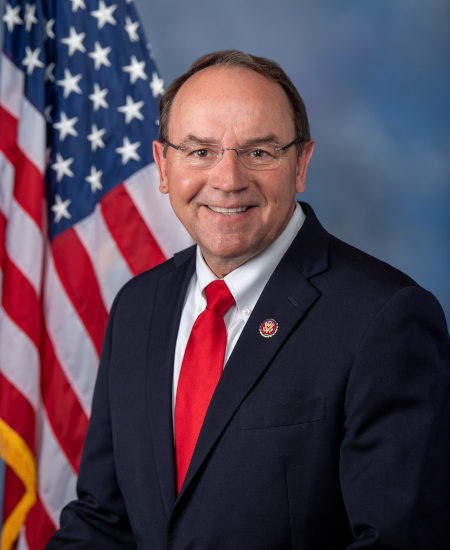
Rep. Thomas P. Tiffany
Sponsored bills
Managing Predators Act This bill gives states the authority to manage the populations of gray wolves and to determine if the wolves are endangered or threatened species. Specifically, the bill permanently removes the populations of gray wolf in Wisconsin, Michigan, Minnesota, and Wyoming from the federal endangered and threatened species list. In addition, the bill revises requirements for the gray wolf in any state other than Wisconsin, Michigan, Minnesota, and Wyoming. If the population of the gray wolf, as estimated by such state, is at or above a population goal established by the state, then the Department of the Interior may not make a determination that the wolf in such state is an endangered or threatened species.
Improving Confidence in Veterans' Care Act This bill prescribes oversight requirements for the Department of Veterans Affairs (VA) regarding health care professionals at VA medical centers. Specifically, the bill requires the VA to ensure each VA medical center consistently compiles, verifies, and reviews specified documentation for each VA health care professional (including contractors). The VA shall ensure that specified health care professionals hold an active Drug Enforcement Administration registration. Each VA medical center must implement (1) monitoring of the performance and quality of the health care delivered by each health care professional at the center, and (2) reviews of such care if an individual notifies the VA of any potential concerns relating to a failure to meet generally accepted standards of clinical practice. The bill imposes notification requirements in situations where the VA substantiates a concern relating to the clinical competency of, or quality of care delivered by, a current or former VA health care professional. The VA is prohibited from entering into a settlement agreement relating to an adverse action against a VA health care professional if such agreement includes terms that require the VA to conceal certain information from the employee's personnel file. Such prohibition does not apply to adverse actions determined to be prohibited personnel practices. The VA must provide mandatory training, at least biannually, to employees of each medical center who are responsible for specified tasks (e.g., those who are responsible for compiling, validating, or reviewing the credentials of VA health care professionals).
Reducing Antiquated Permitting for Infrastructure Deployment Act or the RAPID Act This bill modifies review requirements for deployment of a small personal wireless service facility and establishes a presumption related to the deployment of wireless facilities on properties owned by an Indian tribe or a Native Hawaiian organization. Specifically, the bill exempts the deployment of a small personal wireless service facility from specified environmental and historic preservation review requirements. The bill also establishes a rebuttable presumption that a wireless provider has completed a request for review if an Indian tribe or a Native Hawaiian organization has received certain completed forms with information reasonably necessary to ascertain whether historic properties of religious and cultural significance may be affected by the deployment of new or collocated wireless facilities.
This resolution urges the U.S. Postal Service to take steps to ensure the continuation of its six-day mail delivery service.
No taxpayer funding for United Nations Human Rights Council Act This bill prohibits the Department of State from making contributions to the United Nations Human Rights Council, either as a percentage of the U.S. contribution to the regular budget of the United Nations or as a voluntary contribution to the council.
"Six Triple Eight" Congressional Gold Medal Act of 2021 This bill directs the Speaker of the House of Representatives and the President pro tempore of the Senate to arrange for the award of a Congressional Gold Medal in honor of the women of the 6888th Central Postal Directory Battalion (commonly known as the Six Triple Eight) in recognition of their pioneering military service, devotion to duty, and contributions to increase the morale of personnel stationed in the European theater of operations during World War II. The medal shall be given to the Smithsonian Institution and made available for display and research.
Chinese Research Funds Accounting Act This bill directs the Government Accountability Office (GAO) to conduct a study on federal funding made available to entities located in China or majority owned or controlled by the Chinese Communist Party for research in the five years prior to enactment of this bill. Not later than 120 days after the enactment of this bill, the GAO shall brief Congress on the data that is available with respect to federal funding made available to such entities for research.
You Must Be Alive To Vote Act of 2021 This bill requires each state, in order to receive certain education and transportation funds, to annually certify that the state has an agreement with the Social Security Administration to share death information for the purpose of removing the names of ineligible voters from the official list of eligible voters.
Oversight for Members And Relatives Act or the OMAR Act This bill prohibits the use of campaign funds to compensate the spouse of a candidate or an individual holding federal office. It also requires disclosure of payments made to spouses or immediate family members. Specifically, the bill prohibits an authorized committee of a candidate or any other political committee that is established, maintained, or controlled by a candidate or an individual holding federal office from directly or indirectly compensating the spouse of the candidate or individual for services provided to or on behalf of the committee. The prohibition does not apply to a political committee of a political party. Next, the bill requires a political committee to report on disbursements to the spouse or an immediate family member of the candidate or the individual holding federal office. Finally, the bill requires any penalty for a violation of the bill to be imposed on the candidate or the individual holding federal office if the candidate or individual involved knew of the violation. Further, it prohibits the committee involved from reimbursing the candidate or individual for the penalty.