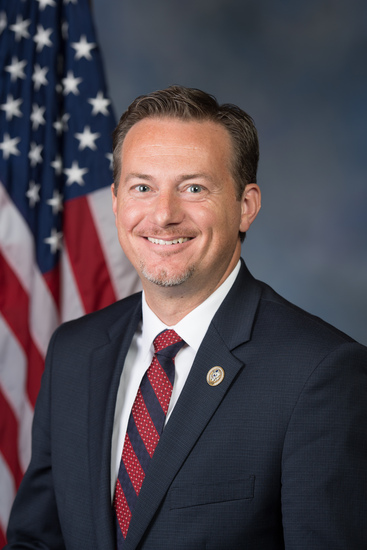
This resolution supports the designation of National FFA Week. It also (1) recognizes the important role of the National FFA Organization (Future Farmers of America) in developing the next generation of leaders who will change the world, and (2) celebrates the 90th anniversary of the iconic FFA jacket.
Rep. Michael Cloud
Sponsored bills
Feral Swine Act This bill extends through FY2028 the feral swine eradication and control pilot program to respond to the threat feral swine pose to agriculture, native ecosystems, and human and animal health.
No Retaining Every Gun In a System That Restricts Your Rights Act This bill modifies the retention requirements for firearm transaction records of federal firearms licensees (FFLs) that go out of business. Current law generally requires FFLs that go out of business to deliver their firearm transaction records to the Bureau of Alcohol, Tobacco, Firearms and Explosives (ATF). This bill removes the requirement for FFLs that go out of business to deliver their firearm transaction records to the ATF. Further, the bill requires the ATF to destroy all out-of-business records it has collected from FFLs.
Maddy summaryThis bill prohibits the Department of Defense from using funds to pay for or reimburse abortion services, except when the pregnancy endangers the mother's life, results from rape, or results from incest. It directly affects military personnel, civilian DOD employees, and contractors receiving medical care at military facilities by restricting funding for abortion-related expenses. Key provisions include amending federal law to ban reimbursement for travel or licensing costs related to abortion services and repealing a 2022 DOD memo that expanded access to such care. The bill explicitly blocks all funding for abortion services beyond the existing exceptions, with no new exceptions added. It does not change abortion access for civilians outside the military healthcare system.
Maddy summaryThis bill prohibits Members of Congress from receiving student loan debt relief for their service in Congress. It blocks them from qualifying for service-based student loan forgiveness tied to their congressional tenure and prevents eligibility for any new federal student loan programs created while they are in office. The law directly affects current and future Members of Congress by denying them specific debt relief benefits related to their congressional service, as defined by the bill's provisions. It does not change student loan policies for the general public.
Maddy summaryHR 1229, the "Stop CRT Act," codifies Executive Order 13950 into law and restricts federal funding for entities teaching specific concepts about race. It prohibits federal grants to organizations that teach any of six specified ideas, including that race determines moral worth, the U.S. is fundamentally racist, or individuals bear responsibility for historical actions based on race. The bill directly affects schools, nonprofits, and other recipients of federal funds by banning support for educational content matching these prohibitions. Key provisions require federal agencies to deny funding to any entity advancing these concepts, making the executive order legally binding. This policy change alters how federal funds are distributed based on mandated educational content.
Maddy summaryHR 1228 prohibits the U.S. military and Department of Defense-operated academic institutions from promoting specific anti-American or racist theories in training. It bans military programs that teach ideas such as "the U.S. is fundamentally racist," "the Constitution is fundamentally racist," or that "an individual’s worth is determined by race." The bill explicitly states it does not restrict protected speech, research access, or educational contexts that clearly disavow military endorsement of such theories. This directly affects military training curricula, workshops, and educational materials within the armed forces.
Maddy summaryThe Federal Agency Sunset Commission Act of 2023 would establish a 13-member commission to review all federal agencies every 12 years (or less) to determine if they should be abolished, reorganized, or continued. The commission would evaluate agencies based on specific criteria including efficiency, cost-effectiveness, duplication with other agencies, and whether the agency has achieved its original purpose. Agencies would be scheduled for review and potentially abolished unless Congress reauthorizes them, with a supermajority vote allowing up to a 2-year extension. This bill directly affects all federal agencies and would require Congress to periodically assess the necessity of government programs. The commission would also monitor new legislation to prevent unnecessary creation of new agencies or programs.
Maddy summaryHR 1200, the National Right-to-Work Act, prohibits requiring workers to join a union or pay dues as a condition of employment in both private-sector workplaces (covered by the National Labor Relations Act) and railroad industries (covered by the Railway Labor Act). The bill amends key sections of these laws to eliminate provisions that allowed union security agreements, meaning workers in unionized settings would no longer be forced to pay dues to retain their jobs. This directly affects employees in unionized workplaces across the U.S., particularly those in industries with existing union contracts that included mandatory dues. The law changes the legal framework to ensure union membership and dues payment remain voluntary for all workers.
Maddy summaryHR 503, the "No TikTok on United States Devices Act," would require the President to block all U.S. transactions with ByteDance Limited (TikTok's parent company) within 30 days of enactment, effectively banning TikTok on U.S. devices. This uses emergency economic powers to prohibit financial dealings involving ByteDance or any entity it owns that handles TikTok data. The bill includes exceptions for national security, law enforcement, and security research activities. It also mandates a 120-day report from intelligence agencies assessing Chinese government access to U.S. user data via TikTok.