Willie O'Ree Congressional Gold Medal Act This bill provides for the award of a Congressional Gold Medal to Willie O'Ree or, if unavailable, to a member of his family, in recognition of his contributions and commitment to hockey, inclusion, and recreational opportunity.
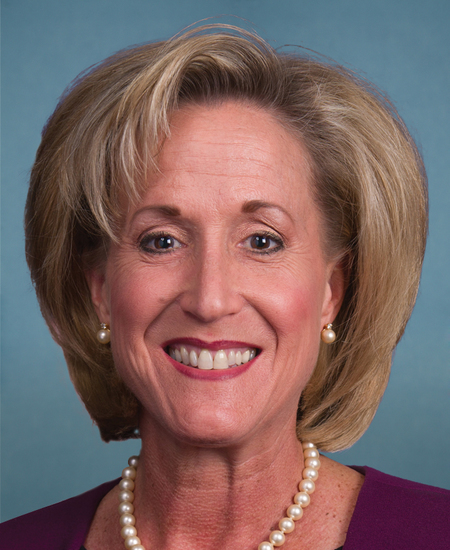
Rep. Ann Wagner
Sponsored bills
Redirecting Resources to the Border Act This bill addresses the relocation of personnel and fencing deployed in the National Capital Region in response to the January 6, 2021, attacks on the U.S. Capitol building and grounds. Specifically, the bill requires all fencing installed in response to the attacks to be relocated to the southern land border of the United States. The Department of Defense must reassign National Guard members who were deployed in response to the attacks to the National Capital Region on or after January 6, 2021, to the southern land border of the United States to assist U.S. Customs and Border patrol.
This bill prohibits the use of federal funds (1) 15 days after its enactment, to support the mission of the National Guard in the District of Columbia in response to the attacks on the U.S. Capitol buildings and grounds on January 6, 2021; or (2) to install permanent fencing around the perimeter of any U.S. Capitol buildings or grounds. On January 7, 2021, in response to the attacks, razor wire fencing was erected to secure the perimeter of the U.S. Capitol; the fencing was initially to remain in place for 30 days and was kept in place through periodic extensions.
Luke and Alex School Safety Act of 2021 This bill requires the Department of Homeland Security (DHS) to establish a Federal Clearinghouse on School Safety Best Practices for use by state and local educational and law-enforcement agencies, institutions of higher education, health professionals, and the public. The bill requires DHS to collect clearinghouse data analytics, user feedback on the implementation of best practices and recommendations identified by the clearinghouse, and any evaluations conducted on these best practices and recommendations. In addition, DHS must coordinate with the Departments of Education, Health and Human Services, and Justice to assess and identify best practices and recommendations and establish an advisory board to provide feedback and propose additional recommendations. Further, the bill specifies the criteria for best practices and recommendations of the clearinghouse, including evidence that the best practice or recommendation has had a significant effect on improving the health, safety, and welfare of individuals in school settings. Finally, the bill provides for grant program review.
Just and Unifying Solutions To Invigorate Communities Everywhere Act of 2021 or the JUSTICE Act This bill addresses policies and issues regarding policing practices and law enforcement accountability. The bill funds state and local grants, incentivizes state and local reporting on the use of certain policing practices, creates new federal offenses for certain misconduct, and establishes best practices and training requirements. The bill funds state and local grants, including to support the use of body-worn cameras, to implement information sharing systems for disciplinary records of law enforcement officers, and to prohibit officers from engaging in sexual acts under color of the law. Further, it requires state and local governments that receive grants under the Edward Byrne Memorial Justice Assistance Grant program to report information related to use-of-force incidents and the use of no-knock warrants. At the federal level, the bill establishes new criminal offenses related to falsifying police reports and engaging in sexual acts under color of law. The bill directs the Department of Justice to develop training on de-escalation tactics, behavioral health crises, alternatives to the use of force, and the duty to intervene when another officer uses excessive force. Finally, the bill establishes and funds the National Criminal Justice Commission. Among other tasks, the commission must develop best practices for policing tactics and procedures.
Born-Alive Abortion Survivors Protection Act This bill establishes requirements for the degree of care a health care practitioner must provide in the case of a child born alive following an abortion or attempted abortion. Specifically, a health care practitioner who is present must (1) exercise the same degree of care as would reasonably be provided to any other child born alive at the same gestational age, and (2) ensure the child is immediately admitted to a hospital. Additionally, a health care practitioner or other employee who has knowledge of a failure to comply with the degree-of-care requirements must immediately report such failure to law enforcement. A health care practitioner who fails to provide the required degree of care, or a health care practitioner or other employee who fails to report such failure, is subject to criminal penalties—a fine, up to five years in prison, or both. An individual who intentionally kills or attempts to kill a child born alive is subject to prosecution for murder. The bill bars the criminal prosecution of a mother of a child born alive under this bill and allows her to bring a civil action against a health care practitioner or other employee for violations.
This resolution condemns the military coup that took place in Burma (Myanmar) on February 1, 2021. It also calls on the Burmese military to (1) release all those detained arbitrarily in the coup, (2) restore all forms of communications, and (3) return to power all members of the civilian government.
This resolution removes Representative Eric Swalwell from the House Permanent Select Committee on Intelligence.
Let States Cut Taxes Act This bill removes a prohibition on states and territories using COVID-19 (i.e., coronavirus disease 2019) relief funding under the American Rescue Plan Act of 2021 to offset a reduction in revenue resulting from a reduction in taxes or a delay in the imposition of a tax or tax increase.
College Transparency Act This bill requires the National Center for Education Statistics to establish a secure and privacy-protected data system that contains information about postsecondary students. Specifically, the data system must evaluate student enrollment patterns, progression, completion, and postcollegiate outcomes, and higher education costs and financial aid; provide complete and customizable information for students and families making decisions about postsecondary education; reduce the requirements for reporting by institutions of higher education; and periodically match with other federal systems of data. The bill also establishes a postsecondary student data system advisory committee.