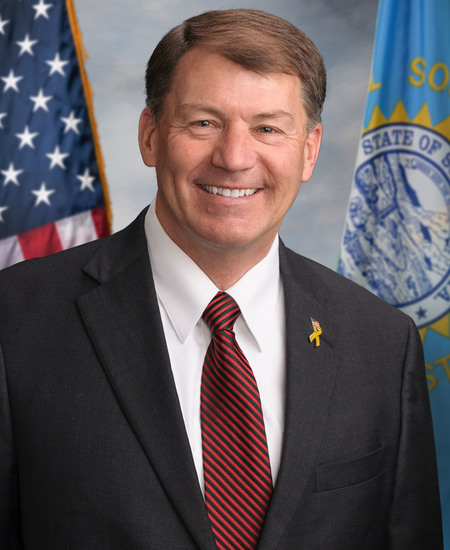
Photo of Mike Rounds
R United States Senate · South Dakota On the 2026 ballot

Sen. Mike Rounds

Compare
Total votes
1,044
all sessions
Attendance
93%
71 missed
Higher than 92% of chamber peers
With party
92%
of cast votes
Near the chamber average
Bipartisan score
4%
crosses aisle rarely
Near the chamber average
Sponsored
1,068
bills & resolutions
Near the chamber average
Committees
18
assignments
1,068 bills and resolutions

Sponsored bills

Total
1,068
Primary
148
Co-sponsor
920
This page
1,068
matching current filters
Co-sponsor S 495
In committee · United States Senate · Co-sponsor
Prioritizing Help to Businesses Act

Prioritizing Help to Businesses Act This bill authorizes additional H-2B visas for temporary nonagricultural workers in states with relatively low unemployment. Currently, such visas are capped nationally at 66,000 a year. For positions in states that had a seasonally adjusted unemployment rate of 3.5% or lower in at least three of the six most recent Bureau of Labor Statistics monthly reports issued in the previous fiscal half year, a certain number of H-2B visas may be issued that do not count against the 66,000 per year cap. For such exempted H-2B visas, a state may receive each year no more than 125% of the number of visas for aliens working in the state in the last completed fiscal year or 2,500, whichever is less.

In committee Mar 1, 2021 1 co-sponsor
Co-sponsor S 480
In committee · United States Senate · Co-sponsor
Main Street Tax Certainty Act

Main Street Tax Certainty Act This bill makes permanent the tax deduction for qualified business income. (Under current law, the deduction expires after December 31, 2025.) Qualified business income is defined as the net amount of qualified items of income, gain, deduction and loss with respect to any trade or business, excluding capital gains or losses, dividends, interest income, or income earned outside the U.S.

In committee Feb 25, 2021 1 co-sponsor
Co-sponsor S 488
In committee · United States Senate · Co-sponsor
Iran Sanctions Relief Review Act of 2021

Iran Sanctions Relief Review Act of 2021 This bill restricts the President's authority to unilaterally undertake certain actions with respect to Iran and increases congressional oversight of those actions. Specifically, the President must report to Congress before terminating or waiving sanctions related to Iran or taking a licensing action that significantly alters U.S. foreign policy with respect to Iran. Each report must (1) describe the proposed action and its rationale, and (2) indicate whether or not the action is intended to significantly alter foreign policy concerning Iran. If the intention is to alter that policy, the report must provide additional information about the policy objectives and anticipated effects of the action. After the President submits a report, the bill provides Congress with a 30-day period to review it; this period is extended to 60 days for reports submitted between July 10 and September 7. During this period, Congress may enact a joint resolution approving or disapproving the action. During the review period, the President may not take the action unless Congress passes a joint resolution of approval; if Congress enacts a joint resolution of disapproval, the bill prohibits the President from taking the action. The bill also outlines procedures for the introduction and consideration of these types of joint resolutions.

In committee Feb 25, 2021 1 co-sponsor
Co-sponsor SRES 72
In committee · United States Senate · Co-sponsor
A resolution opposing the lifting of sanctions imposed with respect to Iran without addressing the full scope of Iran's malign activities, including its nuclear program, ballistic and cruise missile capabilities, weapons proliferation, support for terrorism, hostage-taking, gross human rights violations, and other destabilizing activities.

This resolution opposes lifting specified sanctions on Iran and resolves that these sanctions may be terminated only after Iran has ceased providing support for acts of international terrorism and has dismantled its nuclear, biological, and chemical weapons and related technologies.

In committee Feb 24, 2021 1 co-sponsor
Co-sponsor S 401
In committee · United States Senate · Co-sponsor
Conscience Protection Act of 2021

Conscience Protection Act of 2021 This bill provides statutory authority for certain protections for health care providers that refuse to participate in abortions based on religious beliefs or other convictions. Health care providers include individual professionals, medical facilities, health insurance organizations, and social services providers that refer clients to health care services. The federal government and entities that receive federal funding for health-related activities, including state and local governments, may not discriminate against a health care provider that refuses to be involved in, or provide coverage for, abortions. Currently, similar requirements apply to various related activities, including certain employment or personnel decisions (the Church Amendments), abortion services training (the Coats-Snowe Amendment), qualified health plans offered through health insurance exchanges, and annual appropriations bills for the Department of Health and Human Services (HHS) and other federal agencies (the Weldon Amendment). The HHS Office for Civil Rights must investigate complaints of this kind of discrimination. Furthermore, HHS may terminate or reduce HHS funding for health-related activities if a person or entity fails to comply with nondiscrimination requirements. Additionally, the Department of Justice or any entity adversely affected by such discrimination may bring a civil action to obtain appropriate relief. A plaintiff does not need to seek or exhaust administrative remedies before bringing the action. A plaintiff may also bring an action, including one for money damages, against a governmental entity. In many cases, principles of sovereign immunity shield states and some localities from these kinds of actions.

In committee Feb 24, 2021 1 co-sponsor
Co-sponsor S 406
In committee · United States Senate · Co-sponsor
National Right-to-Work Act

National Right-to-Work Act This bill repeals those provisions of the National Labor Relations Act and the Railway Labor Act that permit employers to make an agreement with a labor union to require employees to join such union as a condition of employment. Currently, at least 27 states have enacted laws prohibiting employers from compelling employees to become members of a union as a condition of employment.

In committee Feb 24, 2021 1 co-sponsor
Co-sponsor S 370
In committee · United States Senate · Co-sponsor
Strengthening Local Processing Act of 2021

Strengthening Local Processing Act of 2021 This bill revises provisions related to meat and poultry processing establishments, including smaller establishments (i.e., those with between 10 and 500 employees) and very small establishments (i.e., those with fewer than 10 employees or annual sales of less than $2.5 million). For example, the Department of Agriculture (USDA) must establish a searchable database of peer-reviewed validation studies for use in developing Hazard Analysis and Critical Control Points plans for smaller and very small establishments. The bill increases the maximum federal cost share from 50% to 65% that USDA may provide to assist states in creating meat and poultry inspection programs. Additionally, USDA must conduct outreach with states that have meat and poultry inspection programs, but that do not have Cooperative Interstate Shipment programs. The Cooperative Interstate Shipment program allows state-inspected facilities to operate as federally-inspected facilities and ship their products in interstate commerce and internationally. USDA must also award competitive grants for activities to adapt production, processing, distribution, and sales systems to respond to and recover from the effects of the COVID-19 pandemic, including activities that support (1) the health and safety of meat and poultry plant employees, suppliers, and customers; (2) increased processing capacity; and (3) the resilience of the small meat and poultry processing sector. Further, the bill establishes grant programs to (1) establish or expand career training programs at community colleges, vocational schools, and universities related to meat and poultry processing; and (2) support smaller and very small establishments by offsetting the cost of training new meat and poultry processors.

In committee Feb 23, 2021 1 co-sponsor
Co-sponsor S 35
Passed · United States Senate · Co-sponsor
Officer Eugene Goodman Congressional Gold Medal Act

Officer Eugene Goodman Congressional Gold Medal Act This bill directs the Speaker of the House of Representatives and the President pro tempore of the Senate to arrange for the presentation of a Congressional Gold Medal to U.S. Capitol Police Officer Eugene Goodman for his actions to protect the Senate chamber during the security breach at the U.S. Capitol on January 6, 2021.

Passed Feb 18, 2021 1 co-sponsor
Co-sponsor SRES 45
In committee · United States Senate · Co-sponsor
A resolution celebrating Black History Month.

This resolution recognizes Black History Month as an opportunity to reflect on U.S. history and to commemorate the contributions of African Americans. It calls for the United States to (1) honor the contribution of pioneers who helped to ensure its legacy; and (2) move forward as a nation "indivisible, with liberty and justice for all."

In committee Feb 8, 2021 1 co-sponsor
Co-sponsor S 293
In committee · United States Senate · Co-sponsor
Dignity for Aborted Children Act

Dignity for Aborted Children Act This bill sets out requirements for the disposition of human fetal tissue from an abortion. Specifically, it requires abortion providers to obtain a patient's informed consent for one of two specified methods of disposition. First, patients may choose to retain possession of the tissue. A patient may choose to transfer the tissue to an entity that provides interment or cremation services. Second, the patient may elect to release the tissue to the provider. Providers must ensure any tissue released to them is interred or cremated within seven days of the procedure in a manner consistent with state law regarding the disposal of human remains. Abortion providers must report annually about these requirements and other specified information. The bill provides civil or criminal penalties for violations of disposal, informed consent, and reporting requirements.

In committee Feb 8, 2021 1 co-sponsor
Showing 1,031 to 1,040 of 1,068 bills