

Paycheck Fairness Act This bill addresses wage discrimination on the basis of sex. Specifically, it (1) limits an employer's defense that a pay differential is based on a factor other than sex to only bona fide job-related factors in wage discrimination claims, (2) enhances nonretaliation prohibitions, (3) makes it unlawful to require an employee to sign a contract or waiver prohibiting the employee from disclosing information about the employee's wages, and (4) increases civil penalties for violations of equal pay provisions. Additionally, the Equal Employment Opportunity Commission (EEOC) and the Office of Federal Contract Compliance Programs must train EEOC employees and other affected parties on wage discrimination. The bill directs the Department of Labor to (1) establish and carry out a grant program for negotiation skills training for girls and women, (2) conduct studies to eliminate pay disparities between men and women, and (3) make available information on wage discrimination to assist the public in understanding and addressing such discrimination. The bill also establishes the Secretary of Labor's National Award for Pay Equity in the Workplace for an employer who has made a substantial effort to eliminate pay disparities between men and women. Finally, the bill requires the EEOC to issue regulations for collecting from employers compensation and other employment data according to the sex, race, and national origin of employees for use in enforcing laws prohibiting pay discrimination.
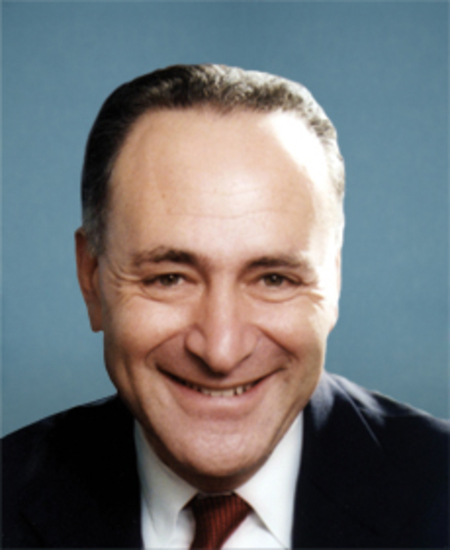
Sen. Charles E. Schumer
Sponsored bills
Securing Access to Lower Taxes by ensuring Deductibility Act or the SALT Deductibility Act This bill repeals the temporary restrictions in taxable years 2018 through 2025 on the deductibility of state and local taxes.
Eliminating a Quantifiably Unjust Application of the Law Act or the EQUAL Act This bill eliminates the federal sentencing disparity between drug offenses involving crack cocaine and powder cocaine. Currently, different threshold quantities of crack cocaine and powder cocaine (e.g., 28 grams of crack cocaine and 500 grams of powder cocaine) trigger the same statutory criminal penalties. This bill eliminates the lower quantity thresholds for crack cocaine offenses. Under the bill, the same threshold quantities of crack cocaine and powder cocaine trigger the same statutory criminal penalties. The change applies to future cases and cases pending on the date of enactment. With respect to past cases, the bill authorizes resentencing of a defendant who was convicted or sentenced for a crack cocaine offense before the date of enactment.
Global Health, Empowerment and Rights Act This bill establishes that a foreign nongovernmental organization shall not be disqualified from receiving certain U.S. international development assistance solely because the organization provides medical services using non-U.S. government funds if the medical services are legal in both the United States and the country in which they are being provided. Such foreign organizations shall not be subject to requirements relating to their use of non-U.S. funds for advocacy or lobbying activities, other than those that apply to U.S. nongovernmental organizations. Current U.S. policy prohibits various foreign assistance from going to a foreign nongovernmental organization unless it agrees to not perform or actively promote abortions.
This resolution establishes procedures concerning the article of impeachment against former President Donald John Trump, including specific issues to be briefed by the parties, deadlines for filing trial documents, and the date for consideration of the article.
Raise the Wage Act of 2021 This bill increases the federal minimum wage for regular employees over a 5-year period, for tipped employees, and for newly hired employees who are less than 20 years old. The bill sets forth a schedule of annual increases in the federal minimum wage for individuals with disabilities. The Department of Labor shall no longer issue special certificates for the payment of subminimum wages to such individuals after the final wage increase under this bill for such individuals takes effect. Labor shall provide, upon request, technical assistance and information to employers to (1) help them transition their practices to comply with wage increases and other requirements under this bill for individuals with disabilities, and (2) ensure continuing employment opportunities for such individuals. The bill eliminates the separate minimum wage requirements for tipped, newly hired, and disabled employees. After a specified period, these employees shall be paid the same minimum wage as regular employees. Labor must publish any increase in the minimum wage in the Federal Register and on its website 60 days before it takes effect.
This resolution suspends Senate rules prohibiting the taking of pictures in the Senate Chamber to permit the taking of an official photograph of the swearing in of Members of the Senate for the impeachment trial of former President Donald J. Trump on January 26, 2021.
This bill requires the federal government to pay states for 100% of the cost of National Guard duty for a mission assignment validated by the Federal Emergency Management Agency pursuant to certain declarations related to the COVID-19 (i.e., coronavirus disease 2019) public health emergency. The bill applies to declarations, with respect to COVID-19, of major disasters, emergencies, national emergencies, and public health emergencies.
Kobe Bryant & Gianna Bryant Helicopter Safety Act This bill directs the Federal Aviation Administration (FAA) to issue regulations to implement National Transportation Safety Board recommendations for crash-resistant systems with respect to existing and new U.S.-registered turbine-powered rotorcraft (e.g., a helicopter) certificated for six or more passenger seats. Specifically, the FAA must require all U.S.-registered turbine-powered rotorcraft certificated for six or more passenger seats to be equipped with a flight data recorder, a cockpit voice recorder, and a terrain awareness and warning system. The FAA may exempt any civilian helicopter from one or more of the equipment requirements.
Direct Support for Communities Act This bill provides FY2021 supplemental appropriations to the Department of Housing and Urban Development (HUD) to award additional Community Development Block Grants to units of local government and counties to prevent, prepare for, and respond to coronavirus and the COVID-19 (i.e., coronavirus disease 2019) public health emergency. Specifically, within 30 days, HUD must distribute 50% of such funds to metropolitan cities and other units of local government and 50% to counties and parishes. These funds may be used to cover costs or replace lost, delayed, or decreased revenues stemming from the COVID-19 public health emergency. Additionally, the bill designates the funding as emergency spending, which is exempt from discretionary spending limits.