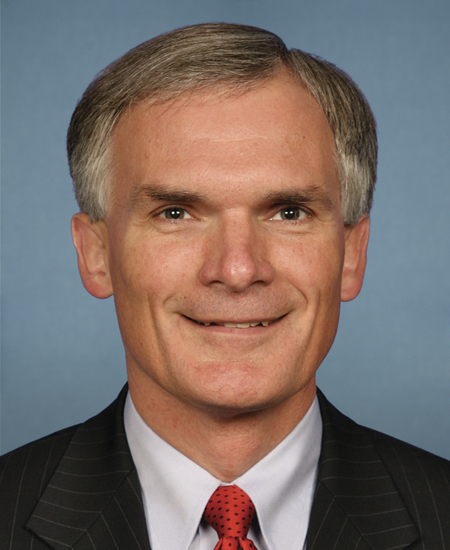
Photo of Robert E. Latta
R United States House · District 5 · Ohio On the 2026 ballot

Rep. Robert E. Latta

Compare
Total votes
2,818
all sessions
Attendance
100%
of floor votes
Higher than 97% of chamber peers
With party
97%
of cast votes
Higher than 82% of chamber peers
Bipartisan score
2%
crosses aisle rarely
Lower than 82% of chamber peers
Sponsored
508
bills & resolutions
Lower than 92% of chamber peers
Committees
4
assignments
508 bills and resolutions

Sponsored bills

Total
508
Primary
63
Co-sponsor
445
This page
508
matching current filters
Co-sponsor HR 9129
In committee · United States House · Co-sponsor
GUARD Act of 2026

Maddy summaryThe GUARD Act of 2026 requires U.S. national security agencies to evaluate whether humanoid or quadruped robots made by foreign entities pose a risk to national security. If a robot is determined to be unsafe or comes from a country of concern, the Federal Communications Commission will add it to a banned list, preventing its use in U.S. communications networks. The law mandates that agencies report their findings to Congress within specific timeframes, ensuring transparency about these security assessments. Importantly, the rule does not apply to allies such as NATO members or designated Major Non-NATO Allies.

In committee Sep 1, 2026 1 co-sponsor
Co-sponsor HR 6152
In committee · United States House · Co-sponsor
Foreign Robocall Elimination Act

Maddy summaryHR 6152, the Foreign Robocall Elimination Act, establishes an interagency task force to address foreign robocalls entering the United States. The task force, composed of the FCC, FTC, DOJ, and private sector representatives, will study the origins, impacts, and potential solutions to foreign robocalls and must submit a report to Congress within 360 days. The bill also modifies existing law to require FCC notices about robocall mitigation every three years instead of annually, and introduces a bond requirement for providers using the Robocall Mitigation Database. This legislation affects telecommunications providers, federal agencies, and all U.S. telephone users who receive unwanted calls. The bill aims to improve coordination between U.S. agencies and foreign countries in combating illegal robocalls through concrete policy changes.

In committee Sep 1, 2026 1 co-sponsor
Primary HR 10164
In committee · United States House · Lead sponsor
BEDROCK Act

Maddy summaryThe BEDROCK Act directs the Secretary of Commerce to designate a senior official who will lead federal efforts to boost the competitiveness and supply-chain resilience of the U.S. biomanufacturing industry. This official is tasked with identifying barriers to private sector investment, mapping complex regulatory pathways across agencies like the FDA and EPA, and publishing a prioritized action plan to address vulnerabilities in critical inputs such as enzymes and cell lines. The bill also requires the government to create a public web resource that consolidates federal information and designates specific agency points of contact to help businesses navigate commercialization processes. These requirements are set to terminate five years after the law is enacted, with periodic reports submitted to Congress to track progress.

In committee Aug 27, 2026 0 co-sponsors
Co-sponsor HR 4635
Passed · United States House · Co-sponsor
To designate the facility of the United States Postal Service located at 890 East 152nd Street in Cleveland, Ohio, as the Technical Sergeant Alma Gladys Minter Post Office Building.

Maddy summaryThis bill (HR 4635) designates the U.S. Postal Service facility at 890 East 152nd Street in Cleveland, Ohio, as the "Technical Sergeant Alma Gladys Minter Post Office Building." It updates all official references to the location to use this new name, with no policy changes or direct impact on residents or services beyond the ceremonial renaming.

Passed Aug 6, 2026 1 co-sponsor
Primary HR 9914
In committee · United States House · Lead sponsor
Collaboration on Adversarial Threats and Security Risks Act

Maddy summaryThis bill creates a legal exemption from antitrust laws for companies and organizations that share information or coordinate actions to protect against security risks posed by artificial intelligence. Specifically, it allows these entities to exchange data or agree to temporarily delay the release or deployment of AI systems if they believe such steps are necessary to prevent threats like weaponization, attacks on critical infrastructure, or unauthorized access. To qualify for this protection, the organizations must act in good faith, use the shared information solely for security purposes, and submit a written notice to the Department of Justice before implementing any coordinated delays. The law also ensures that details submitted to the government remain confidential and allows the Attorney General to seek court orders against companies that fail to prove their actions were legitimate security measures.

In committee Jul 23, 2026 0 co-sponsors
Co-sponsor HR 9827
In committee · United States House · Co-sponsor
Wildfire Reduction Market Expansion Act of 2026

Maddy summaryThe Wildfire Reduction Market Expansion Act of 2026 updates the Clean Air Act to broaden the definition of renewable biomass eligible for carbon credits. It specifically allows materials from forest management, such as slash, storm debris, and wood residuals, to be counted as renewable fuel if they come from sustainably managed lands or public forests designated for fuel reduction. The bill also includes vegetation cleared from defensible space around buildings and from wildfire risk reduction projects in the wildland-urban interface. By clarifying these categories and establishing certification requirements, the legislation aims to increase the supply of biomass available for generating renewable energy credits.

In committee Jul 22, 2026 1 co-sponsor
Primary HR 7970
In committee · United States House · Lead sponsor
STOP Nitazenes Act

Maddy summaryThis bill, known as the STOP Nitazenes Act, directs the federal government to permanently classify nitazenes and related synthetic opioids as Schedule I controlled substances, placing them in the same legal category as heroin and fentanyl. The legislation specifically targets a broad range of chemical compounds, including etonitazene and other variants, by defining them as 2-benzylbenzimidazole opioids and requiring the Attorney General to publish a list of qualifying substances. Under the bill, any nitazene substance temporarily scheduled under emergency provisions would be made permanently scheduled upon enactment, ensuring long-term federal control. The law also mandates that the Attorney General issue implementing rules within one year, allowing for immediate interim enforcement while providing opportunities for public comment before final regulations are established.

In committee Jul 21, 2026 0 co-sponsors
Co-sponsor HR 2004
In committee · United States House · Co-sponsor
Tyler’s Law

Maddy summaryHR 2004, titled "Tyler’s Law," requires the Secretary of Health and Human Services to study how often hospital emergency departments test for fentanyl during overdose cases (beyond standard drug tests), including associated costs, patient benefits/risks, and impacts on privacy and patient-physician relationships. The study must be completed within one year of the bill's enactment. Based on the study results, the Secretary must issue guidance within six months on whether emergency departments should routinely test for fentanyl, how to inform clinicians about test contents, and how such testing may affect future overdose risks and health outcomes. This bill directly affects hospital emergency departments and patients experiencing overdoses by shaping future testing protocols.

In committee Jul 21, 2026 1 co-sponsor
Primary HR 9774
In committee · United States House · Lead sponsor
To amend the Federal Food, Drug, and Cosmetic Act to provide for expedited approval of priority nonprescription drugs, and for other purposes.

Maddy summaryThis bill creates a new program to speed up the approval process for specific over-the-counter drugs that could offer significant public health benefits. Drug companies can request this "priority" status for new medications intended for conditions that currently require a prescription, provided the drugs are new or contain active ingredients never seen in nonprescription products. If approved, the FDA will assign senior staff and specialized teams to work closely with the companies, offering faster guidance and more efficient review schedules while maintaining the same safety and effectiveness standards. The program includes a requirement to publish a list of eligible health conditions and will expire in September 2032 unless renewed by Congress.

In committee Jul 20, 2026 0 co-sponsors
Showing 1 to 10 of 508 bills
1 2 3 51 Next