

Protecting Consumer Access to Generic Drugs Act of 2021 This bill prohibits the manufacturer of a brand-name, generic, or biosimilar drug from entering into certain agreements to resolve or settle a patent infringement claim in connection with the sale of a drug or biological product. Specifically, such an agreement shall, with some exceptions, be a violation of the bill if the filer of a subsequent application to market a drug or biological product receives anything of value and agrees to limit or forego research, development, manufacturing, marketing, or sales of the subsequent drug or biological product. (Typically, a subsequent application seeks to market a generic or biosimilar version of a patented drug or biological product.) Penalties for violations of the bill include civil penalties and loss of the 180-day exclusivity period for a generic drug. The Federal Trade Commission (FTC) shall have exclusive authority to litigate to enforce the bill. When a generic or biosimilar drug manufacturer enters into an agreement with another drug manufacturer related to the manufacturing, marketing or sale of a drug, the manufacturers shall certify that the material they have given the FTC concerning the agreement contains (1) the complete agreement; and (2) any agreements related to the main agreement, including descriptions of any oral agreements or representations.
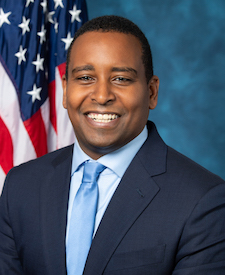
Rep. Joe Neguse
Sponsored bills
Build America's Libraries Act This bill establishes and provides funds through FY2024 for the Build America's Libraries Fund, from which the Institute of Museum and Library Services (IMLS) must allocate funding to states and, through them, need-based grants to libraries to make long-term improvements to library facilities. The IMLS must also award grants to Indian tribes and organizations that primarily serve and represent Native Hawaiians. Specifically, the bill requires each state that receives an allocation, and each library that receives a grant, to carry out certain activities to improve library facilities. These activities include constructing and renovating library facilities, investing in infrastructure projects to improve internet access and connectivity, improving indoor air quality, and making facilities accessible to individuals with disabilities. The bill also outlines administrative and oversight provisions, including by requiring library projects to use iron and steel products that are produced in the United States.
Research Investment to Spark the Economy Act of 2021 or the RISE Act of 2021 This bill authorizes the Departments of Agriculture, Commerce, Defense, Education, Energy, the Interior, Health and Human Services, and Transportation, National Aeronautics and Space Administration (NASA), National Science Foundation, and Environmental Protection Agency to provide support for research regarding COVID-19 (i.e., coronavirus disease 2019) or research disrupted by the COVID-19 pandemic. Support may be used to provide supplemental funding to extend the duration of a grant to a research institution, national laboratory, or individual that was awarded prior to the enactment of this bill, or to expand the purposes of such a grant as specified; issue awards to research the effects of the current pandemic and potential future pandemics; and provide flexibility on awards to account for facility closures or other limitations during the COVID-19 public health emergency. Agencies must provide the support as rapidly as possible. Provided funds shall remain available through FY2021.
This resolution expresses support for the goals of the International Decade for People of African Descent and calls on the United States, in cooperation with African descent communities and organizations, to develop strategies to combat racism domestically and globally.
Alzheimer's Caregiver Support Act This bill authorizes grants to expand training and support services for families and caregivers of individuals living with Alzheimer's disease or a related dementia. The Department of Health and Human Services may award these grants to community organizations and health care and social service providers.
Protecting America's Wilderness and Public Lands Act This bill provides for the preservation, conservation, and recreational use of public lands, including in Arizona, California, Maine, North Carolina, Oregon, Virginia, Washington, and the U.S. Virgin Islands. In Colorado, the bill designates wilderness, potential wilderness, a recreation management area, wildlife conservation areas, a national historic landscape, and special management areas and establishes the Greater Thompson Divide Fugitive Coal Mine Methane Use Pilot Program, the Fugitive Methane Emission Leasing Program, and a recreation area. In California, the bill establishes a recreation area, partnerships, and a special management area; designates a trail, wilderness, potential wilderness, and wild, scenic, and recreational rivers; establishes a special conservation management area; establishes the San Gabriel National Recreation Area Public Advisory Council and the San Gabriel National Recreation Area Partnership; and adds specified areas to the Rosie the Riveter/World War II Home Front National Historical Park. In Washington, the bill designates wilderness and wild, scenic, and recreational rivers. In Arizona and Oregon, the bill withdraws specified federal lands. In North Carolina and Virginia, the bill requires a study of designating an area as the Great Dismal Swamp National Heritage Area. In Maine, the bill designates a recreational river. In the U.S. Virgin Islands, the bill establishes a heritage area. In Virginia, the bill adds certain lands to Rough Mountain and Rich Hole Wildernesses. The bill extends the Cape Cod National Seashore Advisory Commission until September 26, 2028. The bill establishes an outdoor recreation legacy partnership grant program. The bill establishes a National Heritage Area System.
Arctic Refuge Protection Act This bill repeals the Arctic National Wildlife Refuge oil and gas program. The bill designates approximately 1,559,538 acres of land within Alaska in the Arctic National Wildlife Refuge as a component of the National Wilderness Preservation System.
Coronavirus Medicaid Response Act This bill increases the Medicaid federal matching rate, also known as the Federal Medical Assistance Percentage (FMAP), for states and U.S. territories that experience economic downturns (i.e., high unemployment) beginning on or after January 1, 2020, in accordance with specified requirements and limitations. The bill's increase is in addition to previously enacted FMAP increases relating to COVID-19 (i.e., coronavirus disease 2019) but may not result in an FMAP greater than 95%.
Children's Health Insurance Program Pandemic Enhancement and Relief Act or the CHIPPER Act This bill extends through FY2022 the 11.5% increase to the enhanced federal matching rate, also known as the enhanced Federal Medical Assistance Percentage (FMAP), that is otherwise applicable under the Children's Health Insurance Program (CHIP), subject to specified conditions. For example, in order to receive the increased FMAP in FY2021 and FY2022, a state must cover, without cost-sharing, testing and treatment for COVID-19 (i.e., coronavirus disease 2019), including vaccines, specialized equipment, and therapies.
This resolution honors the life and legacy of former Representative John Robert Lewis and commends his achievements in the struggle for civil rights.