Maddy summaryHB 3 establishes the Texas Interoperability Council to coordinate statewide emergency communication systems, ensuring police, fire, and medical responders can communicate during crises. The bill creates a grant program administered by the council to help local governments (cities, counties, and emergency districts) purchase interoperable radio equipment and build compatible infrastructure. Key provisions require the council to develop a strategic plan for emergency communications and prioritize funding for equipment that works across different agencies. This directly affects local public safety agencies by mandating new communication standards and providing financial support for system upgrades.
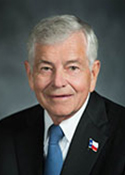
Rep. Tom Craddick
Sponsored bills
Maddy summarySB 2 allows justices of the peace in counties without medical examiners to skip autopsies for deaths caused by natural disasters (like hurricanes or floods), provided they confirm: 1) the death resulted from disaster injuries, 2) no unlawful act caused it, and 3) no family member is seeking an autopsy. It requires the state to create a training program for these justices on managing mass fatality events, including autopsy decisions, body documentation, and coordinating with agencies. The law expires April 1, 2027, and directly affects local officials handling disaster-related deaths in rural counties. The bill does not impose licensing or fees, as implied in its title but not reflected in the actual text.
Maddy summaryHB 298 creates a rule for when Texas state legislators lose their seats due to missing sessions. If a senator or representative misses 14 unexcused floor sessions during a regular legislative session (or 3 during a special session) without majority approval from their chamber, their seat becomes vacant. This applies only to absences occurring after the bill’s effective date and does not affect existing terms. The bill directly affects legislators who fail to attend sessions without valid justification approved by their chamber’s majority.
Maddy summaryHB 291 requires Texas medical schools to ensure at least 50% of required coursework for medical degrees uses letter grades (A-F) or equivalent tiered systems for assessment. It prohibits medical schools from using standardized test scores as the sole factor in admissions decisions and mandates that schools must notify the legislature and Texas Higher Education Coordinating Board before revising admission or academic standards. The bill also explicitly prohibits medical schools from considering race, sex, color, ethnicity, or national origin in admissions or employment decisions. These provisions apply to all medical schools in Texas offering medical degrees or certificates.
Maddy summaryHB 5 allocates $324 million in supplemental funds from Texas' economic stabilization fund for disaster relief and preparedness. It provides $200 million to match federal disaster aid and support state disaster funds, $50 million for flood warning systems and equipment in 27 counties affected by a July 2025 flood declaration, and $24 million to improve weather forecasting and flood management in the Texas Hill Country. An additional $50 million is contingent on passing related legislation about emergency communication systems. The bill directly affects local governments in designated counties and state agencies managing disaster response.
Maddy summaryHB 2 requires justices of the peace in counties without a medical examiner to complete training on managing mass fatality events within one year of election. The training covers autopsy decisions, body identification protocols, missing persons data collection, interagency coordination, and real-time family notifications. Failure to complete this training is defined as "incompetency" for removal under local government law. The bill also allows the Texas Commission on Fire Protection to access criminal history records for license applicants and employees while restricting disclosure of that information. It authorizes fees related to these requirements.
Maddy summaryHB 226 requires youth camp operators in Texas to provide each camper with an active radio frequency identification (RFID) tag capable of tracking location if a camper goes missing or during severe weather/disasters. The bill directly affects youth camp operators and requires them to obtain written consent from a camper’s parent or legal guardian before issuing a tag. Key provisions include mandating the tags for emergency location tracking, prohibiting their use without parental consent, and directing the health commissioner to adopt implementing rules. The bill does not require ongoing tracking but only activates the tag during specific emergency scenarios.
Maddy summaryHB 64 creates a rule that Texas state senators and representatives lose their seats if absent from all legislative proceedings without approved leave for seven consecutive days when their house is in session. This provision directly affects legislators who miss sessions without permission, triggering an immediate vacancy. The bill specifies that the absence must occur during days the house is meeting, not just calendar days. It would take effect immediately if passed with a two-thirds vote, otherwise 91 days after the legislative session ends.
Maddy summaryHB 228 prohibits state-funded entities from using public money for lobbying activities. It directly affects local governments and private organizations that receive state funds, banning them from paying for: (1) their own lobbying expenses, (2) registered lobbyists, (3) related entities of registered lobbyists, or (4) firms hired to influence legislation or policy. The bill amends Texas Government Code Section 556.0055 to enforce these restrictions, applying to expenditures made on or after its effective date. This policy change clarifies that state funds cannot support efforts to sway government decisions.
Maddy summaryHB 214, the Texas Women's Privacy Act, requires certain facilities like restrooms, locker rooms, and shelters to be designated for use based on biological sex (male or female). It directly affects correctional facilities, family violence shelters, institutions of higher education, and political subdivisions (e.g., cities, school districts). The bill prohibits the use of multiple-occupancy private spaces (like shared restrooms) by individuals whose biological sex differs from the space’s designated sex, while allowing single-occupancy spaces for individual use. Violations may result in civil penalties or private lawsuits for affected individuals.