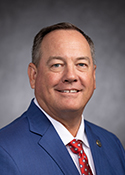
Photo of Jeff Barry
R Texas House · District 29 On the 2026 ballot

Rep. Jeff Barry

Compare
Total votes
3,724
all sessions
Attendance
98%
66 missed
Higher than 75% of chamber peers
With party
91%
of cast votes
Lower than 79% of chamber peers
Bipartisan score
5%
crosses aisle rarely
Higher than 81% of chamber peers
Sponsored
188
bills & resolutions
Near the chamber average
Committees
3
assignments
188 bills and resolutions

Sponsored bills

Total
188
Primary
55
Co-sponsor
133
This page
188
matching current filters
Co-sponsor HB 265
Passed · Texas House · Co-sponsor
Relating to governmental oversight of youth camps, including youth camp rules, duties, and the advisory committee.

Maddy summaryHB 265 strengthens Texas youth camp oversight by requiring the health department to review camp safety rules by April 2026, in consultation with a newly structured advisory committee. The committee must include nine members representing emergency management, law enforcement, pediatric care, child psychology, abuse prevention, camp operators, parents, and geographic diversity. The bill mandates camp operators to provide safe facilities and conduct annual criminal background checks on staff, including sex offender database verification. These provisions directly affect youth camp operators, staff, and campers by establishing clearer safety standards and oversight mechanisms.

Passed Sep 2, 2025 1 co-sponsor
Co-sponsor HB 295
In committee · Texas House · Co-sponsor
Relating to election procedures regarding accepting a voter with a residence address that is not current and the immediate effect of a voter's registration after the registrar's receipt of certain change of address notices.

Maddy summaryHB 295 changes Texas election rules for voters who move within their county but haven't updated their registration. It allows voters to cast ballots in their current precinct immediately after submitting a statement verifying their new address and meeting residency requirements, instead of waiting 30 days for registration changes to take effect. The bill requires voters to provide the same information needed for initial registration, including their current address and a statement confirming they reside in the precinct. This applies only to address change notices submitted after the bill's effective date. The law affects voters who relocate within their county but haven't updated their registration records.

In committee Aug 28, 2025 1 co-sponsor
Co-sponsor HB 308
Introduced · Texas House · Co-sponsor
Relating to creating the criminal offense of trespass on or near school or day-care center property.

Maddy summaryHB 308 creates a new criminal offense for trespassing on or near school or day-care center property. It applies to individuals who enter school property or remain within 250 feet of it if their conduct is disruptive, threatening, or harassing to students, staff, or school operations, and they lack a valid reason (like custody) or written permission from the school. The law requires that the person ignores a reasonable request to leave from school staff before being charged. Violating this law is classified as a Class A misdemeanor, punishable by up to one year in jail and a fine. The bill specifically targets disruptive behavior near schools, not general trespassing.

Introduced Aug 28, 2025 1 co-sponsor
Co-sponsor HB 3
Passed · Texas House · Co-sponsor
Relating to the interoperability of emergency communication equipment and infrastructure in this state, including the creation and operation of the Texas Interoperability Council, a grant program administered by the council, and the purchase of certain public safety radio communication systems.

Maddy summaryHB 3 establishes the Texas Interoperability Council to coordinate statewide emergency communication systems, ensuring police, fire, and medical responders can communicate during crises. The bill creates a grant program administered by the council to help local governments (cities, counties, and emergency districts) purchase interoperable radio equipment and build compatible infrastructure. Key provisions require the council to develop a strategic plan for emergency communications and prioritize funding for equipment that works across different agencies. This directly affects local public safety agencies by mandating new communication standards and providing financial support for system upgrades.

Passed Aug 27, 2025 1 co-sponsor
Co-sponsor SB 2
Passed · Texas Senate · Co-sponsor
Relating to disaster preparedness, response, and recovery; requiring a license; authorizing fees.

Maddy summarySB 2 allows justices of the peace in counties without medical examiners to skip autopsies for deaths caused by natural disasters (like hurricanes or floods), provided they confirm: 1) the death resulted from disaster injuries, 2) no unlawful act caused it, and 3) no family member is seeking an autopsy. It requires the state to create a training program for these justices on managing mass fatality events, including autopsy decisions, body documentation, and coordinating with agencies. The law expires April 1, 2027, and directly affects local officials handling disaster-related deaths in rural counties. The bill does not impose licensing or fees, as implied in its title but not reflected in the actual text.

Passed Aug 27, 2025 1 co-sponsor
Co-sponsor HB 48
Passed · Texas House · Co-sponsor
Relating to the creation of a working group to study alert notification systems.

Maddy summaryHB 48 creates a nine-member working group under the Texas Division of Emergency Management to study the state's alert notification systems. The group will evaluate current systems used by the Texas Department of Public Safety and emergency management, including how "notification fatigue" (reducing unnecessary alerts that cause people to ignore them) affects their effectiveness. The working group must hold hearings, consult with federal agencies, and submit a report with legislative recommendations by December 1, 2026. The working group expires on January 1, 2027, after completing its study.

Passed Aug 27, 2025 1 co-sponsor
Co-sponsor HJR 10
In committee · Texas House · Co-sponsor
Proposing a constitutional amendment relating to the determination of a quorum of the senate or house of representatives.

Maddy summaryHJR 10 proposes amending the Texas Constitution to change the quorum requirement for the Texas Senate or House of Representatives from two-thirds to a simple majority of members. This would allow legislative business to proceed with fewer members present, directly affecting how both chambers conduct sessions and pass legislation. The amendment must be approved by Texas voters in a May 2, 2026, election, with the ballot asking whether "a majority of the members" should constitute a quorum. If passed, this change would alter a core procedural rule governing legislative operations.

In committee Aug 26, 2025 1 co-sponsor
Co-sponsor HB 298
In committee · Texas House · Co-sponsor
Relating to a vacancy in the office of senator or representative due to excessive absence.

Maddy summaryHB 298 creates a rule for when Texas state legislators lose their seats due to missing sessions. If a senator or representative misses 14 unexcused floor sessions during a regular legislative session (or 3 during a special session) without majority approval from their chamber, their seat becomes vacant. This applies only to absences occurring after the bill’s effective date and does not affect existing terms. The bill directly affects legislators who fail to attend sessions without valid justification approved by their chamber’s majority.

In committee Aug 26, 2025 1 co-sponsor
Co-sponsor HB 66
In committee · Texas House · Co-sponsor
Relating to the creation of the disaster relief and prevention matching grant and loan program and the disaster relief and prevention account.

Maddy summaryHB 66 creates a Texas Disaster Relief and Prevention Matching Grant and Loan Program, funded through a new state account. It provides matching grants to local governments and businesses in declared disaster areas for disaster recovery, infrastructure repairs, and future disaster mitigation. The bill also authorizes loans for these entities and for individuals to repair or rebuild disaster-damaged homes with added mitigation features. Eligibility requires applicants to qualify for FEMA public assistance or SBA disaster loans.

In committee Aug 22, 2025 1 co-sponsor
Co-sponsor HB 291
Introduced · Texas House · Co-sponsor
Relating to medical school admissions, coursework, academic standards, and employment decisions in this state.

Maddy summaryHB 291 requires Texas medical schools to ensure at least 50% of required coursework for medical degrees uses letter grades (A-F) or equivalent tiered systems for assessment. It prohibits medical schools from using standardized test scores as the sole factor in admissions decisions and mandates that schools must notify the legislature and Texas Higher Education Coordinating Board before revising admission or academic standards. The bill also explicitly prohibits medical schools from considering race, sex, color, ethnicity, or national origin in admissions or employment decisions. These provisions apply to all medical schools in Texas offering medical degrees or certificates.

Introduced Aug 22, 2025 1 co-sponsor
Showing 11 to 20 of 188 bills