

Maddy summaryThis bill amends the Public Safety Officers' Benefit Program to improve processing of claims for officers injured or killed in the line of duty. It establishes clear timelines for the Bureau to notify claimants about missing information (90 days) and make determinations (270 days), with automatic interim benefits issued if deadlines aren't met. The bill requires regular outreach to public safety officers and underserved agencies, mandates annual audits of backlogged claims, and strengthens subpoena authority to obtain necessary information. It also creates a pathway for expedited processing when claims are approved by the 9/11 Victim Compensation Fund or World Trade Center Health Program. The bill does not change benefit amounts but aims to make the claims process more efficient and transparent for public safety officers and their families.
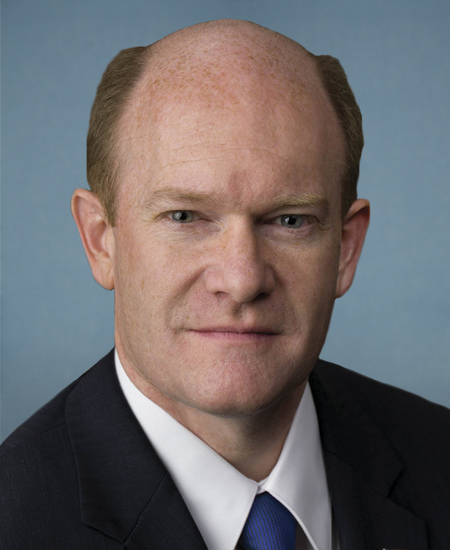
Sen. Christopher A. Coons
Sponsored bills
Maddy summaryThis bill establishes the "INCLUDE Project" at the National Institutes of Health (NIH) to advance research on Down syndrome. It directs NIH to coordinate and expand research into co-occurring health conditions (like Alzheimer's, heart disease, and autoimmune disorders) affecting individuals with Down syndrome, while avoiding duplication of existing efforts. The law requires NIH to build large study populations, support inclusive clinical trials, identify biomarkers, and improve quality of life for people with Down syndrome and their families. NIH must submit biennial reports to Congress detailing research progress and findings. The bill directly affects NIH research programs and future medical care for people with Down syndrome.
National Plan for Epilepsy Act This bill requires the Department of Health and Human Services (HHS) to establish a national plan, form an advisory council, and take other actions to address epilepsy. The requirements sunset on December 31, 2035. Specifically, the bill requires HHS to carry out a National Plan for Epilepsy to prevent, diagnose, treat, and cure epilepsy. In carrying out the plan, HHS must implement activities such as coordinating research and services across all federal agencies and soliciting public comments. Also, HHS must establish an Advisory Council on Epilepsy Research, Care, and Services. The advisory council must report to HHS and Congress every two years with an evaluation of federally funded efforts. Additionally, HHS must annually report to Congress with recommended actions based on its assessments of the nation’s progress on epilepsy.
Maddy summaryThe ARCH Act requires the Secretary of Defense to establish a records preservation program for specific Afghan individuals who served with U.S. forces between 2001 and 2021. This program allows eligible applicants, including former military personnel, intelligence operators, and justice sector officials, to submit applications through a secure online portal to have their service records and biometric data preserved by the Department of Defense. The bill mandates that these records be kept for potential future use by the applicant or their designee, while prohibiting fees for the application process. Applicants who are denied classification based on eligibility or derogatory information are granted the right to file one written appeal and may request to reopen their case to provide additional clarifying information.
Maddy summaryThe INSULIN Act of 2026 requires health insurance plans to limit insulin copayments to $35 per 30-day supply starting in 2027, with plans choosing to cap costs at 25% of the negotiated price after 2028. The bill also mandates that pharmacy benefit managers pass all rebates and discounts related to insulin directly to health plans rather than retaining them. Additional provisions include measures to speed up the approval process for generic and biosimilar insulin products, establish a pilot program to provide affordable insulin to uninsured individuals in 10 states, and create a resource center and hotline to help uninsured people access assistance programs.
Maddy summaryThis joint resolution directs the President to withdraw U.S. Armed Forces from hostilities against Iran that were not authorized by Congress. The bill relies on the War Powers Resolution, asserting that military action in Iran began without a formal declaration of war or specific statutory approval and has exceeded the legal time limits for such engagement. While ordering a removal of troops, the measure allows the United States to continue defending against attacks on its own personnel, conducting intelligence activities, and providing defensive support to partner nations.
Maddy summaryThis resolution designates the week of August 22 through August 30, 2026, as "National Park Week." It directly affects the public by encouraging responsible visits and support for the National Park System, which includes parks, battlefields, and historical sites located across the United States and its territories. The measure serves as a formal declaration to highlight the parks' role in recreation, education, and economic activity without altering any laws or funding.
Maddy summaryThe TABOO Act requires all individuals serving as special envoys or representatives to foreign governments to comply with standard federal ethics rules, including financial disclosure and conflict-of-interest laws, regardless of whether they are paid or working in a volunteer capacity. Individuals in these roles must confirm within 30 days that they have no financial interests in the countries they represent, or place existing interests in blind trusts, and agree to avoid new such interests for one year after leaving their position. Federal agencies must submit quarterly lists of these officials to Congress, detailing their duties and the foreign entities they engage with. Violations can result in criminal penalties, loss of government support services, suspension from duties, and delays in the confirmation process for future nominees.
Maddy summaryThe Back-to-School Supplies Affordability Act prevents new tariffs from being applied to specific school supplies and educational materials, ensuring their prices remain at levels seen before January 19, 2025. This legislation directly affects students, families, teachers, and schools by exempting items such as notebooks, backpacks, pencils, pens, and certain electronic devices from increased import duties. The Secretary of Commerce is tasked with designating additional classroom items for this exemption in coordination with the Secretary of Education, while providing regular reports to Congress on the covered products. To maintain legislative oversight, the bill includes a mechanism allowing Congress to pass a joint resolution to disapprove any specific item designated for tariff exemption by the executive branch.
Maddy summaryThe Protect American Values Act of 2026 prohibits the use of federal funds to implement or enforce a specific Department of Homeland Security rule regarding the "Public Charge" ground of inadmissibility. This legislation directly affects immigrants and their families by preventing the government from using financial resources to carry out policies that could restrict access to essential services like food, medical care, and housing. The bill includes a statement of congressional intent arguing that the targeted rule would harm community health, increase poverty, and circumvent established immigration laws. By blocking funding for this specific regulatory action, the act aims to maintain current eligibility standards for public assistance without altering the underlying statutory framework.