This resolution establishes procedures for access to the Senate floor, including requiring entrance through cloakrooms and limiting staff access, during impeachment proceedings against former President Donald Trump. Additionally, the resolution limits access to the second floor of the Senate Wing of the Capitol during these proceedings, and it requires the Sergeant at Arms and Doorkeeper of the Senate to enforce these procedures.
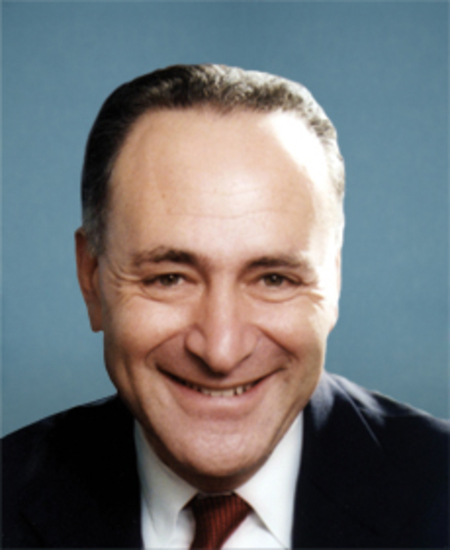
Sen. Charles E. Schumer
Sponsored bills
This resolution requires the Sergeant at Arms and Doorkeeper of the Senate to install appropriate equipment and furniture (e.g., tables and chairs to accommodate managers and counsel) in the Senate chamber for use during the impeachment trial of former President Donald Trump.
This resolution requires that, during impeachment proceedings against former President Donald Trump, the press galleries of the Senate chamber must remain open for members of the press and access to all other galleries shall be available only to Members of Congress. The Sergeant at Arms and Doorkeeper of the Senate must enforce these procedures.
This resolution establishes procedures for laptop computer use on the floor of the Senate chamber and in other rooms of the Senate floor during impeachment proceedings against former President Donald Trump.
This resolution calls on the President to take executive action to cancel up to $50,000 in federal student loan debt for borrowers. Further, it encourages the President to (1) ensure that borrowers have no tax liability from the debt cancellation, (2) ensure that the debt cancellation helps close racial wealth gaps, and (3) pause student loan payments and interest accumulation on federal student loans for the duration of the COVID-19 (i.e., coronavirus disease 2019) pandemic.
This resolution expresses the sense of the Senate that the federal government has a duty to develop a holistic agenda to respond to racial injustice, unemployment, the COVID-19 (i.e., coronavirus disease 2019) pandemic, and climate change. The resolution further outlines the goals of this agenda to build a society with greater racial, economic, and gender justice; dignified work; healthy communities; and a stable climate. Additionally, the resolution identifies efforts to support these goals.
Safe Environment from Countries Under Repression and Emergency Act or the SECURE Act This bill allows qualified nationals of a country that has or had a temporary protected status designation to obtain permanent resident status. Such an alien qualifies for permanent residence if the alien had temporary protected status, qualified for such status on certain dates, or was present in the United States due to having been granted deferred enforced departure status that extended past a certain date; has been continuously present in the United States for three years before applying for adjustment or before being removed after a certain date; is not inadmissible or deportable for certain reasons; and passes applicable background checks. The continuous presence requirement may be waived in certain instances. A spouse, domestic partner, child, or unmarried child of a qualifying alien may also obtain permanent resident status under the bill upon meeting certain requirements. An alien with a pending application shall receive work authorization and be eligible for travel authorization. An alien may not be removed if the alien (1) has a pending application, or (2) is prima facie eligible for permanent resident status under this bill and intends to apply. Information from applications may not be used or shared for immigration enforcement, with limited exceptions such as for identifying fraudulent claims. The Department of Homeland Security must report to Congress when terminating a country's temporary protected status designation with an explanation justifying the termination.
Child and Dependent Care Tax Credit Enhancement Act of 2021 This bill modifies the tax credit for employment-related expenses incurred for the care of a taxpayer's dependent to (1) increase to $400,000, the adjusted gross income threshold level above which the credit is incrementally reduced; (2) increase the dollar limits on the allowable amount of the credit; (3) specify rules for married couples filing separate returns; (4) allow an inflation adjustment to the adjusted gross income threshold and the maximum credit amounts, beginning after 2022; and (5) make the credit refundable.
American Opportunity Accounts Act This bill establishes tax-exempt American Opportunity Accounts to provide children at birth with a $1,000 savings account with annual contributions up to $2,000 depending on family income. The accounts are available to children at age 18 for specified purposes, including educational expenses, home ownership, and investment that provides long-term returns.
Family and Medical Insurance Leave Act or the FAMILY Act This bill entitles every employee to a family and medical leave insurance (FMLI) monthly benefit payment of two-thirds of the employee's regular pay, limited to a maximum of $4,000, for not more than 60 days of qualified caregiving. The bill establishes the Office of Paid Family and Medical Leave within the Social Security Administration to administer the FMLI program. An FMLI benefit payment must be coordinated with any periodic benefits received under a state or local temporary disability insurance or family leave program. The bill imposes a tax on employers, employees, and self-employed individuals to fund FMLI benefits. It also establishes the Federal Family and Medical Leave Insurance Trust Fund to hold tax revenues.