Emergency Water Infrastructure Improvements Act of 2021 This bill provides financial support for water infrastructure. Specifically, the bill provides appropriations to the Environmental Protection Agency for grants under the drinking water state revolving fund program to address contaminants in drinking water, which may include the repair and replacement of water distribution system components. Additionally, the bill directs the Department of Commerce to provide a specified amount of funding to address contaminants in drinking water from unobligated amounts of certain funds provided for economic development assistance programs.
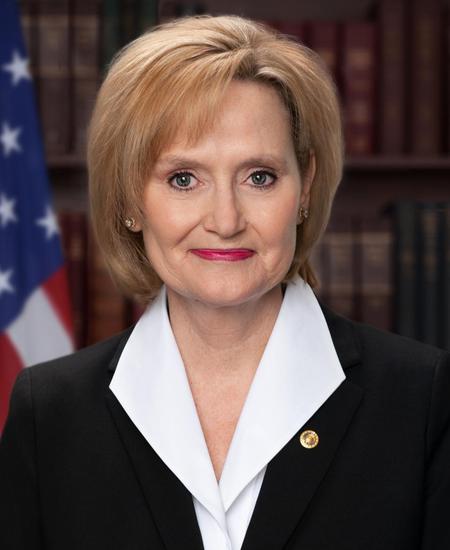
Sen. Cindy Hyde-Smith
Sponsored bills
Ensuring Lasting Smiles Act This bill requires private health insurance plans to cover diagnosis and treatment of congenital anomalies and birth defects, such as reconstructive services and items. Coverage must include services and items that functionally improve, repair, or restore any body part that is medically necessary for normal bodily functions or appearance, as determined by the treating physician. Coverage limits and cost-sharing requirements for such services and items may not be more restrictive than those applicable to all medical and surgical benefits under the plan.
This bill waives certain eligibility requirements for hospitals participating in the 340B drug discount program (i.e., a program that allows entities to receive covered outpatient drugs at reduced prices from manufacturers) during the COVID-19 (i.e., coronavirus disease 2019) public health emergency. Specifically, the bill waives the required minimum proportion of low-income patients served for hospitals that began participating in the program during or prior to the COVID-19 emergency.
Protecting Children From Experimentation Act of 2021 This bill establishes a new criminal offense for performing gender reassignment medical interventions on minors. It also provides that a minor who receives such an intervention may bring a civil action against each person who performed that intervention. The bill defines these interventions as certain surgeries or the use of hormones to change the body of an individual to correspond to a sex that is discordant with the individual's biological sex. It excludes, however, interventions in cases where an individual has ambiguous external biological sex characteristics or where a physician has determined that an individual does not have normal sex chromosome structure, sex steroid hormone production, or sex steroid hormone action. An individual who performs these interventions on a minor is subject to criminal penalties—a fine, a prison term of up to five years, or both. A minor who receives these medical interventions may not be arrested or prosecuted for an offense under this bill.
Executive Branch Emissions Transparency Act This bill requires the Office of Management and Budget to establish and maintain a publicly accessible and searchable database of fossil fuel-powered travel by the President, the Vice President, and political appointees where such travel is on official business or paid for by a third party if the individual is appearing in their official capacity. The bill makes an exception where publishing on the database could be deemed a national security risk.
Combating Global Poverty Through Energy Development Act This bill supports the elimination of restrictions that limit support for certain energy projects at specified international financial institutions. Specifically, the bill requires the Department of the Treasury to instruct the U.S. executive directors of certain financial institutions (e.g., the International Finance Corporation, the International Monetary Fund, and the Inter-American Development Bank) to (1) oppose any restriction or prohibition on the financing of coal, oil, natural gas, or civil nuclear energy projects; and (2) seek to rescind current restrictions or prohibitions on this financing. Further, not more than 50% of amounts made available for the International Bank for Reconstruction and Development may be used until Treasury certifies that the bank (1) has rescinded any restrictions or prohibitions on the financing of coal, oil, natural gas, or civil nuclear energy projects; and (2) has in effect a policy promoting the financing of these projects. Treasury must coordinate with designated agencies to identify steps the United States can take to promote international financing of these energy projects in order to help developing countries access affordable and reliable power.
End Taxpayer Funding of Gender Experimentation Act of 2021 This bill modifies provisions relating to federal funding for, and health insurance coverage of, gender reassignment medical interventions, which include surgical remedies and hormone therapy arising from a conflict between an individual's gender identity and the sex the individual has or was identified as having at birth. Specifically, the bill prohibits the use of federal funds for gender reassignment medical interventions or for health coverage that includes such interventions. Additionally, such interventions may not be provided in a federal health care facility or by a federal employee. Under current law, coverage of these interventions through Medicare and Medicaid is generally determined at the state level. The bill's restrictions regarding the use of federal funds do not apply to treatment of individuals with medically verifiable disorders of sex development, such as individuals born with atypical development of chromosomal, gonadal, or anatomical sex. The bill also prohibits qualified health plans from including coverage for gender reassignment medical interventions. Further, plans that include coverage for such interventions are not eligible for federal subsidies.
Gun Owner Registration Information Protection Act This bill prohibits federal funding of, or support for, state databases that list (1) firearms lawfully owned or possessed by individuals, or (2) individuals who lawfully own or possess firearms.
English Language Unity Act of 2021 This bill establishes English as the official language of the United States. It establishes a framework for implementation and enforcement, including by testing English as part of the naturalization process.
Developing Responsible Individuals for a Vibrant Economy Act or the DRIVE Safe Act This bill directs the Department of Transportation to promulgate regulations to implement an apprenticeship program for licensed commercial motor vehicle drivers under the age of 21. Under the program, an apprentice must complete two probationary periods that total 400 hours of on-duty time, of which at least 240 hours must be driving time in a commercial motor vehicle. Additionally, the apprentice must be accompanied in the cab of the commercial motor vehicle by an experienced driver. Further, the bill requires all commercial motor vehicles used in the program for training to be equipped with safety technology such as active braking collision mitigation systems and video event capturing systems. An employer shall not knowingly allow, require, permit, or authorize a driver under the age of 21 to operate a commercial motor vehicle unless the driver is participating in, or has completed, an apprenticeship program that meets the requirements set forth in this bill.