

Maddy summaryHR 82, the Social Security Fairness Act of 2023, repeals two provisions that reduce Social Security benefits for certain government workers. It eliminates the Government Pension Offset (GPO), which cuts spousal or survivor benefits for people with pensions from jobs not covered by Social Security (like federal or state government roles), and the Windfall Elimination Provision (WEP), which lowers retirement benefits for those with similar pensions. The law takes effect for benefits paid after December 2023, requiring the Social Security Administration to adjust benefit calculations to remove these reductions. This change directly affects public-sector employees who previously had their Social Security benefits reduced due to their government pensions.
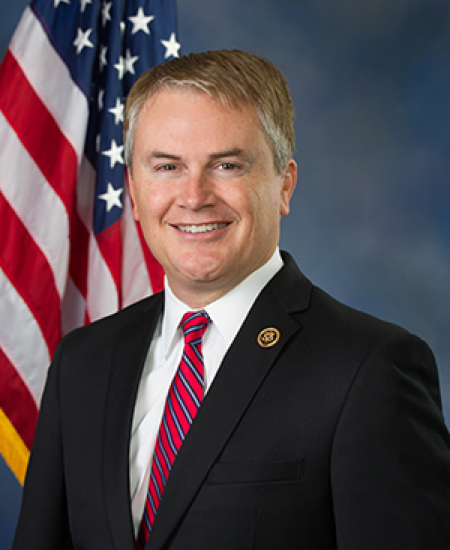
Rep. James Comer
Sponsored bills
Maddy summaryThis bill designates the U.S. Postal Service facility at 340 South Loudon Avenue in Baltimore, Maryland, as the "United States Representative Elijah E. Cummings Post Office Building." It updates all federal references in laws, documents, and records to reflect this new name. The bill honors former U.S. Representative Elijah E. Cummings (D-MD), who served from 2007 until his passing in 2019, and became law on January 4, 2025.
Maddy summaryHR 163, the "Finish the Wall Act," mandates the immediate resumption of border wall construction along the U.S.-Mexico border within 24 hours of enactment. It requires the Department of Homeland Security to use all existing funds appropriated since 2016 for this purpose, prohibits canceling pre-January 2021 contracts, and sets a deadline of September 30, 2026, to complete the wall system. The bill directly affects the Department of Homeland Security, contractors with prior wall contracts, and border facilities, which must also comply with DNA collection requirements under federal law. It focuses on concrete policy actions - resuming construction, using existing funds, and meeting a specific timeline - without addressing broader policy impacts.
Maddy summaryHR 45 (FIND Act) requires federal government contractors to certify they do not discriminate against firearm businesses (including manufacturers, dealers, and trade associations) in their policies or practices. The bill mandates that contractors and subcontractors (for contracts over 10% of the prime contract value) certify they have no discriminatory policies and will not adopt them during the contract term. Violations could lead to contract termination and potential debarment. This applies to all federal procurement contracts awarded after the bill's enactment, excluding sole-source contracts. The law aims to ensure firearm businesses are treated equally in government contracting without restricting legitimate business criteria like creditworthiness or legal compliance.
Maddy summaryThe Federal Information Security Modernization Act of 2024 modernizes federal cybersecurity by requiring agencies to implement continuous security risk assessments, adopt zero trust architecture, and conduct regular penetration testing. It establishes new requirements for agencies to report major incidents to Congress within 72 hours and notify affected individuals within 45 days of discovering a breach. The bill creates a new Federal Chief Information Security Officer position to oversee agency cybersecurity efforts and coordinates with the National Cyber Director. It also mandates improved information sharing between agencies and the Cybersecurity and Infrastructure Security Agency (CISA), along with enhanced vulnerability disclosure processes for contractors and awardees.
Maddy summaryHR 7867, the REG Budgeting Act of 2024, establishes annual budget limits on "unfunded regulatory costs" that federal agencies can impose on state/local governments or businesses through new rules. The Office of Management and Budget (OMB) must set these limits by September 30 each year, requiring agencies to seek congressional approval before finalizing rules that exceed their allocated limit. Agencies must also submit detailed justifications and report on cost overruns to Congress and publish notices with specific cost impact statements. This bill directly affects all federal agencies issuing regulations with cost implications for external entities, adding new transparency and approval steps to the rulemaking process.
Maddy summaryThis bill establishes federal governance requirements for artificial intelligence systems used by government agencies. It requires agencies to create detailed AI governance charters for high-risk systems, including information about development, training data, and how the system is used. Agencies must provide plain language notifications to individuals affected by AI-driven decisions and maintain public inventories of AI systems through a Federal AI System Inventory. The bill creates a new oversight role within the Office of Management and Budget and mandates regular evaluations of agency AI governance practices. These requirements apply to all federal agencies and their contractors using AI systems that make decisions affecting individuals.
Maddy summaryThe White Oak Resilience Act establishes a voluntary coalition of federal agencies, states, private groups, and landowners to coordinate nationwide efforts restoring white oak forests. It creates a "White Oak Restoration Initiative Coalition" to address policy barriers, recommend improvements, and coordinate cross-boundary projects, while directing the USDA and Interior Departments to conduct assessments and launch 5 pilot restoration projects on federal lands. The bill also creates a dedicated fund through the National Forest Foundation to support white oak reforestation, nursery expansion, and seedling research, and requires a national strategy to address tree seedling shortages affecting restoration. This primarily affects federal land managers, private forest landowners, and tree nurseries by streamlining existing resources to improve white oak regeneration and resilience.
Maddy summaryHR 4428, the Guidance Clarity Act, requires federal agencies to include a specific statement on all guidance documents they issue. This statement must clearly state that the document has no legal force, does not bind the public or the agency, and is only for clarifying existing laws or policies. Agencies must display this statement prominently on the first page of such guidance, effective 30 days after the Office of Management and Budget issues implementing instructions. The bill directly affects federal agencies and the public receiving these documents, ensuring transparency about the non-binding nature of agency guidance.
Maddy summaryThe FOCA Act of 2023 requires federal agencies to stop mandating or banning contractor agreements with labor organizations (like union contracts) in construction project bids and contracts. It directly affects federal contractors, subcontractors, and agencies managing construction projects funded by the government. The bill prohibits favoring or penalizing contractors based on their labor affiliation status, aiming to promote fair competition and reduce costs. It also mandates updates to federal contracting rules within 60 days of enactment to implement these changes.