Maddy summarySRES 229 is a procedural Senate resolution authorizing the Committee on Foreign Relations to share specific records with the Department of Justice. It directly affects the Foreign Relations Committee and the Department of Justice by permitting them to provide records related to a panel discussion attended by committee staff. These records are needed for the court case *United States v. Peter Biar Ajak* (CR-24-00394-PHX-SPL) pending in Arizona federal court. The resolution allows the committee chair and ranking member to release these records without violating Senate privileges, as required by Senate Rule XI. This is a limited, case-specific authorization with no broader policy changes.
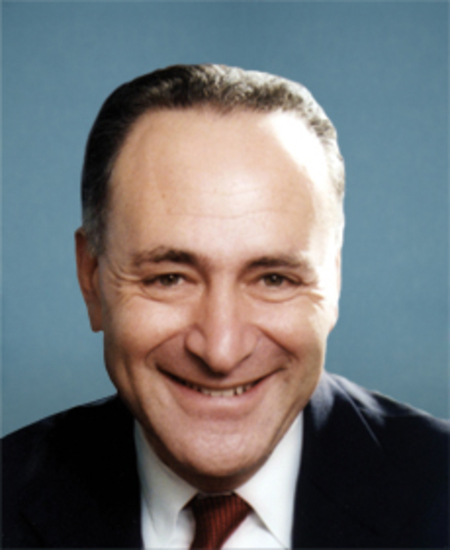
Sen. Charles E. Schumer
Sponsored bills
Maddy summarySRES 218 is a non-binding Senate resolution condemning the acceptance of presidential aircraft or other substantial gifts from foreign governments. It states such acceptance poses national security risks (citing Air Force One’s sensitive technology) and violates the Constitution’s Foreign Emoluments Clause, which requires congressional consent for presidential gifts from foreign states. The resolution demands that any such gift must have explicit congressional approval and urges rejecting foreign aircraft that don’t meet U.S. defense security standards. It applies to the President and sets a procedural expectation, not a new law, emphasizing constitutional compliance and public trust.
Maddy summaryThis resolution (SRES 224) calls for urgent U.S. diplomatic action to address the severe humanitarian crisis in Gaza, where approximately 2.2 million civilians face acute hunger and malnutrition, including 10,000 children identified with acute malnutrition since January 2025. It highlights that Gaza’s borders have been blocked since March 2, 2025, preventing entry of food, medicine, and other lifesaving aid, leading to closed bakeries and exhausted food rations. The Senate resolution specifically urges the White House and State Department to use all available diplomatic tools to end the blockade, secure hostage releases, and achieve a durable conflict resolution. As a non-binding resolution, it does not enact law but formally expresses the Senate’s concern and directs executive branch action.
Maddy summaryThe Truth in Tariffs Act (S 1741) requires most businesses selling goods to U.S. consumers to clearly display the portion of a product's price attributable to new tariffs (specifically tariffs imposed after January 20, 2025) as a separate "tariff surcharge." It exempts small businesses (as defined by the Small Business Act) from this requirement. The Federal Trade Commission (FTC) will enforce this rule under its existing authority, treating violations as unfair or deceptive practices under the FTC Act. This law directly affects retailers and manufacturers selling consumer goods, aiming to make tariff costs transparent to shoppers.
Maddy summaryS 1705, the Chip Security Act, requires U.S. companies exporting specific advanced integrated circuits (used in AI systems and high-performance computing) to install location verification technology before shipping them abroad. It directly affects manufacturers and exporters of chips classified under U.S. export control numbers like 3A090 or 4A090. The bill mandates that these chips include security mechanisms to verify their location and prevent diversion or tampering, with companies needing to report suspicious activity like unauthorized location changes. The Commerce Secretary must implement these requirements within 180 days and conduct annual assessments to update security standards. This aims to strengthen compliance with export laws and protect national security by securing chip supply chains.
Maddy summaryS 1668 prohibits senior U.S. government officials - including the President, Vice President, Members of Congress, and Senate-confirmed appointees - from issuing, sponsoring, or endorsing cryptocurrencies, tokens, or stablecoins for profit. It also bans acquiring similar financial interests through derivatives or investment funds, while allowing normal public market trading. Violations face civil penalties of up to 10% of the financial interest's value or profits gained, and criminal charges if losses exceed $1 million or personal financial gain occurs. The law applies during official service and for one year after leaving office.
This joint resolution terminates the national emergency declared by President Donald J. Trump on April 2, 2025, which imposed a 10% tariff on most imports to the United States and additional duties on specified trading partners.
This bill increases the annual limit on the tax credit for qualified railroad track maintenance expenses (also referred to as the short line railroad tax credit) and expands eligibility for claiming the credit. Under current law, the tax credit is limited each tax year to $3,500 multiplied by the sum of the number of miles of railroad track owned or leased by the taxpayer (miles owned or leased) and the number of railroad track miles assigned to the taxpayer by a Class II or III railroad (miles assigned). This bill increases the annual limit to $6,100 multiplied by the sum of miles owned or leased and miles assigned. The $6,100 amount used in the calculation of the tax credit limit is adjusted for inflation for tax years beginning after 2025. The bill also expands eligibility for the tax credit to include gross expenses for maintaining railroad tracks owned or leased as of January 1, 2024. Under current law, the tax credit is limited to gross expenses for maintaining railroad tracks owned or leased as of January 1, 2015.
Assault Weapons Ban of 2025 This bill makes it a crime to knowingly import, sell, manufacture, transfer, or possess a semiautomatic assault weapon (SAW) or large capacity ammunition feeding device (LCAFD). The prohibition does not apply to a firearm that is (1) manually operated by bolt, pump, lever, or slide action, except for certain shotguns; (2) permanently inoperable; (3) an antique; (4) only capable of firing rimfire ammunition; or (5) a rifle or shotgun specifically identified by make and model. The bill also exempts from the prohibition the following, with respect to a SAW or LCAFD: importation, sale, manufacture, transfer, or possession related to certain law enforcement efforts, or authorized tests or experiments; importation, sale, transfer, or possession related to securing nuclear materials; and possession by a retired law enforcement officer. The bill permits continued possession, sale, or transfer of a grandfathered SAW, which must be securely stored. A licensed gun dealer must conduct a background check prior to the sale or transfer of a grandfathered SAW between private parties. The bill permits continued possession of, but prohibits sale or transfer of, a grandfathered LCAFD. Newly manufactured LCAFDs must display serial number identification. Newly manufactured SAWs and LCAFDs must display the date of manufacture. The bill also allows a state or local government to use Edward Byrne Memorial Justice Assistance Grant Program funds to compensate individuals who surrender a SAW or LCAFD under a buy-back program.
Maddy summaryThis bill directs the Department of Education to use the International Holocaust Remembrance Alliance (IHRA) definition of antisemitism when reviewing discrimination complaints under Title VI of the Civil Rights Act. It specifically applies to cases involving discrimination based on Jewish ancestry or ethnic characteristics in schools and programs receiving federal funding. The bill clarifies that this guidance does not expand the Department’s authority, alter existing discrimination standards, or affect First Amendment rights. It aims to ensure consistent enforcement against antisemitism in federally funded education settings, building on existing Department practices since 2019.