Electronic Service for Effectiveness, Reduction of Violence, and Improved Court Efficiency Act of 2021 or the E-SERVICE Act This bill requires the Department of Justice to award demonstration grants to certain state or tribal courts to implement a program for properly and legally serving protection orders electronically. Courts that receive these grants must be part of a multidisciplinary partnership of government entities and various domestic violence stakeholders.
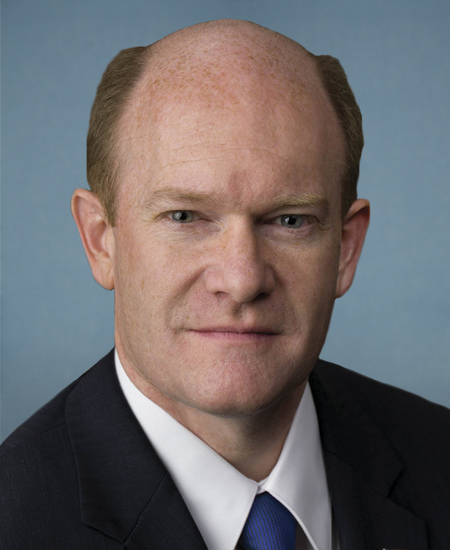
Sen. Christopher A. Coons
Sponsored bills
Fair Day in Court for Kids Act of 2021 This bill provides legal protections for a noncitizen (i.e., an individual referred to as an alien in federal law) who is detained or subject to immigration-related proceedings. The Department of Justice (DOJ), or the Department of Health and Human Services (HHS) in a case involving an unaccompanied child, may appoint or provide counsel at the government's expense to noncitizens in removal proceedings and related appeals. An unaccompanied child must be represented by counsel paid for and appointed by the government at every stage of such proceedings unless the child has obtained counsel at their own expense. If HHS fails to provide counsel to an unaccompanied child, the deadline for filing a motion to reopen a proceeding shall not apply, and the filing of such a motion shall stay the child's removal from the United States. The Department of Homeland Security (DHS) must provide a complete copy of a noncitizen's immigration file to the noncitizen (or the noncitizen's counsel) within seven days of a notice to appear for an immigration proceeding, and failure to provide the file shall result in a delay in the proceeding. DHS must provide access to counsel for all detained noncitizens. The bill authorizes HHS to enter into contacts or award grants for providing immigration-related legal services to children. The Office of Refugee Resettlement must develop model guidelines for representing noncitizen children in immigration proceedings.
Department of State, Foreign Operations, and Related Programs Appropriations Act, 2022 This bill provides FY2022 appropriations for the Department of State, foreign operations, and related programs. The bill provides appropriations to the State Department for Administration of Foreign Affairs, International Organizations, and International Commissions. The bill provides appropriations for related agencies and programs, including the U.S. Agency for Global Media, the Asia Foundation, the U.S. Institute of Peace, the Center for Middle Eastern-Western Dialogue Trust Fund, the Eisenhower Exchange Fellowship Program, the Israeli Arab Scholarship Program, the East-West Center, and the National Endowment for Democracy. The bill provides appropriations for other commissions, including the Commission for the Preservation of America's Heritage Abroad, the U.S. Commission on International Religious Freedom, the Commission on Security and Cooperation in Europe, the Congressional-Executive Commission on the People's Republic of China, and the U.S.-China Economic and Security Review Commission. The bill provides appropriations to the U.S. Agency for International Development (USAID), the State Department and the President for International Security Assistance, and the President and International Financial Institutions for Multilateral Assistance. The bill provides appropriations for bilateral economic assistance to the President; the State Department; Independent Agencies, including the Peace Corps, the Millennium Challenge Corporation, the Inter-American Foundation, and the U.S. African Development Foundation; and the Department of the Treasury. The bill provides appropriations for export and investment assistance to the Export-Import Bank of the United States, the U.S. International Development Finance Corporation, and the U.S. Trade and Development Agency. The bill sets forth requirements and restrictions for using funds provided by this and other appropriations acts.
Inspector General Access Act of 2021 This bill transfers responsibility for investigating certain allegations of misconduct from the Department of Justice (DOJ) Office of Professional Responsibility to the DOJ Office of the Inspector General. Specifically, the bill transfers responsibility for allegations relating to a DOJ attorney's authority to investigate, litigate, or provide legal advice.
Improving Seniors' Timely Access to Care Act of 2021 This bill establishes several requirements and standards relating to prior authorization processes under Medicare Advantage (MA) plans. Specifically, MA plans must (1) establish an electronic prior authorization program that meets specified standards, including the ability to provide real-time decisions in response to requests for items and services that are routinely approved; (2) annually publish specified prior authorization information, including the percentage of requests approved and the average response time; and (3) meet other standards, as set by the Centers for Medicare & Medicaid Services, relating to the quality and timeliness of prior authorization determinations.
Military Forces Assuring that Treatment of Items by Gender are Uniform and Equal across the Services Act of 2021 or the Military FATIGUES Act of 2021 This bill requires the Office of the Under Secretary of Defense for Personnel and Readiness within the Department of Defense to establish consistent criteria for determining which uniform or clothing items across the military departments are considered uniquely military for purposes of calculating the standard cash clothing replacement allowance for members of the armed forces. The office must review the established criteria every five years and recommend adjustments to enlisted clothing allowances if they are insufficient to pay for uniquely military items. Additionally, the office must periodically review uniform clothing plans of the military departments to identify data and requirements necessary to facilitate cost discussions and recommend adjustments, items in the military departments' calculations of the enlisted standard cash clothing replacement allowances to develop a standard by which to identify significant cost differences that need addressing, plans of the military departments for changing uniform items to determine if the changes will result in significant out-of-pocket cost differences among the departments or among genders, and initial officer clothing allowances to identify requirements needed to facilitate cost discussions and adjustment recommendations.
Freedom to Vote Act This bill addresses voter registration and voting access, election integrity and security, redistricting, and campaign finance. Specifically, the bill expands voter registration (e.g., automatic and same-day registration) and voting access (e.g., vote-by-mail and early voting). It also limits removing voters from voter rolls. Next, the bill establishes Election Day as a federal holiday. The bill declares that the right of a U.S. citizen to vote in any election for federal office shall not be denied or abridged because that individual has been convicted of a criminal offense unless, at the time of the election, such individual is serving a felony sentence. The bill establishes certain federal criminal offenses related to voting. In particular, the bill establishes a new criminal offense for conduct (or attempted conduct) to corruptly hinder, interfere with, or prevent another person from registering to vote or helping someone register to vote. Additionally, the bill sets forth provisions related to election security, including by requiring states to conduct post-election audits for federal elections. The bill outlines criteria for congressional redistricting and generally prohibits mid-decade redistricting. The bill addresses campaign finance, including by expanding the prohibition on campaign spending by foreign nationals, requiring additional disclosure of campaign-related fundraising and spending, requiring additional disclaimers regarding certain political advertising, and establishing an alternative campaign funding system for certain federal offices.
Revising and Expediting Actions for the Crisis Hotline for Veterans Act or the REACH for Veterans Act This bill requires the Department of Veterans Affairs (VA) to update training and procedures for call responders of the Veterans Crisis Line. Specifically, the VA must enter into an agreement with an outside organization to review the training for crisis line call responders. The VA must update the training if any deficiencies are identified after the review. Among other requirements, the VA must develop guidelines on retraining and quality management for when a call responder has an adverse event or needs improvement, annually perform a common cause analysis for identified callers to the crisis line who died by suicide in situations where the crisis line was the last point of contact, develop enhanced guidance and procedures to respond to calls to the crisis line related to substance use and overdose risk, review the current emergency dispatch standard operating procedure of the crisis line, and solicit feedback from veterans service organizations on how to conduct outreach regarding the move to 988 as the new suicide and mental health crisis hotline. Each call responder must be subject to at least two calls per month that are silently monitored by a supervisor to check for quality of conduct. The Veterans Crisis Line, Office of Mental Health and Suicide Prevention of the VA, and National Center for Patient Safety of the VA must establish quality management processes and expectations for staff of the crisis line.
Veterans Preventive Health Coverage Fairness Act This bill eliminates veterans' copayments for medication, hospital care, and medical services related to preventive health services provided by the Department of Veterans Affairs. The bill expands the definition of preventive health services to include (1) evidence-based items or services that have an A or B rating in the recommendations of the United States Preventive Services Task Force; (2) immunizations that have a recommendation from the Advisory Committee on Immunization Practices of the Centers for Disease Control and Prevention with respect to the individual involved; and (3) with respect to women, the preventive care and screenings provided for in the Health Resources and Services Administration Preventive Services Guidelines in effect as of the date of enactment of this bill.
This resolution supports the designation of October 3-October 9, 2021, as National 4-H Week. It also (1) recognizes the important role of 4-H in youth development and education, and (2) encourages all citizens to recognize 4-H for the significant impact the organization and members have made and continue to make by empowering young people with the skills needed to lead for a lifetime.