

In committee Sep 17, 2026
1 co-sponsor
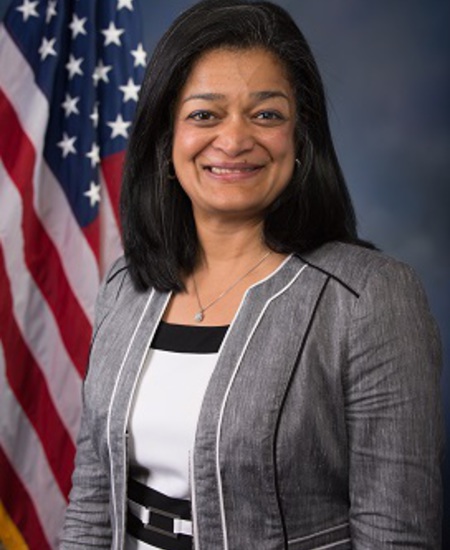
Rep. Pramila Jayapal
Total votes
2,837
all sessions
Attendance
96%
101 missed
Lower than 89% of chamber peers
With party
96%
of cast votes
Near the chamber average
Bipartisan score
2%
crosses aisle rarely
Near the chamber average
Sponsored
1,928
bills & resolutions
Higher than 90% of chamber peers
Committees
7
assignments
1,928 bills and resolutions
Sponsored bills
Total
1,928
Primary
131
Co-sponsor
1,797
This page
1,928
matching current filters
Debt-Free College Act of 2026
Maddy summaryThe Debt-Free College Act of 2026 establishes a state-federal partnership that provides federal grants to states to cover the unmet financial need of eligible students attending in-state public colleges, effectively making tuition debt-free for those who qualify. To participate, states must commit to capping tuition increases at inflation levels, maintaining their current level of funding for higher education, and implementing student success programs that support low-income and underserved populations. The bill also creates a separate five-year grant program for specific minority-serving institutions and tribal colleges to help them cover student costs, while simultaneously expanding federal financial aid eligibility to include "Dreamer students" who entered the United States as minors under certain conditions.
In committee Sep 16, 2026
1 co-sponsor
Food for Thought Act of 2026
Maddy summaryThe Food for Thought Act of 2026 establishes a competitive grant program administered by the Department of Agriculture to provide free meals and snacks to low-income college students at eligible institutions, including community colleges, historically Black colleges and universities, and other minority-serving schools. To qualify, an institution must have at least 20 percent of its undergraduate students eligible for Federal Pell Grants, and grants are awarded for a maximum duration of two years with funds restricted to meal preparation, outreach, and limited equipment purchases. Recipients are required to prioritize students who receive Pell Grants or report food insecurity, while also evaluating institutional policies that may create barriers to enrollment and referring students to other federal benefit programs like SNAP. The bill authorizes appropriations for fiscal years 2027 through 2032 and mandates that the Secretary of Agriculture submit reports to Congress on the program's impact on student retention and completion rates.
In committee Sep 16, 2026
1 co-sponsor
ASAP Act
Maddy summaryThis bill would require Medicare to cover early detection screening tests for Alzheimer's disease and related dementias starting January 1, 2028. It defines eligible tests as FDA-cleared genomic blood tests, blood product analyses, or equivalent medical imaging methods (like protein expression or whole genome sequencing) that detect pre-symptomatic or early-stage conditions. Medicare beneficiaries would receive this coverage without cost-sharing for these specific screenings. The bill amends Medicare coverage rules to explicitly include these tests under Section 1861(nnn) of the Social Security Act.
In committee Sep 16, 2026
1 co-sponsor
Affirming the commitment of the House of Representatives to defend the Fourteenth and Fifteenth Amendments to the Constitution and to oppose efforts to intimidate voters, suppress the vote, or interfere with free and fair elections.
Maddy summaryThis House resolution reaffirms the chamber's commitment to defending the Fourteenth and Fifteenth Amendments by opposing actions perceived as voter intimidation or suppression. It specifically condemns the deployment of armed federal agents or immigration enforcement personnel near polling places and calls on the Department of Homeland Security to confirm that such operations will not occur during the 2026 elections. The bill also opposes the creation of a national database of confidential voter registration information and rejects legislation requiring documentary proof of citizenship for voter registration. Additionally, it supports restoring federal preclearance protections for voting laws and calls on the Speaker of the House to promptly administer oaths of office to duly elected representatives.
In committee Sep 15, 2026
1 co-sponsor
WIC for Kids Act
Maddy summaryThe WIC for Kids Act expands eligibility for the Special Supplemental Nutrition Program for Women, Infants, and Children (WIC) to include children in households receiving Head Start services, food assistance on Indian reservations, or nutrition block grants in Puerto Rico, American Samoa, and the Northern Mariana Islands. The bill extends the standard certification period for WIC-eligible children from one year to two years and allows state agencies to align recertification dates for all eligible family members within a household. Additionally, it requires states to automatically certify infants born to participating mothers without requiring a new application and grants automatic eligibility to children in kinship care arrangements.
EducationSupports EducationThe bill expands WIC eligibility to children in Head Start, which is an early childhood education program. This indirectly supports educational access for young children.
HealthcareSupports HealthcareThe bill expands eligibility for the WIC program, which provides nutrition assistance, directly supporting public health and access to healthcare-related benefits for children.
In committee Sep 15, 2026
1 co-sponsor
Providing for congressional disapproval under chapter 8 of title 5, United States Code, of the rule submitted by U.S. Immigration and Customs Enforcement of the Department of Homeland Security relating to "Establishing a Fixed Time Period of Admission and an Extension of Stay Procedure for Nonimmigrant Academic Students, Exchange Visitors, and Representatives of Foreign Information Media".
Maddy summaryThis joint resolution seeks to overturn a Department of Homeland Security rule that would establish fixed time periods for admission and specific extension procedures for nonimmigrant academic students, exchange visitors, and representatives of foreign information media. If enacted, the bill would prevent this immigration regulation from taking effect, thereby maintaining the existing framework for how these individuals manage their stay in the United States. The measure directly affects international students, cultural exchange participants, and foreign journalists by blocking changes to their visa duration limits and renewal processes.
In committee Sep 14, 2026
0 co-sponsors
EBOLA Act
Maddy summaryThe EBOLA Act requires the President to rejoin the World Health Organization within 30 days of enactment and immediately coordinate with that body to address an ongoing Ebola outbreak in Central and Eastern Africa. The legislation authorizes necessary funding to cover U.S. membership fees and financial obligations, as well as voluntary contributions to support international disease response efforts. By mandating this rapid re-entry into the global health agency, the bill aims to enhance the nation's ability to monitor emerging infectious diseases and prevent the spread of the virus to American soil.
In committee Sep 10, 2026
1 co-sponsor
Higher Education Oversight for Nonprofits Ensuring Standards and Transparency Act
Maddy summaryThis bill establishes new procedural safeguards for the Internal Revenue Service when conducting tax inquiries or examinations of universities, requiring high-level Treasury approval based on reasonable belief that a university may not qualify for tax-exempt status. It mandates that the IRS provide written notice to the institution before beginning an inquiry and at least 15 days before starting a formal examination, offering the university the opportunity to hold a conference to discuss concerns. The legislation imposes strict time limits, requiring inquiries to be completed within 90 days and examinations within two years, while also restricting the ability to re-examine a university for five years if no significant tax issues are found. Additionally, it requires the Secretary of the Treasury to submit confidential reports to congressional committees detailing any new university tax investigations.
In committee Sep 10, 2026
1 co-sponsor
Thirty-Two Hour Workweek Act
Maddy summaryThe Thirty-Two Hour Workweek Act amends the Fair Labor Standards Act to establish a new standard for overtime pay, requiring employers to pay time-and-a-half for hours worked beyond thirty-two hours per week. The bill also introduces daily overtime rules that mandate premium pay for workdays exceeding eight or twelve hours. To allow businesses to adjust, the law phases in the weekly overtime threshold over four years, starting at thirty-eight hours and decreasing by two hours each year until it reaches thirty-two. Employers are prohibited from reducing an employee's total compensation or benefits as a result of these new coverage requirements.
In committee Sep 8, 2026
1 co-sponsor
Ask Maddy
·
AI policy assistant
Ask Maddy about Pramila Jayapal
Scope: oregon
Hi! I can help you understand Pramila Jayapal's legislative record. What would you like to know?
Try one of these
i
Maddy answers using official bill text and legislative records. Always verify before sharing.
Sources cited inline