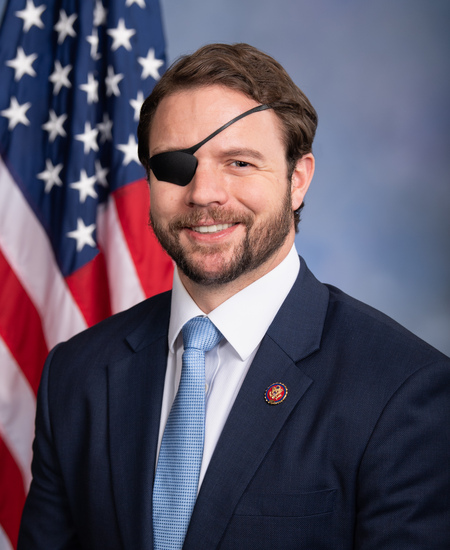
Photo of Dan Crenshaw
R United States House · District 2 · Texas

Rep. Dan Crenshaw

Compare
Total votes
2,837
all sessions
Attendance
92%
224 missed
Lower than 92% of chamber peers
With party
95%
of cast votes
Higher than 84% of chamber peers
Bipartisan score
3%
crosses aisle rarely
Lower than 82% of chamber peers
Sponsored
1,057
bills & resolutions
Near the chamber average
Committees
7
assignments
1,057 bills and resolutions

Sponsored bills

Total
1,057
Primary
75
Co-sponsor
982
This page
1,057
matching current filters
Primary HR 1059
In committee · Oregon House · Lead sponsor
Jobs and Opportunities for Medicaid Act

Maddy summaryThe Jobs and Opportunities for Medicaid Act would require most Medicaid recipients aged 18 to 65 to work or volunteer at least 20 hours per week (averaged monthly) to maintain health coverage, starting January 1, 2026. Exemptions include individuals who are pregnant, primary caregivers for children under 6, medically unable to work, or enrolled in substance abuse treatment programs. States would need to verify each month whether recipients meet this work requirement to continue receiving Medicaid benefits.

In committee Feb 6, 2025 0 co-sponsors
Co-sponsor HR 946
In committee · Oregon House · Co-sponsor
ORPHAN Cures Act

Maddy summaryThe ORPHAN Cures Act (HR 946) adjusts how the government calculates approval timelines for certain rare disease treatments under the Drug Price Negotiation Program. It clarifies that periods when a drug was previously designated as an "orphan drug" (for rare diseases) won't count toward the timeline for price negotiations. The bill also broadens the definition of "rare disease" to cover multiple conditions simultaneously, aligning with existing federal law. This directly affects manufacturers of orphan drugs by potentially extending their exclusivity periods before price negotiations begin.

In committee Feb 6, 2025 1 co-sponsor
Co-sponsor HR 1026
In committee · Oregon House · Co-sponsor
Primary Care Enhancement Act of 2025

Maddy summaryThe Primary Care Enhancement Act of 2025 changes how certain primary care arrangements are treated for tax purposes. It defines "direct primary care service arrangements" as fixed-fee models (max $150/month per person, excluding prescriptions/anesthesia/labs) that won’t count as "health plans" under tax law. This allows the fees to be treated as deductible medical expenses and requires employers to report them on W-2 forms. The law applies to taxable years starting after 2025, affecting patients in these arrangements, employers offering them, and tax filing processes.

In committee Feb 5, 2025 1 co-sponsor
Co-sponsor HR 992
In committee · Oregon House · Co-sponsor
PATROL Act

Maddy summaryHR 992, the PATROL Act, prohibits the federal Attorney General from suing states that build border barriers (like walls or fences) to prevent illegal entry or protect state territory. It specifically blocks civil lawsuits under existing border laws (33 U.S.C. 401/403) against states for such barrier projects. The bill defines key terms like "barrier" (including walls or fences) and "immigration laws" to clarify its scope. This directly affects states constructing border infrastructure and limits federal legal actions against those efforts. The bill does not create new border policies but changes the legal landscape for state-led border security measures.

In committee Feb 5, 2025 1 co-sponsor
Co-sponsor HR 978
In committee · Oregon House · Co-sponsor
Superior National Forest Restoration Act of 2025

Maddy summaryThis bill rescinds a 2023 federal withdrawal of lands in Minnesota's Superior National Forest, allowing mining operations to resume. It requires the Secretary to complete environmental reviews for mine plans within 18 months (or 6 months for supplements) and reissues canceled mineral leases with 20-year terms plus automatic 10-year renewals. The bill directly affects mining companies operating in the forest, particularly those with canceled leases or rejected applications since 2021. It mandates issuance of new permits for surface use related to mining and prohibits judicial review of these reissued leases.

In committee Feb 5, 2025 1 co-sponsor
Co-sponsor HR 987
In committee · Oregon House · Co-sponsor
Fair Access to Banking Act

Fair Access to Banking Act This bill places restrictions on certain banks, credit unions, and payment card networks if they refuse to do business with a person who complies with the law. Restrictions include prohibiting the use of electronic funds transfer systems and lending programs, termination of an institution's depository insurance, and specified civil penalties. Banks and other specified financial institutions are allowed to deny financial services to a person only if the denial is justified by a documented failure of that person to meet quantitative, impartial, risk-based standards established in advance by the institution. This justification may not be based upon reputational risks to the institution. The bill establishes the right for a person to bring a civil action for a violation of this bill.

In committee Feb 5, 2025 1 co-sponsor
Co-sponsor HR 1014
In committee · Oregon House · Co-sponsor
Specialist Joey Lenz Act of 2025

Maddy summaryThis bill requires annual health assessments for all active-duty military members beginning in 2026. It mandates specific tests including a sports physical, an annual heart test (electrocardiogram), and detailed blood work covering metabolic and blood count panels, plus optional thyroid and heart-related tests if needed. The bill also ensures these assessments include any existing health evaluations required by prior laws, such as those from the 2020 National Defense Authorization Act. The policy directly affects all active-duty service members in the U.S. military.

In committee Feb 5, 2025 1 co-sponsor
Co-sponsor HR 835
Passed · Oregon House · Co-sponsor
9/11 Memorial and Museum Act

Maddy summaryHR 835, the 9/11 Memorial and Museum Act, provides a one-time federal grant of $5-10 million to the National September 11 Memorial & Museum (operated by an IRS 501(c)(3) organization) for its operations, security, and maintenance. The bill requires the museum to offer free admission to veterans, first responders, and victims' families, plus weekly free public hours, and mandates annual financial audits and public reporting to Congress. Grant funds must be used to preserve the site, educate visitors, and increase access for economically disadvantaged groups. The funding is subject to annual appropriations and does not authorize ongoing federal support beyond the one-time grant.

Passed Feb 5, 2025 1 co-sponsor
Primary HR 927
In committee · Oregon House · Lead sponsor
To amend the Higher Education Act of 1965 to prohibit institutions of higher education from requiring ideological oaths or similar statements, and for other purposes.

Maddy summaryHR 927 prohibits colleges and universities from requiring students, employees, or applicants to endorse ideologies promoting racial, ethnic, or color-based discrimination or to provide statements about their race, ethnicity, national origin, or views on diversity, equity, and inclusion topics. The bill specifically bars institutions from using such statements for admissions, hiring, or contracting decisions. It includes key exceptions allowing institutions to request research content, certification of compliance with antidiscrimination laws, or discussions about teaching approaches. The law does not restrict academic coursework, research, or voluntary disclosures of personal information.

In committee Feb 4, 2025 0 co-sponsors
Co-sponsor HR 943
In committee · Oregon House · Co-sponsor
No User Fees for Gun Owners Act

Maddy summaryHR 943, the "No User Fees for Gun Owners Act," bans states and local governments from requiring insurance, taxes, or user fees as conditions for owning, buying, or selling firearms. It specifically prohibits these fees for firearm manufacture, importation, acquisition, transfer, or continued ownership, except for general sales taxes applied equally to all goods. The bill amends federal law to prevent states from imposing such conditions on gun ownership or commerce, while allowing standard sales taxes to apply uniformly. This directly affects gun owners, dealers, and manufacturers by removing mandatory fees tied to firearm transactions. The law does not restrict general sales taxes but eliminates state-specific fees as a prerequisite for firearm-related activities.

In committee Feb 4, 2025 1 co-sponsor
Showing 231 to 240 of 1,057 bills
Previous 1 … 23 24 25 … 106 Next