

Maddy summaryThis bill, the PAPA Act of 2025, restricts how aircraft tracking data (ADS-B) can be used and regulates fees on general aviation aircraft. It prohibits using ADS-B data to identify aircraft for revenue purposes without owner consent, allows its use only for air traffic safety by controllers, and extends this restriction to all government officials. For airport fees, it requires public disclosure of cost-saving efforts, alternative revenue sources, fee impact assessments, and specific safety project costs before imposing landing/takeoff fees on general aviation aircraft. All fees collected must be used exclusively for airside safety projects, not other airport expenses. The bill defines general aviation aircraft as those used for personal, recreational, training, or non-commercial purposes (excluding scheduled airlines and military flights).
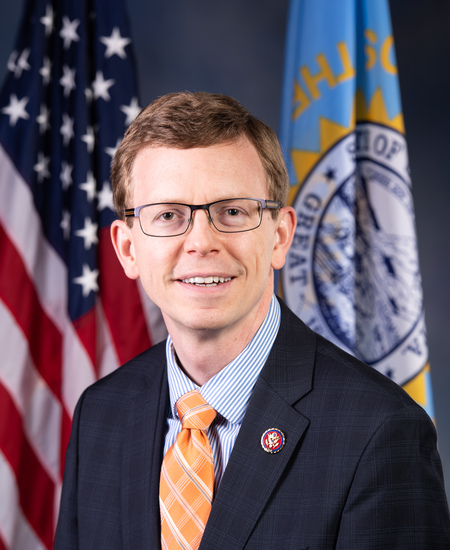
Rep. Dusty Johnson
Sponsored bills
Maddy summaryThis bill encourages states to use the Federal Permitting Improvement Steering Council's online dashboard for environmental reviews of certain large infrastructure projects. It specifically targets states that issue permits under Clean Water Act sections 401, 402, or 404 (related to water pollution). States are urged to coordinate through this dashboard to streamline the review process for projects requiring these permits, though participation is voluntary. The bill does not create new requirements but promotes existing federal tools for faster project approvals.
Maddy summaryThis bill requires major internet companies (including social media, streaming services, and app stores) and broadband providers to contribute to the Universal Service Fund, which subsidizes affordable broadband in rural and high-cost areas. It exempts smaller companies that transmit less than 3% of U.S. broadband data or earn under $5 billion annually. The Federal Communications Commission must create a new support mechanism to help rural broadband providers cover costs, while ensuring contributions remain fair and predictable. The bill explicitly states it does not grant the FCC new authority over these companies.
Maddy summaryHR 3957 amends the Robert T. Stafford Disaster Relief Act to directly authorize Indian Tribal Governments to request fire management assistance from the President, rather than requiring them to go through state governments. The bill allows tribal leaders (Chief Executives) to submit requests directly to the President for fire-related disaster aid, which would be processed through FEMA. It also requires the President to update federal regulations within one year, clarifying that tribes can receive aid directly or through state requests, while mandating government-to-government consultation with tribes during rulemaking. This change ensures tribal governments have a clear, direct pathway to access federal fire management resources during emergencies.
Maddy summaryHR 3972, the Highway Funding Flexibility Act of 2025, redirects unobligated funds from two existing federal highway programs to allow states greater flexibility in how they use these resources. Specifically, it permits states to use unused funds from the National Electric Vehicle Infrastructure Formula Program and charging/fueling infrastructure grants for highway construction, bridge repairs, wildlife crossing projects, commercial vehicle parking, and related engineering - instead of being restricted to EV charging infrastructure. The bill requires that these funds be distributed to states based on their standard highway funding apportionment and ensures they remain available for their intended highway purposes without new obligation limits. This change affects states receiving federal highway funds who have unobligated balances from these specific programs.
Maddy summaryThis bill prohibits male students from participating in athletic programs at the U.S. Military Academies (West Point, Annapolis, and Air Force Academy) designated exclusively for women or girls. It allows males to train with such teams only if no female athlete loses a roster spot, competition opportunity, scholarship, or other benefit. The bill defines "sex" as biological sex at birth and clarifies that "athletic programs" include all team-based activities requiring participation. It directly affects the women's sports teams at these three service academies and their eligibility rules.
Maddy summaryHR 3843, the Baseload Reliability Protection Act, prohibits the retirement or fuel-source conversion of certain large, reliable power plants (over 25 megawatts, not relying on intermittent renewables like solar/wind without storage) in areas designated as high or elevated risk for electricity shortages. It directly affects power plant operators in these high-risk regions, requiring them to maintain existing facilities unless they qualify for an exemption. Exemptions can be granted if operators demonstrate financial hardship, safety risks, or prove they’ll replace the plant with a comparable reliable unit, with potential federal grants or loans from the Department of Energy to cover operational costs. The bill explicitly blocks consideration of greenhouse gas emissions in exemption decisions and mandates standardized risk assessment criteria for identifying high-risk areas.
Maddy summaryHR 3777, the Public Land Search and Rescue Act, creates a federal grant program to fund remote search and rescue activities on public lands managed by the Interior or Agriculture Departments. The program provides up to 75% federal funding for eligible states or local teams to purchase equipment, maintain gear, and reimburse costs for locating and rescuing people lost or injured in remote areas. Priority is given to areas with high visitor-to-resident ratios, and grants require applicants to be legally authorized to conduct such rescues. This bill directly affects state/local search and rescue organizations operating on federal lands by providing new funding mechanisms for their remote operations.
Maddy summaryHR 649, the Whole Milk for Healthy Kids Act of 2025, amends the National School Lunch Act to allow schools participating in the program to offer students both organic and non-organic whole milk, in addition to reduced-fat, low-fat, and fat-free options. Key provisions include clarifying that milk fat in whole milk should not count toward saturated fat limits for meal compliance, prohibiting schools from purchasing milk from Chinese state-owned enterprises, and ensuring schools cannot be barred from offering the full range of milk types listed. The bill directly affects public and private schools serving the National School Lunch Program by expanding their milk options for students. It focuses on concrete policy changes to dietary offerings and sourcing restrictions within the school nutrition program.
Maddy summaryHR 3634, the Interactive Federal Review Act, requires the U.S. Department of Transportation to encourage highway projects receiving federal grants (like INFRA, RAISE, or Mega program funds) to use digital platforms and 3D models for environmental reviews under the National Environmental Policy Act (NEPA). It mandates the DOT to publish guidance within 90 days, select at least 10 projects to test these tools, and prioritize grant applications that plan to use them for public engagement and environmental analysis. The bill also requires reports to Congress within 180 days detailing efficiency metrics and examples of digital workflows, plus public examples of digital environmental documents within a year. This aims to speed up reviews and improve public understanding of project impacts, directly affecting federally funded highway projects.