Gym Mitigation and Survival Act of 2021 or the GYMS Act of 2021 This bill establishes a grant program to provide economic support to eligible fitness facilities in response to the COVID-19 (i.e., coronavirus disease 2019) pandemic. Specifically, the bill authorizes the Small Business Administration to make initial and supplemental grants to privately owned fitness facilities that primarily provide health or fitness services and that do not offer golf, hunting, sailing, or riding facilities. The total amount of grant funds for a recipient may not exceed $25 million, and the recipient must use these funds for payroll costs, rent or mortgage obligations, and other ordinary and necessary business expenses.
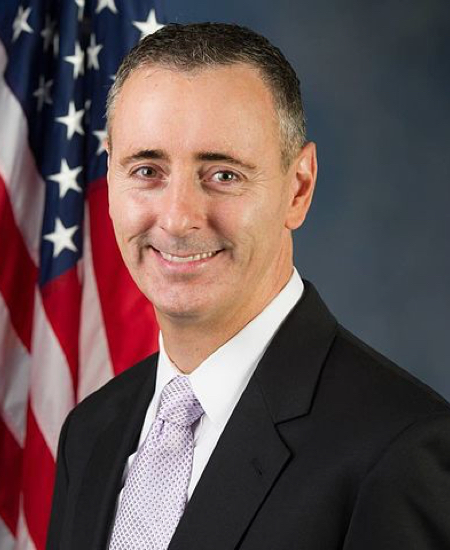
Rep. Brian K. Fitzpatrick
Sponsored bills
Health Standards To Advance Transparency, Integrity, Science, Technology Infrastructure, and Confidential Statistics Act of 2021 or the Health STATISTICS Act of 2021 This bill requires efforts to standardize reporting of public health data, including for COVID-19 (i.e., coronavirus disease 2019) data. It also expands access to federal databases for health research. Specifically, the Centers for Disease Control and Prevention (CDC) must develop uniform standards for health departments and other entities that report public health data. The Department of Health and Human Services (HHS) may award grants to entities for adopting the uniform standards and otherwise improving their reporting capabilities. Furthermore, the CDC must, in consultation with the National Institutes of Health, establish specific standards within 30 days for reporting COVID-19 data. HHS must also disseminate this data subject to privacy and other requirements. Additionally, the Office of Management and Budget must issue guidance on federal health data collection that covers, for example, ensuring data quality and increasing access to health data for research. The National Center for Health Statistics (NCHS) must carry out a demonstration program to expand an existing program that links different federal data sets for statistical public health research, including research on food insecurity, housing instability, and other social determinants of health. In particular, the program must link to the National Death Index, a database of death records maintained by the NCHS. Finally, the bill requires the CDC to award grants to research entities and public health departments to increase their capacity for conducting statistical public health research.
Barriers to Suicide Act of 20 21 This bill requires the Department of Transportation (DOT) to establish a program to facilitate the installation of evidence-based suicide deterrents on bridges, including suicide prevention nets and barriers. DOT may award competitive grants to states and local governments to carry out the program. The Government Accountability Office must conduct a study to identify the types of structures, other than bridges, that attract a high number of individuals attempting suicide-by-jumping and the types of nets or barriers that are effective at reducing such suicides.
This resolution supports the designation of Career and Technical Education Month to celebrate career and technical education across the United States.
United States-Israel PTSD Collaborative Research Act This bill establishes a grant program for collaborative efforts between the United States and Israel to advance research on post-traumatic stress disorders. The Department of Defense, in coordination with the Department of Veterans Affairs and the Department of State, shall award grants to eligible academic institutions or nonprofit entities in the United States. Work shall be conducted by the eligible entity and an entity in Israel under a joint research agreement.
Real Economic Support That Acknowledges Unique Restaurant Assistance Needed To Survive Act of 2021 or the RESTAURANTS Act of 2021 This bill temporarily establishes and provides funding for the Restaurant Revitalization Fund, from which the Department of the Treasury shall make grants to eligible food and beverage purveyors to cover specified costs such as payroll, operational expenses, and paid sick leave. For the grant program's initial period, Treasury must (1) prioritize awarding grants to marginalized and underrepresented communities, and (2) only award grants to eligible food and beverage purveyors with annual revenues of less than $1.5 million in 2019. For tax purposes, grant amounts are excluded from the recipient's gross income. An entity that received a loan under the Paycheck Protection Program established to support small businesses in response to COVID-19 (i.e., coronavirus disease 2019) may not apply for or use a restaurant revitalization grant for the same expenses for which the entity received the paycheck protection loan. Further, a grant applicant may request an additional amount to cover the cost of providing 10 days of paid sick leave to its employees. Treasury must report a list of grant recipients with the amount each recipient received, as well as demographics and other specified information.
Supporting State and Local Leaders Act This bill repeals the prohibition against granting state and local governments a tax credit for paid sick and paid family and medical leave.
Coronavirus Assistance for American Families Act This bill provides individual taxpayers with additional recovery rebates in 2021. The amount of such rebates is $1,400 per individual ($2,800 for married individuals filing joint tax returns) and $1,400 for each dependent of the taxpayer. The rebate is phased out for individuals whose adjusted gross income exceeds $75,000 ($150,000 for joint returns). To be eligible for the rebate, taxpayers must include a valid Social Security account number on their tax returns. The bill directs the Department of the Treasury to conduct a public awareness campaign to inform taxpayers of the availability of the rebate.
Family Savings for Kids and Seniors Act This bill provides an annual inflation adjustment after 2021 to the $5,000 tax exclusion for employer-provided dependent care assistance.
End Banking for Human Traffickers Act of 2021 This bill establishes requirements related to the use of financial transactions in human trafficking. The Financial Institutions Examination Council must review procedures to improve the capability of specified programs to target financial transactions relating to severe forms of human trafficking. The Interagency Task Force to Monitor and Combat Trafficking must submit to Congress recommendations for the revision of anti-money laundering programs specifically targeting severe forms of human trafficking. The bill provides additional criteria to be considered by the Department of State to indicate a country's serious and sustained efforts to eliminate human trafficking for purposes of certain foreign assistance. Specifically, the bill adds criteria regarding whether a country has taken or is taking steps to implement a framework for preventing financial transactions involving severe forms of human trafficking.