Maddy summaryHR 1280 (DRAIN THE SWAMP Act) requires federal agencies to relocate at least 30% of their headquarters employees from Washington D.C. to offices outside the metro area within one year of enactment. Affected employees must switch to pay rates based on their new location and lose full-time telework privileges. Exceptions apply for employees with ADA accommodations requiring full-time telework. Agencies must report progress to Congress within 180 days and include staffing data in future budget requests.
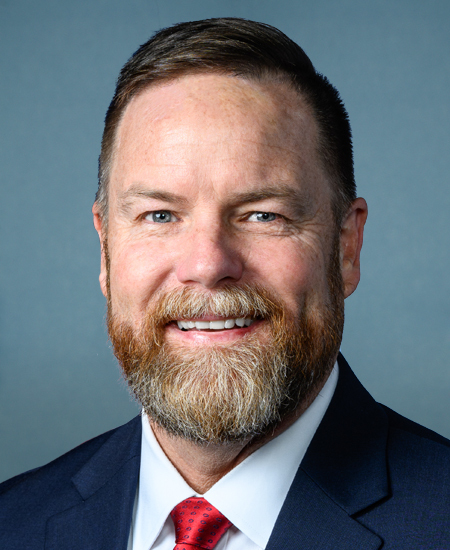
Rep. Aaron Bean
Sponsored bills
Maddy summaryHR 1279 would require certain Medicaid recipients (excluding those under 18, over 65, pregnant, caregivers, or in education/health programs) to complete 80 hours monthly of work, community service, or approved work programs to maintain Medicaid eligibility. This applies to individuals who fail to meet this "community engagement requirement" for three consecutive months, triggering a loss of federal Medicaid funding for that month. States would verify compliance using existing databases (like payroll records) before requesting additional proof. The bill does not change Medicaid eligibility criteria but ties federal funding to this new activity requirement for qualifying individuals.
Alternatives to Prevent Addiction In the Nation Act or the Alternatives to PAIN Act This bill reduces cost-sharing and prohibits the imposition of certain utilization requirements under the Medicare prescription drug benefit for certain non-opioid pain management drugs. Specifically, the bill requires such drugs to be covered without a deductible and to be placed on the lowest cost-sharing tier (if any). The bill also prohibits the imposition of prior authorization requirements (i.e., requiring prior approval from a plan) or step therapy requirements (i.e., requiring the use of alternative drugs before a drug is covered under a plan) with respect to such drugs.
Maddy summaryHR 1232, the National Right-to-Work Act, would make union membership voluntary for workers in most private-sector jobs by removing legal requirements for employees to join a union or pay dues as a condition of employment. It directly affects workers in unionized workplaces covered by the National Labor Relations Act (including most private employers) and railroad workers covered by the Railway Labor Act. The key change eliminates provisions that allowed "union security agreements" (requiring dues or membership), meaning workers could no longer be forced to pay union fees to keep their jobs. This bill does not change other labor rights or create new programs - it only modifies existing laws to allow workers to opt out of union membership and financial obligations.
Maddy summaryHR 1268 updates the legal definition of U.S. customs waters in two key laws (the Tariff Act of 1930 and the Anti-Smuggling Act) to align with current international maritime standards. It replaces the outdated "four leagues from the coast" language with specific references to the U.S. territorial sea (per Presidential Proclamation 5928, 1988) and contiguous zone (per Presidential Proclamation 7219, 1999). This change directly affects U.S. Customs and Border Protection enforcement activities in coastal waters. The bill makes no new policy or tax changes - it only clarifies existing legal boundaries for customs jurisdiction. The update takes effect upon the bill's enactment.
Maddy summaryThis bill creates a 10% tax credit for businesses that modernize or replace freight railcars, directly affecting railcar owners and manufacturers. To qualify, railcars must meet an 8% improvement standard in capacity or fuel efficiency, be built or modernized after enactment, and replace two scrapped railcars. The credit is limited to 1,000 qualified railcars per business annually, with reporting requirements for the Treasury to track claimed credits, scrapped railcars, and new railcar production. The credit applies to railcars placed in service after December 2024, ending three years after enactment.
Maddy summaryThis bill expands 529 college savings account flexibility by allowing funds to cover costs for industry-recognized postsecondary credentials, not just traditional degrees. It defines "qualified expenses" to include tuition/fees for recognized credential programs (like certifications or apprenticeships), required testing fees, and continuing education needed to maintain credentials. To qualify, programs must meet specific criteria, such as appearing on state lists under the Workforce Innovation and Opportunity Act or being listed in VA or Defense directories. The change applies to 529 distributions made after the law's enactment, giving families more options to use these accounts for job-focused training.
This resolution supports the designation of Career and Technical Education Month to celebrate career and technical education across the United States.
Maddy summaryHR 1040, the Senior Citizens Tax Elimination Act, would stop taxing Social Security benefits for seniors by repealing the current tax rule that includes some benefits in gross income. It directly affects senior citizens who currently pay federal income tax on portions of their Social Security payments. The bill adds a provision stating Section 86 of the tax code (which taxes Social Security benefits) no longer applies after enactment. To offset the lost tax revenue, the bill requires the government to appropriate funds to the Social Security and Railroad Retirement trust funds, ensuring they remain fully funded without requiring tax increases.
Maddy summaryHR 1029 would end the United States Agency for International Development (USAID) by prohibiting all federal funding for its operations starting upon the bill's enactment. It requires the rescission of all unobligated funds held by USAID as of the day before enactment and transfers the agency's remaining assets and liabilities to the Secretary of State. This bill directly affects USAID, eliminating its legal authority and funding under the Foreign Assistance Act of 1961 and other laws. The measure would effectively dissolve USAID as a functioning federal agency.