

Department of State Inclusivity Act of 2021 This bill establishes measures at the State Department to promote diversity and to prevent and respond to harassment, discrimination, sexual assault, and retaliation. The bill requires the State Department to develop a comprehensive policy for responding to harassment, discrimination, sexual assault, and retaliation; expand anti-harassment, antidiscrimination, implicit bias, and whistleblower training; establish the Office of Employee Advocacy; survey employees regarding harassment, discrimination, sexual, assault, retaliation, and issues affecting employee retention and diversity; report on the diversity of its workforce; develop a pilot program to use gender-neutral terms in evaluation forms; investigate and report wrongful terminations based on sexual orientation; establish a board to address issues faced by LGBTI+ Foreign Service employees and their families; report on countries that refuse to issue spousal visas for Foreign Service employee spouses due to sexual orientation and recommend how to address this issue; establish a permanent exhibit on the so-called Lavender Scare , which involved the wrongful dismissal of at least 1,000 people from the State Department for alleged homosexuality in the 1950s and 1960s; and make other changes related to anti-harassment, antidiscrimination, diversity, and recruitment. The bill also establishes the Office of the Chief Diversity and Inclusion Officer at the State Department; offers a formal apology from Congress for encouraging the Lavender Scare; and prohibits the use by federal employers of nondisclosure and non-disparagement provisions that cover prohibited discrimination, harassment, or related retaliation.
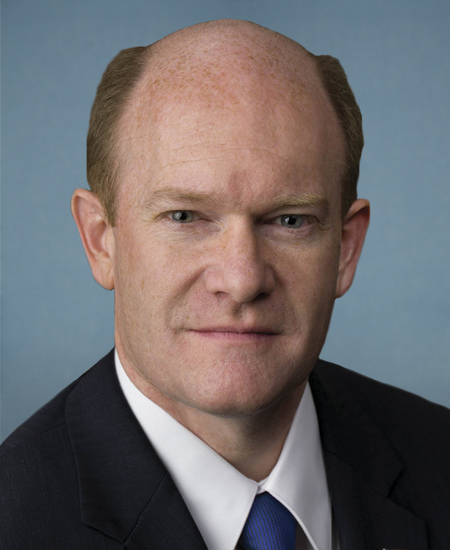
Sen. Christopher A. Coons
Sponsored bills
Daniel Anderl Judicial Security and Privacy Act of 2021 This bill generally prohibits federal agencies and private businesses from publicly posting certain personal information (e.g., home addresses) of federal judges and their immediate family members. It also (1) requires information to be removed upon written request from the federal judge concerned, (2) prohibits data brokers from purchasing or selling such information, and (3) establishes programs to protect such information at the state and local level and to enhance security for judges.
Global War on Terrorism Memorial Location Act This bill authorizes the establishment of a National Global War on Terrorism Memorial in the area of the National Mall.
Veterans' Prostate Cancer Treatment and Research Act This bill requires the Department of Veterans Affairs (VA) to establish in its National Surgery Office an interdisciplinary clinical pathway for all stages of prostate cancer. Clinical pathways are health care management tools designed around research and evidence-based practices that provide direction for the care and treatment of a specific condition. The clinical pathway must include specified elements, such as a diagnosis pathway and a treatment pathway. The VA must consult with and incorporate feedback from (1) veterans who have received prostate cancer care at its medical facilities, and (2) experts in multidisciplinary cancer care and clinical research. Additionally, the VA must publish the clinical pathway on a public VA website and annually update the pathway as needed based on medical literature and evidence-based guidelines. The bill also requires the VA to submit a plan to establish a prostate cancer program using the comprehensive prostate cancer clinical pathway.
Department of Veterans Affairs Post-Traumatic Stress Disorder Processing Claims Improvement Act of 2021 This bill requires the Veterans Benefits Administration (VBA) within the Department of Veterans Affairs (VA) to update an ongoing national training program for claims processors who review compensation claims for service-connected post-traumatic stress disorder (PTSD). Such claims processors will be required to participate in the training at least once a year starting in their second year of being a VA claims processor. The training program must be standardized at regional offices of the VBA and include instruction on stressor development and verification. The VBA must establish a formal process to annually analyze training needs based on identified processing error trends. Additionally, the VBA must establish a formal process to conduct annual studies to help guide the national training program for claims processors. Finally, the VBA must evaluate the guidance relating to PTSD to determine if updates are warranted to provide claims processors with better resources regarding best practices for claims processing, including specific guidance regarding development of claims involving compensation for service-connected PTSD.
Student Veterans Transparency and Protection Act of 2021 This bill addresses the maintenance of the GI Bill Comparison Tool and administration of Department of Veterans Affairs (VA) educational assistance. The VA must maintain the tool and ensure its historical data remains easily and prominently accessible on the VA's benefits website for at least seven years from the initial publication. The VA must retain, maintain, and publish feedback from students and state approving agencies regarding the quality of instruction, recruiting practices, and post-graduation employment placement of approved institutions of higher learning for the duration that the institution is approved for VA benefit purposes. The bill provides institutions of higher learning with up to 30 days to review and respond to any feedback and address issues before the feedback is published. The bill requires that the GI Bill Comparison Tool include updated information, including descriptions of each federal student aid program and the amount of educational assistance an individual may be eligible to receive under the program. The VA must train personnel that provide education benefits counseling, vocational or transition assistance, or similar functions to properly use the comparison tool and provide appropriate education counseling services. The VA must restore entitlement to educational assistance in situations where there is a civil enforcement action or VA action against an educational institution, and an individual was unable to complete the course or program of education due to such action. Individuals may be charged against their entitlement at their request.
Reconnecting Communities Act This bill establishes a grant program to remove, retrofit, or otherwise address infrastructural barriers (e.g., highways, railways, or viaducts) that impede mobility and connectivity, with a particular focus on communities of color and low-income communities. Under this program, the Department of Transportation (DOT) must award three types of grants: community engagement, education, and capacity-building grants to educate and involve community members in transportation and economic development planning; planning and feasibility study grants to develop designs, conduct environmental reviews, and carry out other preliminary activities required to remove, retrofit, or mitigate an infrastructural barrier; and capital construction grants to remove, retrofit, or mitigate an infrastructure barrier. DOT must award the community engagement, education, and capacity-building grants and the planning and feasibility study grants to state, tribal, and local governments; metropolitan planning organizations; and nonprofits. An eligible entity may apply for and receive funding from more than one type of grant. DOT must award the capital construction grants to the owner of an infrastructure barrier. The owner may, if applicable, partner with other eligible entities.
This resolution expresses support for the goals and ideals of American Diabetes Month and decreasing the prevalence of diabetes in the United States through increased research, treatment, and prevention.
This resolution expresses support for the goals and ideals of Sickle Cell Disease Awareness Month. Sickle cell disease is an inherited blood disorder than can lead to pain, anemia, infections, and stroke.
Kenneth P. Thompson Begin Again Act This bill expands eligibility for the expungement of records related to a first-time drug possession offense. Current law permits expungement for offenders who commit the offense before age 21. This bill permits expungement for offenders who commit the offense at any age.