

Safeguard American Voter Eligibility Act or the SAVE America Act This bill requires individuals to provide documentary proof of U.S. citizenship when registering to vote, and requires photo identification to vote, in federal elections. Specifically, the bill prohibits states from accepting and processing an application to register to vote in a federal election unless the applicant presents documentary proof of U.S. citizenship. The bill specifies what documents are considered acceptable proof of U.S. citizenship, such as identification that complies with the REAL ID Act of 2005 that indicates U.S. citizenship. Further, the bill (1) prohibits states from registering an individual to vote in a federal election unless, at the time the individual applies to register to vote, the individual provides documentary proof of U.S. citizenship; and (2) requires states to establish an alternative process to demonstrate U.S. citizenship. Each state must take affirmative steps on an ongoing basis to ensure that only U.S. citizens are registered to vote, which shall include establishing a program to identify individuals who are not U.S. citizens using information supplied by certain sources. Additionally, states must remove noncitizens from their official lists of eligible voters. The bill (1) provides for a private right of action for certain violations, and (2) establishes criminal penalties for certain offenses. Individuals voting in federal elections must present an eligible photo identification document. An individual who votes by absentee ballot must submit a copy of their identification document with both the request for, and the submission of, the absentee ballot.
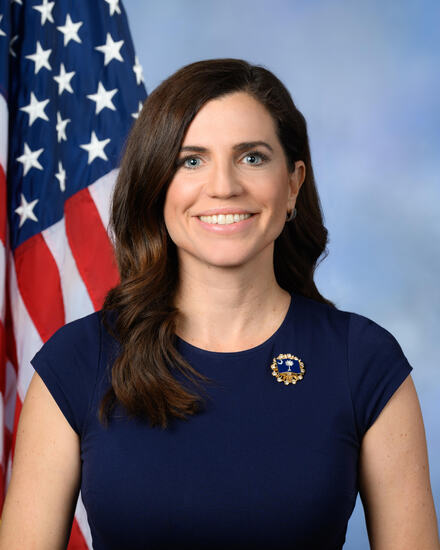
Rep. Nancy Mace
Sponsored bills
Maddy summaryHR 7293, the Protecting Children in Surrogacy Act, prohibits individuals required to register on the National Sex Offender Registry (covered sex offenders) from obtaining a child through surrogacy or entering surrogacy contracts as intended parents. The bill makes it a federal crime punishable by fines or up to 10 years in prison if the surrogacy arrangement involves interstate or foreign commerce (e.g., travel, payments, or communications across state lines). It also bans federal courts from enforcing surrogacy contracts where the intended parent is a covered sex offender. The law directly affects intended parents who are registered sex offenders and aims to prevent them from gaining legal custody of children via surrogacy arrangements.
Maddy summaryHR 1295, the Reorganizing Government Act of 2025, amends federal law to streamline executive branch operations. It requires all executive departments (like the Departments of Defense or Education) to eliminate unnecessary programs, reduce federal employee numbers, and cut burdensome regulations that increase compliance costs. The bill updates deadlines for reorganization plans from 1984 to 2026 and explicitly mandates that all government operations must serve the public interest. These changes apply broadly across the federal government, focusing on efficiency and cost reduction.
Maddy summaryHR 7235, the "Protecting Motherhood Act," requires all federal agencies to stop using the term "birthing person" in official documents and instead use specific terms like "female," "mother," "pregnant woman," or "woman." It directly affects federal agencies that produce regulations, forms, or communications, mandating the use of these defined terms when referring to individuals based on biological sex. The bill provides detailed definitions for terms like "female" (based on biological sex at conception) and "pregnant woman" (an adult human female carrying a child). The law takes effect 30 days after enactment. This is a procedural change focused solely on terminology in government documents, with no direct impact on healthcare access or services.
Maddy summaryHR 7213, the *Safeguarding Benefits for Americans Act of 2026*, requires U.S. citizenship or nationality for eligibility for most federal assistance programs (like SNAP, housing aid, or Medicaid). It mandates applicants to submit a written declaration under penalty of perjury and provide documentary proof (e.g., birth certificate, SSN) verified through Social Security Administration and DHS databases. The bill affects individuals applying for or receiving federal benefits, with exceptions for children in households where at least one member meets the requirement (e.g., children in SNAP or elderly housing programs). It takes effect 1 year after enactment, requiring all current recipients to meet the new rules within 2 years.
Maddy summaryThe No Tax on Boat Loan Interest Act of 2026 would allow individuals to deduct interest paid on loans for qualifying U.S.-manufactured recreational motorboats from their taxable income, similar to how interest on car loans is treated. It defines qualifying boats as motorboats manufactured in the U.S. for recreational use, excluding non-U.S. built vessels, and requires taxpayers to provide the boat's hull identification number on their tax return. This change applies to loans taken out after December 31, 2024, and primarily affects individual boat owners who finance purchases meeting these criteria.
Maddy summaryHR 7156, the SCAM Act, would expand grounds for revoking U.S. citizenship (denaturalization) for naturalized citizens who commit specific offenses within 10 years of becoming citizens. It targets individuals convicted of defrauding federal, state, or local governments (e.g., $10,000+ in public benefit fraud), affiliating with foreign terrorist organizations, or committing aggravated felonies or espionage. If convicted in these categories, the government could automatically revoke citizenship retroactively (as if it never existed) based on evidence that the person lacked good moral character or loyalty to the U.S. at the time of naturalization. This bill directly affects naturalized citizens who commit these offenses within a decade of gaining citizenship, with revocation triggering immediate deportability.
Maddy summaryHR 7068, the "No Convicts Running the Capital Act," prohibits the District of Columbia government from hiring or contracting with individuals or entities linked to serious criminal convictions. It bans appointments to DC government positions for anyone with a final conviction for a violent or dangerous crime (defined as offenses similar to those in DC law), requiring termination of current employees with such convictions within 90 days. Similarly, it prevents DC from entering contracts with vendors employing such individuals, having officers/directors with these convictions, or being controlled by them, terminating existing contracts with affected vendors within 90 days. The law applies to all DC government offices and contracts, focusing on removing individuals with final convictions from government roles and vendor relationships.
Maddy summaryThis bill bars individuals convicted of violent crimes (as defined by federal law) from working in the federal government or for companies contracted by the government. It requires immediate removal of current federal employees with such convictions and prohibits federal agencies from hiring or contracting with individuals holding key roles (e.g., executives, owners, or workers on federal projects) who have been finally convicted of a violent crime. Exceptions may be granted by the Office of Management and Budget if termination would cause a "unique or undue burden." The law applies to all current and future federal contracts and uses existing legal definitions for "violent crime" and "final conviction."
Maddy summaryThis symbolic House resolution expresses U.S. congressional support for Iranian protesters demanding democracy and human rights. It condemns the Iranian regime's violent suppression of protests, including killings, mass arrests, and internet restrictions, while urging the regime to release political prisoners and restore communication access. The resolution reaffirms the Iranian people's right to self-determination through free elections and echoes a 2023 resolution (HCR 7) that similarly praised protesters. As a non-binding expression of support, it does not impose new policies or alter U.S. government actions.