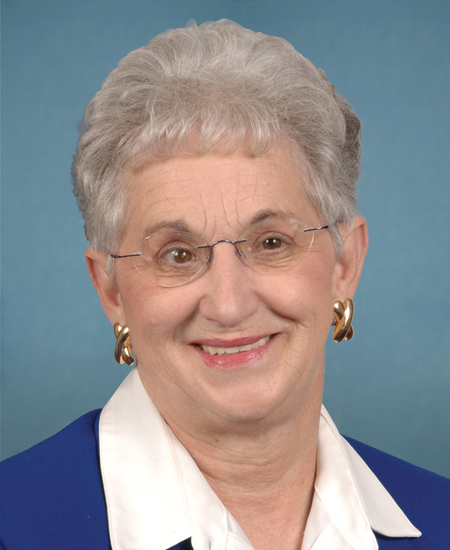
Photo of Virginia Foxx
R United States House · District 5 · North Carolina On the 2026 ballot

Rep. Virginia Foxx

Compare
Total votes
2,837
all sessions
Attendance
98%
68 missed
Higher than 85% of chamber peers
With party
95%
of cast votes
Higher than 83% of chamber peers
Bipartisan score
3%
crosses aisle rarely
Lower than 84% of chamber peers
Sponsored
468
bills & resolutions
Lower than 90% of chamber peers
Committees
5
assignments
468 bills and resolutions

Sponsored bills

Total
468
Primary
72
Co-sponsor
396
This page
468
matching current filters
Co-sponsor HR 8757
In committee · Oklahoma House · Co-sponsor
Promoting Childhood Independence and Resilience Act of 2026

Maddy summaryThis bill amends federal child welfare laws to explicitly state that allowing children to engage in age-appropriate independent activities, such as playing outside or walking to school, does not constitute child abuse or neglect. It requires state child welfare agencies to update their policies and training to ensure parents are not investigated or penalized solely for granting their children reasonable freedom without direct supervision. Additionally, the legislation mandates a study by the Department of Health and Human Services to identify best practices and resources that support parental decisions to foster childhood independence.

In committee May 12, 2026 1 co-sponsor
Co-sponsor HR 8603
In committee · Oklahoma House · Co-sponsor
Dismemberment Abortion Ban Act of 2026

Maddy summaryHR 8603, the Dismemberment Abortion Ban Act of 2026, prohibits physicians from performing abortions that involve dismembering an unborn child and extracting it piece by piece or crushed from the uterus. The law allows exceptions only when the procedure is necessary to save the mother's life, while explicitly permitting other abortion methods for reasons such as rape or incest. It imposes criminal penalties of up to two years in prison or fines on physicians who violate the ban and creates a civil lawsuit system where women or parents of minors can seek monetary damages and attorney fees against providers. The bill also defines an 'unborn child' as a human organism from fertilization until birth and clarifies that the woman undergoing the procedure cannot be prosecuted or held financially liable.

In committee Apr 30, 2026 1 co-sponsor
Co-sponsor HRES 1199
In committee · Oklahoma House · Co-sponsor
Recognizing linemen, the profession of linemen, the contributions of these brave men and women who protect public safety, and expressing support for the designation of April 18, 2026, as "National Lineman Appreciation Day".

Maddy summaryThis House Resolution recognizes the efforts and public safety contributions of linemen and the important role they play in maintaining the nation's energy infrastructure. It expresses support for designating April 18, 2026, as "National Lineman Appreciation Day" and acknowledges linemen as first responders.

In committee Apr 20, 2026 1 co-sponsor
Primary HR 7723
In committee · Oklahoma House · Lead sponsor
Safeguarding Taxpayer Dollars in Child Care Act of 2026

Maddy summaryThis bill strengthens fraud prevention in two federal child care programs: the Child Care and Development Block Grant (CCDBG) and the Child and Adult Care Food Program (CACFP). It requires the Secretary to investigate fraud involving program funds and mandates permanent debarment (removal from the program) for providers found to have committed fraud, such as submitting false information, misrepresenting services, or improperly spending funds. Providers debarred from one program (like CACFP) face automatic debarment from the other (CCDBG), creating a unified enforcement mechanism. The law directly affects child care providers receiving federal funding, aiming to protect taxpayer dollars by ensuring only compliant providers continue to serve eligible families.

In committee Apr 6, 2026 0 co-sponsors
Primary HR 8102
In committee · Oklahoma House · Lead sponsor
Workforce Investments Accountability Act

Maddy summaryThis bill, the Workforce Investments Accountability Act, strengthens how federal workforce training programs are measured and held accountable by updating performance metrics and reporting requirements under the Workforce Innovation and Opportunity Act. It directly affects state and local workforce agencies, training providers, and program participants by requiring more detailed outcome tracking including earnings gains, employment retention, and completion rates. The bill mandates standardized reporting templates, allows access to wage records for better outcome measurement, and introduces stricter sanctions for states and local areas that fail to meet performance targets, including funding reductions and reallotment to higher-performing states. Additionally, it requires at least 50 percent of certain training funds be used for direct skills development services rather than administrative costs.

In committee Mar 26, 2026 0 co-sponsors
Co-sponsor HR 8076
In committee · Oklahoma House · Co-sponsor
PREDICT Act

Maddy summaryThe PREDICT Act prohibits federal government officials, including Members of Congress, their spouses and dependents, high-ranking executive branch employees, and political appointees from trading on prediction markets tied to political events. This restriction applies to any agreement or transaction where payment depends on whether a specific political event occurs, does not occur, or happens to a certain degree. If a covered individual violates this rule, they must pay a 10% fee and forfeit any profits from the transaction, with penalties paid from personal funds rather than government salaries or allowances. The Office of Government Ethics will issue guidance on undefined terms and publish details of any fines on a public website.

In committee Mar 25, 2026 1 co-sponsor
Primary HRES 1115
Passed · Oklahoma House · Lead sponsor
Providing for consideration of the bill (H.R. 556) to prohibit the Secretary of the Interior and the Secretary of Agriculture from prohibiting the use of lead ammunition or tackle on certain Federal land or water under the jurisdiction of the Secretary of the Interior and the Secretary of Agriculture, and for other purposes; providing for consideration of the bill (H.R. 1958) to amend the Immigration and Nationality Act to clarify that aliens who have been convicted of defrauding the United States Government or the unlawful receipt of public benefits are inadmissible and deportable; providing for consideration of the bill (H.R. 4638) to amend the Immigration and Nationality Act to provide that an alien who has been convicted of harming animals used in law enforcement is inadmissible and deportable, and for other purposes; and relating to consideration of motions to suspend the rules.

This resolution provides for the consideration of the bill (H.R. 556) to prohibit the Secretary of the Interior and the Secretary of Agriculture from prohibiting the use of lead ammunition or tackle on certain Federal land or water under the jurisdiction of the Secretary of the Interior and the Secretary of Agriculture, and for other purposes; providing for consideration of the bill (H.R. 1958) to amend the Immigration and Nationality Act to clarify that aliens who have been convicted of defrauding the United States Government or the unlawful receipt of public benefits are inadmissible and deportable; providing for consideration of the bill (H.R. 4638) to amend the Immigration and Nationality Act to provide that an alien who has been convicted of harming animals used in law enforcement is inadmissible and deportable, and for other purposes; and relating to consideration of motions to suspend the rules.

Passed Mar 17, 2026 0 co-sponsors
Co-sponsor HR 6084
In committee · Oklahoma House · Co-sponsor
ERISA Litigation Reform Act

Maddy summaryThe ERISA Litigation Reform Act (HR 6084) changes how lawsuits under the Employee Retirement Income Security Act (ERISA) are handled, directly affecting retirement and health plan beneficiaries who sue plan fiduciaries over alleged violations. It requires plaintiffs to specifically allege and prove that transactions (like purchases of company stock) aren’t exempt under ERISA rules before proceeding. The bill also temporarily halts discovery (gathering evidence) during early court motions to dismiss, mandates document preservation during this pause, and allows courts to impose penalties for failing to preserve relevant evidence. These changes aim to streamline litigation by reducing early-stage discovery costs and frivolous claims.

In committee Mar 17, 2026 1 co-sponsor
Co-sponsor HRES 1111
In committee · Oklahoma House · Co-sponsor
Recognizing the 245th anniversary of the Battle of Guilford Courthouse and encouraging all United States citizens to visit the Guilford Courthouse National Military Park in Guilford County, North Carolina.

Maddy summaryThis resolution (HRES 1111) is a ceremonial recognition of the 245th anniversary of the Battle of Guilford Courthouse (March 15, 1781) during the Revolutionary War. It honors the bravery of American and North Carolinian troops who fought there and encourages all U.S. citizens to visit the existing Guilford Courthouse National Military Park in North Carolina. The resolution has no binding effect or policy changes - it simply commemorates the historical event and promotes public visitation to the park. It does not create new laws, allocate funds, or affect any specific group beyond encouraging general public engagement with the site.

In committee Mar 12, 2026 1 co-sponsor
Co-sponsor HR 1319
In committee · Oklahoma House · Co-sponsor
Modern Worker Empowerment Act

This bill specifies a legal standard for determining whether an individual is considered an independent contractor rather than an employee for the purposes of federal labor laws that address issues such as the federal minimum wage, overtime compensation, and collective bargaining. The rights and protections provided by these laws exclusively apply to employees. Under the bill, an individual is considered an independent contractor if (1) another individual or entity does not exercise significant control over the details of how the individual's work is performed, without regard to any control the other individual or entity may exercise over the final result of the work performed; and (2) while performing such work, the individual has opportunities and risks inherent with entrepreneurship (for example, the discretion to exercise professional judgment). The bill also sets forth factors that may not be used to determine whether an individual is an employee. Specifically, factors such as whether another individual or entity requires the individual to meet certain legal, health and safety, insurance, or performance requirements may not be used to make such a determination.

In committee Feb 20, 2026 1 co-sponsor
Showing 31 to 40 of 468 bills
Previous 1 … 3 4 5 … 47 Next