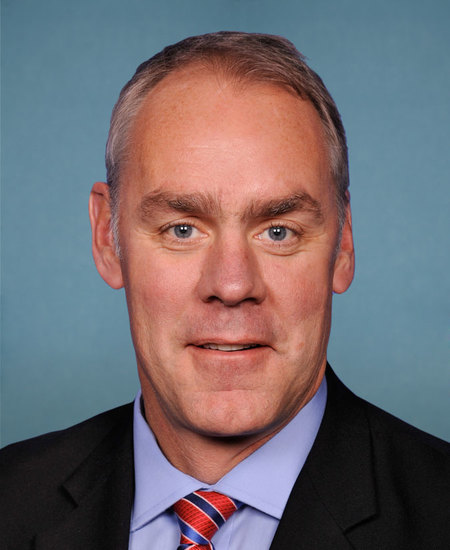
Photo of Ryan K. Zinke
R United States House · District 1 · Montana

Rep. Ryan K. Zinke

Compare
Total votes
1,879
all sessions
Attendance
97%
47 missed
Near the chamber average
With party
94%
of cast votes
Near the chamber average
Bipartisan score
3%
crosses aisle rarely
Near the chamber average
Sponsored
415
bills & resolutions
Lower than 84% of chamber peers
Committees
7
assignments
415 bills and resolutions

Sponsored bills

Total
415
Primary
31
Co-sponsor
384
This page
415
matching current filters
Co-sponsor HR 809
In committee · Oklahoma House · Co-sponsor
Prohibition of Agricultural Land for the People’s Republic of China Act

Prohibition of Agricultural Land for the People's Republic of China Act This bill requires the President to prohibit nonresident aliens, foreign businesses, and agents associated with China's government from (1) purchasing agricultural (including ranching) real estate located in the United States, or (2) participating in Department of Agriculture programs that are unrelated to food and safety regulatory requirements.

In committee Feb 2, 2023 1 co-sponsor
Co-sponsor HR 700
In committee · Oklahoma House · Co-sponsor
Supply Chain Disruptions Relief Act

Maddy summaryThis bill helps new car dealers affected by pandemic-era supply chain disruptions by changing tax rules for inventory sales. It allows dealers using LIFO accounting to treat certain sales of unsold vehicles (liquidations) between March 2020 and December 2021 as "qualified" for tax purposes. Dealers can defer recognizing income from these sales and have until 2026 to replace the sold vehicles before potential tax adjustments apply. The provision specifically targets dealers who couldn't replenish inventory during the supply chain crisis.

In committee Feb 1, 2023 1 co-sponsor
Co-sponsor HR 582
Passed · Oklahoma House · Co-sponsor
Credit Union Board Modernization Act

Maddy summaryHR 582, the Credit Union Board Modernization Act, changes the required meeting frequency for boards of directors at federal credit unions. It replaces a simple "monthly" requirement with tiered schedules based on each credit union's performance rating under the Uniform Financial Institutions Rating System. Top-rated credit unions (ratings 1 or 2) must meet at least six times yearly, with one meeting per fiscal quarter. Lower-rated credit unions (ratings 3, 4, or 5) must meet monthly, and new credit unions must meet monthly for their first five years. This directly affects all federal credit unions by adjusting their board meeting obligations based on their regulatory rating.

Passed Jan 31, 2023 1 co-sponsor
Co-sponsor HR 553
In committee · Oklahoma House · Co-sponsor
Workplace Choice and Flexibility for Individuals with Disabilities Act

Maddy summaryHR 553, the Workplace Choice and Flexibility for Individuals with Disabilities Act, amends the Rehabilitation Act of 1973 to clarify what counts as "competitive integrated employment" for people with disabilities. It updates the definition to explicitly include social interactions with colleagues and customers in regular workplace settings (not just isolated work units) and specifies that jobs paid through federal or state government contracts prioritizing disability employment support - such as those awarded to contractors or subcontractors meeting certain criteria - qualify as competitive. This change ensures state vocational rehabilitation programs can count these jobs as legitimate employment outcomes, aligning with Congressional intent that such roles be considered part of the broader labor market. The bill directly affects state agencies managing vocational rehabilitation services and government contractors providing disability-focused employment support.

In committee Jan 26, 2023 1 co-sponsor
Co-sponsor HR 513
In committee · Oklahoma House · Co-sponsor
FARM Act

Maddy summaryThis bill expands foreign investment review to cover U.S. agriculture by requiring transactions involving foreign control of agricultural businesses to undergo scrutiny by the Committee on Foreign Investment (CFIUS). It classifies agricultural supply chains as both critical infrastructure and critical technologies, directly affecting foreign entities seeking to acquire or influence U.S. farms, food production, and supply chains. The bill mandates annual reports from the Secretary of Agriculture and the Government Accountability Office on foreign investments in agriculture, including risks to food security and intellectual property. These provisions aim to mitigate potential threats to U.S. food supply chains from foreign adversaries through enhanced oversight.

In committee Jan 25, 2023 1 co-sponsor
Co-sponsor HR 22
Passed · Oklahoma House · Co-sponsor
Protecting America’s Strategic Petroleum Reserve from China Act

Maddy summaryHR 22, the *Protecting America’s Strategic Petroleum Reserve from China Act*, blocks the U.S. government from selling petroleum from the Strategic Petroleum Reserve to entities under Chinese Communist Party control or unless sellers guarantee the oil won’t be exported to China. It directly affects the Department of Energy’s management of the reserve and any foreign entities seeking to purchase reserve petroleum. The key mechanism requires the Secretary of Energy to prohibit sales to China-linked entities or impose strict export restrictions on any sale. This policy change aims to prevent strategic petroleum resources from reaching entities tied to China’s government.

Passed Jan 25, 2023 1 co-sponsor
Co-sponsor HR 335
In committee · Oklahoma House · Co-sponsor
STOP Fentanyl Act

Standardizing Thresholds Of Penalties for Fentanyl Act or the STOP Fentanyl Act This bill reduces the drug quantity thresholds that trigger a mandatory minimum prison term for a defendant who manufactures, distributes, imports, exports, or possesses with intent to distribute fentanyl. The bill also creates enhanced criminal penalties for certain violations involving fentanyl that was imported along the U.S.-Mexico border. Specifically, the bill reduces from 400 to 5 grams the fentanyl quantity and from 100 to 0.05 grams the fentanyl analogue quantity that trigger a mandatory minimum prison term for high-level first-time or repeat offenders. It also reduces from 40 to 0.5 grams the fentanyl quantity and from 10 to 0.005 grams the fentanyl analogue quantity that trigger a mandatory minimum prison term for low-level first-time or repeat offenders. Additionally, the bill creates enhanced mandatory minimum prison terms for importing or exporting fentanyl that was imported along the U.S.-Mexico border.

In committee Jan 20, 2023 1 co-sponsor
Co-sponsor HJRES 19
In committee · Oklahoma House · Co-sponsor
Proposing a balanced budget amendment to the Constitution requiring that each agency and department's funding is justified.

This joint resolution proposes a constitutional amendment prohibiting total outlays for a fiscal year from exceeding total receipts for that fiscal year unless (1) Congress authorizes the excess by a three-fifths vote of each chamber, and (2) total outlays do not exceed a specified percentage of the estimated gross domestic product of the United States. The prohibition excludes outlays for repayment of debt principal and receipts derived from borrowing. The amendment requires a three-fifths vote of each chamber of Congress to increase revenue or increase the limit on the debt of the United States. The amendment also requires the President to submit an annual budget in which total outlays do not exceed total receipts. The President's budget must also include justifications and specified details regarding funding proposed for departments and agencies. Congress may waive the requirements due to a declaration of war, a military conflict, an event that causes an imminent and serious military threat to national security, or a natural disaster.

In committee Jan 12, 2023 1 co-sponsor
Co-sponsor HR 297
In committee · Oklahoma House · Co-sponsor
To direct the Secretary concerned to reinstate a member involuntarily separated from the Armed Forces solely on the basis of the refusal of such member to receive a vaccination against COVID-19.

Maddy summaryHR 297 requires the military Secretary to reinstate service members who were involuntarily separated solely for refusing a COVID-19 vaccine. It applies specifically to those separated only due to vaccine refusal, not other reasons. If a covered member chooses reinstatement, they must be returned to their previous rank and branch of service. The bill mandates this action without requiring the member to receive the vaccine.

In committee Jan 11, 2023 1 co-sponsor
Showing 401 to 410 of 415 bills