

Transit to Trails Act of 2021 This bill directs the Department of Transportation (DOT) to establish the Transit to Trails Grant Program to award grants to certain governmental and private entities for projects that increase transportation access and mobility to public lands, inland and coastal waters, parkland, or monuments for critically underserved communities. For example, DOT must (1) prioritize approving certain projects, such as projects that use low-or zero-emission vehicles and those that provide free or discounted rates for low-income riders; (2) develop transportation planning procedures for projects conducted under the program that are consistent with metropolitan and statewide planning processes; and (3) ensure that all new transportation connectors and routes developed under the program are accessible to people with disabilities. The bill requires grant awards to be at least $25,000 and not more than $500,000. Further, the bill requires publicized schedules and routes for transportation systems that are developed after the receipt of a grant under the program.
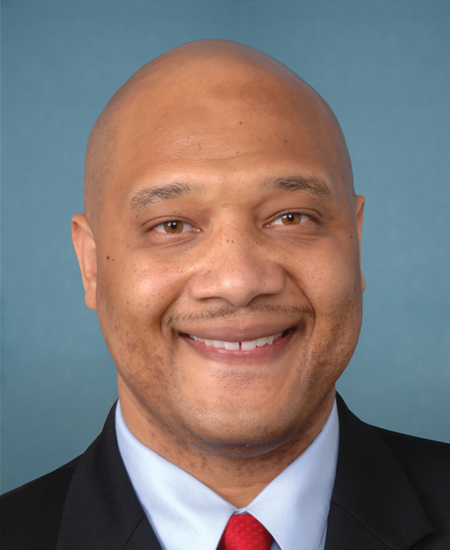
Rep. André Carson
Sponsored bills
Transform, Heal, and Renew by Investing in a Vibrant Economy Act or the THRIVE Act This bill establishes a program to address the economy, racial justice, and climate change. The President must establish a board to advise the President and the heads of federal departments and agencies regarding the implementation of this bill. The President, in consultation with the board, must establish a 10-year plan to create a society that enables and supports greater racial, Indigenous, gender, environmental, and economic justice; work opportunities; healthy communities; a stable climate; and healthy ecosystems. In addition, the President, in consultation with the board, must implement a program that provides support to public or private entities that carry out qualified programs. The programs must meet certain labor, equity, and environmental conditions and support infrastructure, including to expand access to pollution-free, renewable, and affordable energy; care workers and social infrastructure (e.g., health care infrastructure); expanded access to housing; efforts to protect and restore biodiversity or natural habitats and efforts to remediate pollution in communities harmed by environmental, economic, or socioeconomic injustice; agriculture, including agricultural workers; or the development and transformation of the U.S. industrial base, including by expanding manufacturing of clean technologies.
This resolution commemorates the centennial of the establishment of the state of Jordan, expresses admiration and gratitude for the friendship of the Jordanian people, and looks forward to continued cooperation with Jordan on shared national priorities.
Mark Takai Atomic Veterans Healthcare Parity Act This bill includes veterans who participated in the cleanup of Enewetak Atoll in the Marshall Islands between January 1, 1977, and December 31, 1980, as radiation-exposed veterans for purposes of the Department of Veterans Affairs presumption of service-connection for specified cancers. Under a presumption of service-connection, specific conditions diagnosed in certain veterans are presumed to have been caused by the circumstances of their military service. Health care benefits and disability compensation may then be awarded.
This concurrent resolution (1) affirms, on the 400th anniversary of the arrival of the first slave ship, that the nation owes a debt of remembrance not only to those who lived through the injustices of slavery but also to their descendants; and (2) urges the establishment of a U.S. Commission on Truth, Racial Healing, and Transformation to properly acknowledge, memorialize, and be a catalyst for progress, including toward permanently eliminating persistent racial inequities.
This joint resolution proposes a constitutional amendment declaring that women shall have equal rights in the United States and every place subject to its jurisdiction. The amendment prohibits the United States or any state from denying or abridging equal rights under the law on account of sex.
This resolution expresses support for National Sexual Assault Awareness and Prevention Month.
This resolution expresses the sense of the House of Representatives that Marcus Garvey should be recognized as a leader in the struggle for human rights and that the President should take measures to exonerate him of charges brought against him.
This resolution condemns and denounces all forms of anti-Asian sentiment, including those related to COVID-19 (i.e., coronavirus disease 2019), and calls on federal law enforcement officials, working with state and local agencies, to take specified steps. The resolution calls on federal officials to expeditiously investigate and document all credible reports of hate crimes, harassment, bullying, and threats against the Asian American and Pacific Islander communities; the Attorney General to work with state and local agencies and Asian American and Pacific Islander community-based organizations to prevent discrimination and to expand culturally competent and linguistically appropriate education campaigns on public reporting of hate crimes; and the Department of Health and Human Services to issue guidance describing best practices to mitigate racially discriminatory language in describing the pandemic. The resolution recommits the United States to serving as a world leader in building more inclusive, diverse, and tolerant societies by (1) prioritizing language access and inclusivity in communication practices, and (2) combating misinformation and discrimination that put Asian Americans and Pacific Islanders at risk.
This resolution supports the designation of National Teen Dating Violence Awareness and Prevention Month.