

Maddy summaryThe Family Violence Prevention and Services Improvement Act of 2026 amends federal law to enhance support for victims of family violence, domestic violence, and dating violence. The bill authorizes $270 million annually for fiscal years 2027-2031 to fund state, tribal, and community programs, with specific funding reserved for tribal programs (12.5%), national hotlines ($20.5 million for general hotline, $4 million for Indian hotline), and services for underserved populations. It requires grantees to provide trauma-informed, culturally appropriate services while prohibiting discrimination and protecting victim confidentiality, and mandates accessibility for people with disabilities and limited English proficiency. The bill also establishes new technical assistance centers, Tribal resource centers, and community-based prevention programs to address the needs of underserved populations including Native Hawaiians, Alaska Natives, and racial and ethnic minorities.
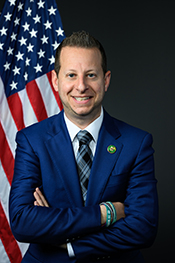
Rep. Jared Moskowitz
Sponsored bills
Maddy summaryThis bill (HR 7313) designates the U.S. Postal Service facility at 3135 1st Avenue North in St. Petersburg, Florida, as the "Poul Hornsleth Post Office." It updates all federal references - such as maps, documents, and regulations - to use the new name for this specific location. The bill has no policy impact beyond renaming the post office and does not affect any individuals or create new requirements. It is a procedural measure to honor Poul Hornsleth through official designation.
Maddy summaryThe CARE for First Responders Act (HR 6601) provides mental health support specifically for first responders, including emergency personnel and 911 operators (defined as "qualified emergency response providers"). It requires the creation of a 24/7 confidential hotline via the 988 Suicide Lifeline, peer support programs staffed by trained responders, and mobile crisis units that offer on-site mental health services during major disasters. The bill mandates trauma-informed, culturally appropriate care and education to reduce stigma around mental health, with a focus on helping responders and their families adjust after disaster work. It authorizes $5 million annually (2026-2030) for these services through grants to state/local health entities.
Maddy summaryHR 6547, the Least Cost Exception Act, modifies the Federal Deposit Insurance Act to allow the FDIC (as the "Corporation") to select non-least-cost resolution methods for failing banks if certain conditions are met. It directly affects the FDIC, the Deposit Insurance Fund, and major global banking institutions by permitting exceptions to standard cost-minimization rules. Key provisions require the FDIC to determine that an alternative method limits further concentration among large banks, comply with specific cost and risk thresholds, and pay the Fund for cost differences over at least five years. The bill mandates annual reporting to Congress on such decisions and defines "covered alternatives" as the least-cost method involving sales to global systemically important banks.
Maddy summaryHR 7271, the Evan Anzoo Memorial Act, requires the Comptroller General to produce a report investigating deaths linked to USAID service cuts. The bill mandates a one-year report estimating 2025 deaths and five-year future deaths due to USAID stop-work orders, plus an assessment of whether specific individuals (like Evan Anzoo, 5, South Sudan, who died after losing HIV treatment) died because of lost USAID services. It also requires an interim update within 180 days and a list of other verified deaths tied to these service disruptions. The act does not change USAID policy but directs a factual review of impacts from prior USAID service reductions.
Maddy summaryThis bill modifies how certain payments are counted toward income for veterans' pension eligibility. It excludes reimbursements for medical expenses (up to actual medical costs) and pain/suffering payments (up to Secretary's case-by-case limit) from income calculations. This directly affects veterans and surviving spouses/children who receive such payments, preventing these reimbursements from reducing their pension benefits. The changes take effect 180 days after the bill's enactment.
Maddy summaryHR 7178, the U.S.-Israel Anti-Killer Drone Act of 2026, requires enhanced U.S.-Israel cooperation to counter Iranian unmanned systems. The bill directs the U.S. and Israel to jointly develop, test, and deploy counter-drone technologies through their existing Operations Technology-Working Group, including sharing threat intelligence and conducting joint training. It increases annual funding for this cooperation from $55 million to $100 million and mandates detailed annual reports to Congress on progress, threat assessments, and the adequacy of current counter-drone capabilities. The bill directly affects U.S. and Israeli military forces by accelerating joint efforts to address threats from Iran-origin drones targeting U.S. allies and military assets in the Middle East.
Maddy summaryThis bill amends the National Defense Authorization Act to require a new unclassified strategy for countering drug trafficking in the Middle East following the fall of Syria's Assad regime. It directs U.S. agencies to assess Captagon and methamphetamine trafficking patterns, identify countries receiving large shipments, evaluate those nations' counter-narcotics capacity, and review U.S. assistance programs. The strategy must also evaluate international cooperation efforts and provide recommendations to disrupt networks linked to former Assad regime actors, Hezbollah, and Iran-backed groups. The bill directly affects U.S. military and law enforcement agencies (like U.S. Central Command) and countries receiving U.S. counter-narcotics aid in the region.
Maddy summaryHR 7171, the Fair Legal Access Grants Act, provides federal grants to states, local governments, and Tribal governments to help individuals seeking extreme risk protection orders (ERPOs) access legal resources. The bill authorizes $50 million annually from 2028 to 2034 to fund legal representation, multilingual legal resource centers, and training for legal and law enforcement staff on ERPO processes. It directly affects people eligible to petition for ERPOs - court orders designed to temporarily restrict firearm access when someone poses a risk of harm to themselves or others. The grants aim to ensure petitioners receive counsel, translation services, and accurate information about the ERPO process, without interfering with state court jurisdiction over such cases.
Maddy summaryThis bill requires the Department of Justice and Health and Human Services to translate key gun violence prevention materials - including extreme risk protection orders and safe storage guides - into the 10 most common non-English languages in the U.S. (like Mandarin, Spanish, and Korean) for limited English proficient populations. It mandates that community-based organizations review translations for cultural appropriateness before publication and prioritizes grant applications that include outreach plans for these communities. The bill also directs DOJ and HHS to create public awareness campaigns using in-language, culturally tailored messaging to promote gun violence prevention strategies. These provisions apply directly to federally funded programs and services aimed at reducing firearm-related harm.