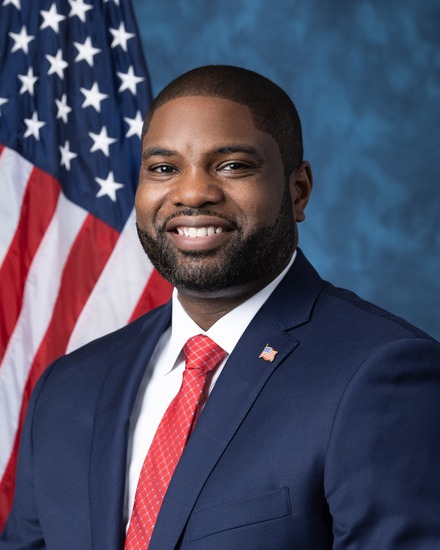
Photo of Byron Donalds
R United States House · District 19 · Florida

Rep. Byron Donalds

Compare
Total votes
2,837
all sessions
Attendance
93%
186 missed
Lower than 93% of chamber peers
With party
90%
of cast votes
Lower than 90% of chamber peers
Bipartisan score
5%
crosses aisle rarely
Higher than 89% of chamber peers
Sponsored
1,462
bills & resolutions
Near the chamber average
Committees
6
assignments
1,462 bills and resolutions

Sponsored bills

Total
1,462
Primary
143
Co-sponsor
1,319
This page
1,462
matching current filters
Co-sponsor HR 1993
Passed · Oklahoma House · Co-sponsor
25th Anniversary of 9/11 Commemorative Coin Act

Maddy summaryThis bill authorizes the U.S. Mint to produce commemorative $5 gold and $1 silver coins marking the 25th anniversary of the September 11, 2001, terrorist attacks. The coins must feature designs honoring victims and first responders (including the inscription "Never Forget") and will be sold only during 2027-2028. All surcharges ($35 per gold coin, $10 per silver coin) collected from sales will fund the National September 11 Memorial and Museum at the World Trade Center, with no net cost to the federal government. The coins are legal tender but primarily intended for collectors, not circulation.

Passed May 21, 2026 1 co-sponsor
Co-sponsor HR 8920
In committee · Oklahoma House · Co-sponsor
Restoring the American Homebuyers Dream Act

Maddy summaryThis bill, titled the Restoring the American Homebuyers Dream Act, aims to share taxpayer information with immigration authorities to help enforce U.S. immigration laws. It modifies the Internal Revenue Code to allow the Department of Homeland Security to request specific details from individuals who use Individual Taxpayer Identification Numbers (ITINs). The information that can be shared includes the person's name, address, ITIN, filing status, and details about their dependents or spouse. The bill states that this data will only be used for immigration enforcement purposes and must be protected under the same rules as other taxpayer information.

In committee May 20, 2026 1 co-sponsor
Primary HR 8812
In committee · Oklahoma House · Lead sponsor
Build Nuclear with Local Materials Act of 2026

Maddy summaryThis bill directs the Nuclear Regulatory Commission to allow the use of standard commercial steel and concrete in non-safety parts of nuclear power plants within 90 days of enactment. The primary goal is to let plant operators use readily available building materials instead of specialized nuclear-grade supplies, which could lower costs and speed up construction. However, the agency retains the authority to reject this approach if it determines that using standard materials would compromise public safety or national security. Ultimately, the law shifts the default material requirements for non-critical plant structures while keeping the final safety decision with the regulator.

In committee May 14, 2026 0 co-sponsors
Co-sponsor HR 8791
In committee · Oklahoma House · Co-sponsor
IGNITE HBCU Excellence Act

Maddy summaryThe IGNITE HBCU Excellence Act authorizes federal grants to Historically Black Colleges and Universities (HBCUs) to fund long-term improvements to their campus facilities and infrastructure. These grants are awarded competitively to eligible HBCUs based on criteria such as the age of their facilities, deferred maintenance needs, financial capacity, and student enrollment levels. Recipients may use the funds to construct or renovate buildings, upgrade technology and broadband systems, improve safety measures, and develop workforce training hubs, while being prohibited from using the money for routine maintenance or athletic facilities. The legislation also includes provisions for reporting on project outcomes and requires institutions to create comprehensive master plans that involve consultation with diverse campus and community stakeholders.

In committee May 13, 2026 1 co-sponsor
Co-sponsor HR 2853
Passed · Oklahoma House · Co-sponsor
Combating Organized Retail Crime Act of 2025

Maddy summaryThis bill would amend federal law to strengthen penalties for organized retail crime by expanding definitions of theft to include digital goods, gift cards, and setting a $5,000 aggregate value threshold for charges over a 12-month period. It would establish a new "Organized Retail and Supply Chain Crime Coordination Center" under Homeland Security to coordinate Federal, State, local, and Tribal law enforcement efforts against cross-jurisdictional theft groups. The Center would share information with retailers, transportation companies, and law enforcement agencies, track crime trends, and produce annual reports on organized retail crime. This legislation directly affects retailers, supply chain businesses, and law enforcement agencies, while targeting organized crime groups responsible for a 93% increase in larceny incidents and rising safety concerns for retail employees. The bill aims to address significant financial losses and supply chain disruptions noted in the National Retail Federation's 2023 data.

Passed May 13, 2026 1 co-sponsor
Co-sponsor HR 2071
Passed · Oklahoma House · Co-sponsor
Save Our Shrimpers Act

Save Our Shrimpers Act This bill prohibits federal funds from being made available to international financial institutions (e.g., the International Monetary Fund) for financing activities related to foreign shrimp farms. The bill also requires an annual report on compliance by U.S. leadership of international financial institutions with policies to oppose financing for certain commodities or minerals. Specifically, the bill requires the Department of the Treasury to condition any provision of federal funds to an international financial institution on the requirement that the funds not be used to finance any activity related to shrimp farming, shrimp processing, or the export of shrimp in any foreign country. Under current law, Treasury must instruct U.S. leadership of international financial institutions to oppose providing financial assistance for the production or extraction of any commodity or mineral for export if (1) the commodity or mineral is in surplus on world markets, and (2) the export of such commodity or mineral will cause substantial injury to U.S. producers of a competing commodity or mineral (or of the same or a similar commodity or mineral). This bill requires the Government Accountability Office to investigate and annually report to Congress on the extent to which U.S. leadership at these institutions have carried out Treasury's instructions.

Passed May 13, 2026 1 co-sponsor
Co-sponsor HR 8730
In committee · Oklahoma House · Co-sponsor
Connected Vehicle Security Act of 2026

Maddy summaryThe Connected Vehicle Security Act of 2026 restricts the importation, sale, and manufacture of vehicles and related technology from specific countries, including China, Russia, Iran, and North Korea, to address national security concerns. The law defines prohibited items as connected vehicles, their software, and hardware components and sets different effective dates, with vehicle bans starting in 2027 and hardware restrictions beginning in 2030. A government official can grant exceptions for specific items after reviewing security risks and notifying Congress, while the agency must publish annual reports on enforcement actions and compliance.

In committee May 11, 2026 1 co-sponsor
Co-sponsor HR 8445
In committee · Oklahoma House · Co-sponsor
Stop DEI Act

Maddy summaryThe Stop DEI Act proposes to prohibit federal funding for institutions of higher education. Specifically, it states that colleges and universities would be ineligible for funds from federal education programs. This ineligibility would occur if an institution considers an individual's race, sex, ethnicity, color, or national origin in ways that violate existing civil rights laws. The bill's aim is to prevent federal funds from being used by institutions whose practices related to these characteristics are deemed to be in violation of those laws.

In committee Apr 22, 2026 1 co-sponsor
Co-sponsor HR 8408
In committee · Oklahoma House · Co-sponsor
Legacy IT Reduction Act of 2026

Maddy summaryThe Legacy IT Reduction Act of 2026 requires federal agencies to create and maintain an inventory of their outdated information technology systems, including details about costs, vendors, and planned updates. Under this bill, agency heads must develop five-year modernization plans every two years that outline how they will update, retire, or replace these legacy systems, with submissions to congressional oversight committees. The Office of Management and Budget will issue guidance on what qualifies as a legacy system and provide templates for inventory and planning, while the Comptroller General will review implementation three years after enactment. The law does not authorize new funding and will expire six years after enactment, with specific exemptions for national security systems and protections against transferring systems to foreign entities.

In committee Apr 21, 2026 1 co-sponsor
Primary HR 8371
In committee · Oklahoma House · Lead sponsor
Reform Immigration Through Biometrics Act

Maddy summaryThe Reform Immigration Through Biometrics Act requires the Secretary of Homeland Security to submit several reports to Congress within 180 days of the bill's enactment. These reports must detail the status, impact, and effectiveness of the existing integrated biometric entry and exit data system. Specifically, the reports will cover the system's effects on legitimate travel, counterterrorism efforts, and identifying individuals who overstay their visas, while ensuring minimal disruption to travel. It also mandates an assessment of how the system matches biometric information for individuals departing the United States against previously collected data, including privacy protections for U.S. citizens regarding facial recognition. Additionally, the bill requires an evaluation of biographic data sharing with the Canadian Border Services Agency.

In committee Apr 21, 2026 0 co-sponsors
Showing 41 to 50 of 1,462 bills
Previous 1 … 4 5 6 … 147 Next