Maddy summarySRES 485 is a Senate resolution honoring the late Senator Harry Mason Reid, Jr., of Nevada, who died in 2021. The resolution expresses the Senate's sorrow at his passing, extends condolences to his family, and directs the Secretary of the Senate to communicate the resolution to the House of Representatives and provide a copy to Reid's family. The Senate also adjourned in his memory as a mark of respect. This is a ceremonial tribute with no policy changes or legal effect.
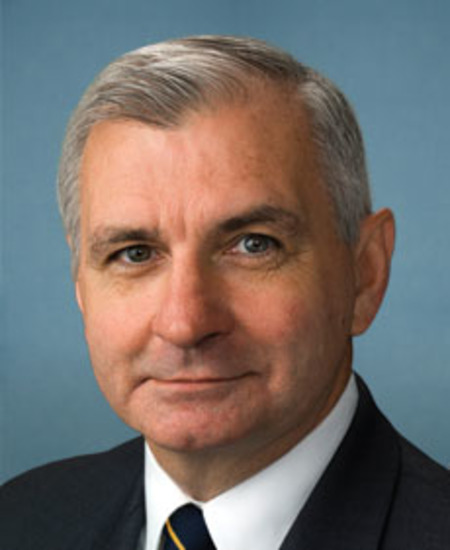
Sen. Jack Reed
Sponsored bills
Maddy summarySRES 484 is a ceremonial Senate resolution honoring the late Senator John "Johnny" Isakson of Georgia. It formally recognizes his 40+ years of public service, including his roles in the Georgia legislature, U.S. House, and U.S. Senate, and his reputation for bipartisan cooperation. The resolution requests the Senate Secretary communicate it to the House and send a copy to Isakson's family. As a commemorative resolution, it has no policy impact or direct effect on any individuals or programs.
This concurrent resolution directs the Secretary of the Senate to make corrections in the enrollment of S. 1605 (National Defense Authorization Act for Fiscal Year 2022) to amend amounts relating to the Eielson Air Force Base and AEGIS Ashore Barracks Planning and Design in Redzikowo, Poland.
Latonya Reeves Freedom Act of 2021 This bill prohibits government entities and insurance providers from denying community-based services to individuals with disabilities that require long-term service or support that would enable such individuals to live in the community and lead an independent life. Specifically, these entities may not discriminate against such individuals in the provision of community-based services by such actions as imposing prohibited eligibility criteria, cost caps, or waiting lists or failing to provide a specific community-based service. Additionally, community-based services must be offered to individuals with such disabilities prior to institutionalization. Institutionalized individuals must be notified regularly of community-based alternatives. The bill requires the Department of Justice to issue regulations requiring government entities and insurance providers to offer community-based long-term services to individuals with such disabilities who would otherwise qualify for institutional placement. Government entities must ensure sufficient availability of affordable, accessible, and integrated housing that is not a disability-specific residential setting or a setting where services are tied to tenancy. Regulations shall also (1) require government entities and insurance providers to perform self-evaluation on current services, policies, and practices and concerning compliance with requirements of this bill; and (2) require government entities to submit a transition plan. The bill provides funds for FY2022 for the Department of Health and Human Services to provide technical assistance with respect to transition plans. The bill allows civil actions by individuals subjected to, or about to be subjected to, a violation of its requirements.
Daniel Anderl Judicial Security and Privacy Act of 2021 This bill generally prohibits federal agencies and private businesses from publicly posting certain personal information (e.g., home addresses) of federal judges and their immediate family members. It also (1) requires information to be removed upon written request from the federal judge concerned, (2) prohibits data brokers from purchasing or selling such information, and (3) establishes programs to protect such information at the state and local level and to enhance security for judges.
Global War on Terrorism Memorial Location Act This bill authorizes the establishment of a National Global War on Terrorism Memorial in the area of the National Mall.
This bill authorizes the National Medal of Honor Museum Foundation to establish a commemorative work on federal land in the District of Columbia in honor of the extraordinary acts of valor, selfless service, and sacrifice displayed by Medal of Honor recipients. The foundation shall be solely responsible for the acceptance of contributions for, and the payment of expenses of, the establishment of the commemorative work. Federal funds may not be used to pay any expenses for the establishment of the commemorative work.
Vet Center Improvement Act of 2021 This bill requires the Department of Veterans Affairs (VA) to evaluate productivity expectations for readjustment counselors of Vet Centers, including by obtaining feedback from counselors that must be audited annually for five years by the Government Accountability Office. The VA must also (1) develop and implement a staffing model for Vet Centers, (2) standardize descriptions of position responsibilities at Vet Centers, and (3) award grants to address food insecurity among veterans and family members of veterans who receive services through Vet Centers or other VA facilities.
Protecting Medicare and American Farmers from Sequester Cuts Act This bill makes several budgetary, technical, and procedural changes, particularly in relation to Medicare and increasing the debt limit. Specifically, the bill continues to exempt Medicare from sequestration until March 31, 2022. (Sequestration is a process of automatic, usually across-the-board spending reductions under which budgetary resources are permanently cancelled to enforce specific budget policy goals.) The bill also establishes expedited Senate procedures for considering legislation to increase the debt limit. The procedures limit debate, waive points of order, and prohibit amendments. The procedures may only be used once and expire after January 16, 2022. Additionally, the bill (1) temporarily extends other provisions under Medicare, including a payment increase under the physician fee schedule; and (2) requires any debits recorded for FY2022 on the statutory pay-as-you-go (PAYGO) scorecards to be deducted from the scorecards for 2022 and added to the scorecards for 2023.
Humane Cosmetics Act of 2021 This bill generally prohibits animal testing in the evaluation of cosmetic products, and it prohibits the sale or transport of cosmetics developed using animal testing, subject to civil penalties. These prohibitions begin one year after enactment. The bill specifies exceptions to these prohibitions, including if such animal testing (1) is conducted outside the United States to comply with a foreign regulatory authority; (2) is pursuant to a specified finding that there are no nonanimal alternatives to test the safety of a potentially dangerous cosmetic product or ingredient; (3) is of a product or ingredient for a drug or device subject to regulation by the Food and Drug Administration (FDA); or (4) is required for a noncosmetic purpose pursuant to a state, federal, or foreign regulatory authority. Further, no animal-testing evidence may be used to establish the safety of a cosmetic product or ingredient that is regulated by the FDA after the effective date of this bill, subject to limited exceptions.