Maddy summarySRES 148 is a ceremonial resolution passed by the U.S. Senate to honor the late Senator Alan K. Simpson of Wyoming, who died in 2022. The resolution expresses the Senate's "profound sorrow and deep regret" over his passing and formally requests the Secretary of the Senate to transmit an enrolled copy to his family. It also directs the Senate to adjourn as a mark of respect during its final session following the resolution's adoption. This resolution has no policy impact or direct effect on constituents - it solely serves as a formal tribute to Simpson's legacy.
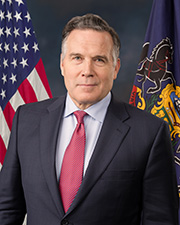
Sen. David McCormick
Sponsored bills
Maddy summaryThe Stop Antisemitism on College Campuses Act requires colleges and universities receiving federal funding to prohibit events promoting antisemitism on their campuses. It defines antisemitism using the International Holocaust Remembrance Alliance's 2016 working definition, including specific contemporary examples like conflating Zionism with racism. The law explicitly bans institutions from authorizing, funding, or supporting such events, applying to all higher education institutions covered under the Higher Education Act of 1965. This policy change directly affects campus event policies at federally funded colleges and universities.
Maddy summaryThis bill allows state and federal correctional facilities (like jails and prisons) to operate cellphone jamming systems to block wireless signals used for contraband devices or by incarcerated individuals. It restricts the FCC from preventing this use, but requires jamming systems to be limited to housing areas within the facility. Facilities must fund the systems entirely themselves (if state-run), consult local law enforcement before implementation, and notify the Bureau of Prisons about operations. The law specifically targets blocking signals to/from contraband devices or inmates, not general cellphone use.
Maddy summaryThe PHIT Act of 2025 (S 1144) allows taxpayers to deduct certain fitness expenses as medical costs on federal income taxes. It covers gym memberships, exercise classes, and fitness equipment (up to $1,000 per person annually, or $2,000 for joint filers), provided the expenses are exclusively for physical activity. Equipment must be used solely for exercise (e.g., athletic shoes worn only for activity), and facilities must meet strict criteria like excluding golf/sailing and complying with anti-discrimination laws. The bill aims to reduce financial barriers to healthy habits by making these costs tax-deductible for eligible taxpayers who itemize deductions.
Financial Integrity and Regulation Management Act or the FIRM Act This bill prohibits the consideration of reputational risk by federal banking agencies when regulating, examining, or supervising a depository institution or credit union. The bill defines reputational risk as the potential for negative publicity or public attention to decrease confidence in the institution, lead to litigation, reduce revenues, or result in other adverse impacts to the institution. Agencies must report on the implementation of this bill.
Maddy summaryThis bill repeals federal waivers that allow California to set its own vehicle and engine emission standards under the Clean Air Act. It directly affects California's Air Resources Board (CARB), prohibiting the state from adopting or enforcing standards for nonroad engines (like construction equipment, farm vehicles, and locomotives) or new motor vehicles. Key provisions include removing federal authorization for California's vehicle standards (Section 177) and invalidating all existing waivers for state emission rules. The bill would eliminate California's ability to enforce its own emission requirements for these categories, shifting authority entirely to federal standards.
Maddy summaryThe Safeguarding Medicaid Act (S 1082) requires all Medicaid applicants and recipients in every state and territory to undergo an asset test, removing previous exemptions for people who are aged, blind, or disabled. It sets the resource limit for eligibility at the same level used for Supplemental Security Income (SSI) benefits, meaning individuals with assets above this threshold would be ineligible for Medicaid. The bill also mandates states to implement electronic asset verification systems within one year of enactment and report annually on the number of asset checks conducted during eligibility renewals and new applications. This affects all Medicaid applicants and recipients nationwide, with states required to track and report savings from these verification efforts to the federal government.
Maddy summaryThis bill expands the Work Opportunity Tax Credit to include military spouses. It adds "qualified military spouse" as a new category eligible for the credit, meaning employers who hire spouses of active-duty service members can claim the tax benefit. To qualify, a spouse must be certified by a local agency as married to an Armed Forces member at the time of hire. The change applies to hires occurring after the law's effective date, directly affecting military spouses seeking employment and employers who hire them.
Maddy summaryThis bill, the Major Richard Star Act (S 1032), allows veterans with combat-related disabilities to receive both their military retired pay and Veterans Affairs disability compensation simultaneously. It amends U.S. Code sections to remove the automatic reduction in retired pay that previously forced these veterans to choose between the two payments. The key change ensures veterans with combat-related disabilities qualify for full retired pay without offset against their VA disability benefits, effective for payments starting after the bill's enactment date. This directly affects veterans receiving military retired pay under Chapter 61 who also qualify for VA disability compensation for combat-related injuries.
Maddy summaryThe FIGHT China Act of 2025 restricts U.S. investments in Chinese companies with ties to China's military or surveillance sectors. It prohibits U.S. persons from engaging in transactions involving "prohibited technologies" such as advanced semiconductors (with specific technical specifications), AI systems, quantum computing, and hypersonic weapons, while requiring notification for certain "notifiable technology" investments. The bill mandates that U.S. investors divest from companies on the Non-SDN Chinese Military-Industrial Complex Companies List within one year of enactment. It establishes a process for identifying Chinese entities subject to these restrictions, with annual reports to Congress required for seven years.