American Innovation and Jobs Act This bill revises and expands the deductibility of research and experimental expenditures to allow immediate expensing of such expenditures. It also allows the amortization over a period of at least 60 months of certain other types of research and experimental expenditures not treated as expenses. The bill increases the maximum amount eligible for the tax credit for new and small businesses and increases to 20% the rate of the credit for business startups.
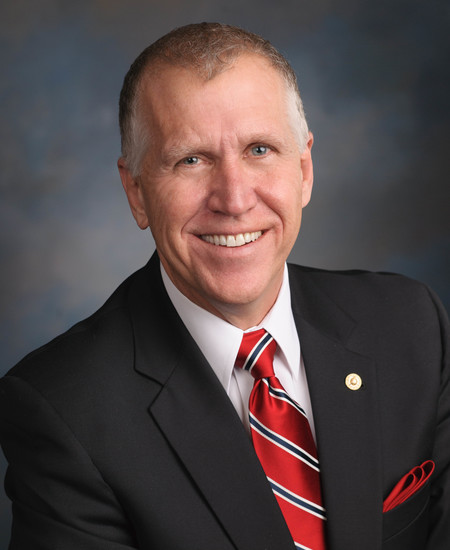
Sen. Thom Tillis
Sponsored bills
Let States Cut Taxes Act This bill removes a prohibition on states and territories using COVID-19 (i.e., coronavirus disease 2019) relief funding under the American Rescue Plan Act of 2021 to offset a reduction in revenue resulting from a reduction in taxes or a delay in the imposition of a tax or tax increase.
Highway Formula Fairness Act This bill modifies the formula that the Department of Transportation uses to apportion federal highway funds among the states for the national highway performance program, the surface transportation block grant program, the highway safety improvement program, the congestion mitigation and air quality improvement program, the national highway freight program, and metropolitan transportation planning.
Sister City Transparency Act This bill requires the Government Accountability Office to study the activities of sister city partnerships involving foreign communities in countries that received a score of 45 or less on Transparency International's 2019 Corruption Perceptions Index. A sister city partnership is a formal agreement between a U.S. community and a foreign community that is recognized by Sister Cities International and that is operating within the United States. Among other elements, the required study must (1) identify oversight practices that U.S communities implement to mitigate the risks of foreign espionage and economic coercion within sister city partnerships, (2) assess the extent to which U.S. communities ensure transparency regarding sister city partnership contracts and activities, and (3) review the range of activities conducted within sister city partnerships.
Mens Rea Reform Act of 2021 This bill establishes a default mens rea standard (i.e., state of mind requirement) for federal criminal offenses—statutory and regulatory—that lack an explicit standard. The government must generally prove that a defendant acted willfully with respect to each element of an offense for which the text does not specify a state of mind.
This resolution condemns the Chinese Coast Guard's military aggression against foreign vessels and the government of China's unlawful claims to the South China Sea. It also applauds the U.S. Navy and the U.S. Coast Guard for their continued efforts to conduct freedom of navigation operations.
Developing Responsible Individuals for a Vibrant Economy Act or the DRIVE Safe Act This bill directs the Department of Transportation to promulgate regulations to implement an apprenticeship program for licensed commercial motor vehicle drivers under the age of 21. Under the program, an apprentice must complete two probationary periods that total 400 hours of on-duty time, of which at least 240 hours must be driving time in a commercial motor vehicle. Additionally, the apprentice must be accompanied in the cab of the commercial motor vehicle by an experienced driver. Further, the bill requires all commercial motor vehicles used in the program for training to be equipped with safety technology such as active braking collision mitigation systems and video event capturing systems. An employer shall not knowingly allow, require, permit, or authorize a driver under the age of 21 to operate a commercial motor vehicle unless the driver is participating in, or has completed, an apprenticeship program that meets the requirements set forth in this bill.
Achieving Thorough Transparency and Accessibility for Information Navigation on Mental Health Act of 2021 or the ATTAIN Mental Health Act This bill requires the Department of Health and Human Services (HHS) to establish a public-facing, online dashboard to publicize federally funded mental health grants. The dashboard must contain, for example, program names and opening and closing dates for applications. In addition, HHS must establish a process to include information voluntarily provided by states about their federally supported mental health grants on the dashboard. In developing the dashboard, HHS must consult with appropriate federal departments and agencies and other stakeholders.
Child Welfare Provider Inclusion Act of 2021 This bill generally prohibits the federal government, states, tribal nations, or localities from discriminating or taking adverse action against a child welfare provider that declines to provide services due to the provider's sincerely held religious beliefs or moral convictions. However, government entities may still take adverse action against a provider that declines to provide adoption or foster care services based on race, color, or national origin. The Department of Health and Human Services must withhold a portion of federal funding for family services and child welfare activities from a government entity that discriminates against a child welfare provider in violation of this bill. Child welfare providers may also sue the government entity for such discrimination. A prevailing provider may recover reasonable attorney's fees and costs. Furthermore, government entities that accept certain federal funding for family services and child welfare activities must waive sovereign immunity as a defense to lawsuits brought under this bill. (In many cases, sovereign immunity shields states, territories, tribal nations, and some localities against private suits.)
Strengthening and Amplifying Vaccination Efforts to Locally Immunize all Veterans and Every Spouse Act or the SAVE LIVES Act This bill authorizes the Department of Veterans Affairs (VA) to furnish a COVID-19 (i.e., coronavirus disease 2019) vaccine to covered individuals during the COVID-19 public health emergency. Under the bill, covered individuals are veterans who are not eligible to enroll in the VA health care system; specified veterans who are eligible for hospital care, medical services, and nursing home care abroad; beneficiaries who are eligible for care due to a specified disability or death of a veteran; family caregivers of veterans who are participating in the VA's Program of Comprehensive Assistance for Family Caregivers; caregivers of veterans participating in the VA's Program of General Caregiver Support Services; caregivers of veterans participating in the VA's Medical Foster Home Program, Bowel and Bladder Program, Home Based Primary Care Program, or Veteran Directed Care Program; and the spouses of veterans. The VA must prioritize the vaccination of (1) veterans who are enrolled in the VA health care system, (2) veterans who fail to enroll but receive hospital care and medical services for specified disabilities in their first 12 months of separation from service, and (3) caregivers accompanying such prioritized veterans. Under the bill, the VA is authorized to offer a vaccine to the spouse of a veteran near the same time the veteran receives the vaccine.