American Cures Act This bill permanently funds several federal agencies and programs that perform biomedical research. The bill provides specified funding for the National Institutes of Health, the Centers for Disease Control and Prevention, the Department of Defense health program, and the Department of Veterans Affairs medical and prosthetics research program. The bill exempts the funding from sequestration, which is a process of automatic, usually across-the-board spending reductions under which budgetary resources are permanently cancelled to enforce specific budget policy goals. It also exempts the budgetary effects of the funding from the Statutory Pay-As-You-Go Act of 2010 (PAYGO) and the Senate PAYGO rule.
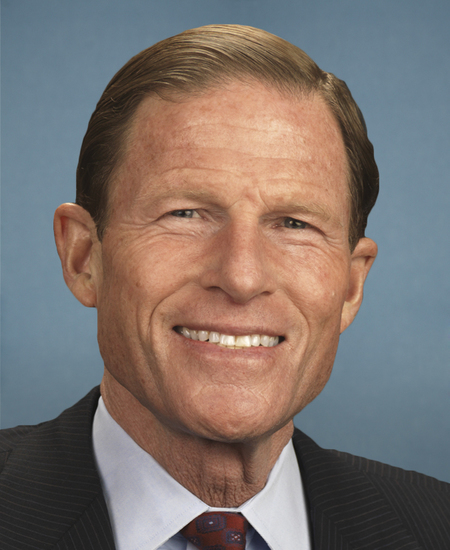
Sen. Richard Blumenthal
Sponsored bills
No Junk Plans Act This bill nullifies a rule by the Department of Treasury, the Department of Labor, and the Department of Health and Human Services regarding short-term, limited-duration health insurance plans. Short-term, limited-duration health insurance plans are plans that may only offer coverage for a limited amount of time under law and that are exempt from the market requirements of the Patient Protection and Affordable Care Act (e.g., coverage of individuals with preexisting conditions). The rule increases the maximum authorized duration of such plans from less than 3 months (including renewals) to an initial maximum duration of less than 12 months (with a total duration of up to 36 months, including renewals). The rule took effect October 2, 2018.
This resolution celebrates the successes of American Indian, Alaska Native, and Native Hawaiian women and the contributions they have made in the United States. The resolution also recognizes the importance of supporting equity, providing safety, and upholding the interests of these women.
This resolution designates March 2021 as National Women's History Month. The resolution also recognizes the celebration of such month as a time to reflect on the contributions that women have made to the United States.
Water Affordability, Transparency, Equity, and Reliability Act of 2021 This bill provides funding for several programs related to controlling water pollution or protecting drinking water, revises requirements concerning the clean water state revolving fund (SRF) and the drinking water SRF, and creates or reauthorizes several grant programs for water infrastructure. For example, the Environmental Protection Agency must establish a grant program for repairing, replacing, or upgrading septic tanks and drainage fields. In addition, the bill makes permanent a grant program for household water well systems in rural areas. It also increases the amount of appropriations for grant programs, including a program that awards grants to prevent lead from contaminating drinking water fountains in schools and day care facilities.
Intercity Passenger Rail Trust Fund Act This bill establishes in the Treasury an Intercity Passenger Rail Trust Fund designed to ensure a safe, sustainable, convenient transportation option for the people of the United States. Amounts in the fund may be used by the Department of Transportation to award grants to the National Railroad Passenger Corporation (Amtrak) for activities associated with the Northeast Corridor and the National Network (Amtrak's state-supported and long-distance service lines).
Prescription Drug Price Relief Act of 2021 This bill establishes a series of oversight and disclosure requirements relating to the prices of brand-name drugs. Specifically, the bill requires the Department of Health and Human Services (HHS) to review at least annually all brand-name drugs for excessive pricing; HHS must also review prices upon petition. If any such drugs are found to be excessively priced, HHS must (1) void any government-granted exclusivity; (2) issue open, nonexclusive licenses for the drugs; and (3) expedite the review of corresponding applications for generic drugs and biosimilar biological products. HHS must also create a public database with its determinations for each drug. Under the bill, a price is considered excessive if the domestic average manufacturing price exceeds the median price for the drug in Canada, the United Kingdom, Germany, France, and Japan. If a price does not meet this criteria, or if pricing information is unavailable in at least three of the aforementioned countries, the price is still considered excessive if it is higher than reasonable in light of specified factors, including development cost, revenue, and the size of the affected patient population. The bill also requires drug manufacturers to report specified financial information for brand-name drugs, including research and advertising expenditures.
Funding Attorneys for Indigent Removal Proceedings Act or the FAIR Proceedings Act This bill expands access to counsel for aliens in immigration proceedings and provides for protections related to such proceedings. An alien shall have the privilege of being represented by counsel in any immigration proceeding, whereas currently this privilege is statutorily provided for only in removal proceedings. Similarly, the Department of Justice (DOJ) may provide counsel at government expense to aliens in any immigration proceeding, whereas currently DOJ is statutorily authorized to provide counsel to aliens only in removal proceedings and at no expense to the government. Under this bill, DOJ shall provide counsel to children and vulnerable individuals in such proceedings, at government expense if necessary. If DOJ fails to do so, certain limits on filing a motion to reopen removal proceedings (such as the time limit for filing) shall not apply, and the alien's removal shall be stayed upon the motion's filing. The Department of Homeland Security (DHS) shall provide each alien, generally at the beginning of proceedings, a complete copy of the alien's case file in DHS possession, unless the alien waives this right in writing. Failure to provide such documents shall delay the alien's removal proceeding. DHS shall facilitate for all detained aliens access to counsel and programs that inform such aliens of their immigration-related rights and obligations.
COVID-19 Disinformation Research and Reporting Act of 2021 This bill requires the National Science Foundation to contract with the National Academies of Sciences, Engineering, and Medicine to study disinformation and misinformation about COVID-19 (i.e., coronavirus disease 2019) on the internet and social media platforms.
Survivors' Access to Supportive Care Act or SASCA This bill sets out programs and requirements to address access and quality issues related to sexual-assault examinations. Specifically, the bill establishes training and technical assistance programs for health care providers on conducting sexual-assault examinations and treating survivors of sexual assault, including in rural and tribal settings; grants for states to assess the availability of trained providers to perform sexual-assault examinations; and a task force to assist state-level efforts to improve medical forensic evidence collection related to sexual assault. The bill also requires institutions of higher education to provide information about the availability of sexual-assault examinations to survivors of sexual assault. Additionally, hospitals and specified components of the Department of Health and Human Services (HHS) must report on access and quality issues concerning sexual-assault examinations and related services. Furthermore, HHS must address access to, and the quality of, trained health care providers who conduct sexual-assault examinations in the National Quality Strategy. This is a national effort to align public-sector and private-sector stakeholders to achieve better health and health care.