Home for the Brave Act of 2021 This bill excludes from income veterans' service-connected disability or death benefits for purposes of determinations made in connection with the Department of Housing and Urban Development's housing assistance programs.
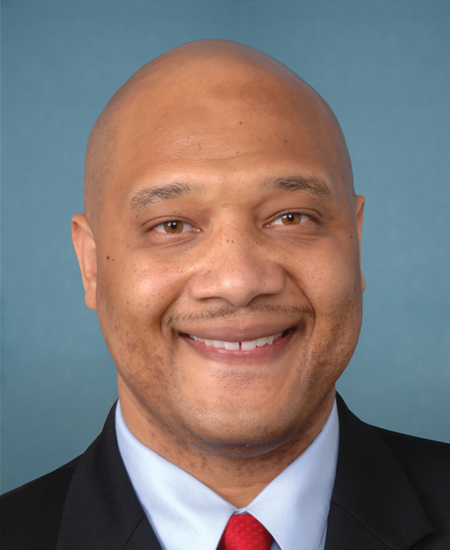
Rep. André Carson
Sponsored bills
Facilitating Innovative Nuclear Diagnostics Act of 2021 This bill establishes separate payment requirements for diagnostic radiopharmaceuticals under the Medicare prospective payment system for hospital outpatient department services. The bill's requirements apply to diagnostic radiopharmaceuticals that have an average daily cost of $500 or more in 2022 and as adjusted based on a specified fee schedule factor in each year thereafter.
This concurrent resolution recognizes the service and sacrifice of those who served and perished in California at Port Chicago Naval Magazine during World War II. The concurrent resolution also exonerates the 50 Port Chicago sailors convicted of the charge of mutiny against the United States and all other charges brought against them after the July 17, 1944, explosion that killed 320. It upgrades the general and summary discharges of the Port Chicago sailors to honorable discharges.
Green New Deal for Public Schools Act of 2021 This bill provides environmental and educational resources to public elementary and secondary schools and Bureau of Indian Education (BIE) schools. Specifically, the bill requires the Department of Energy's (DOE's) Office of Energy Efficiency and Renewable Energy to provide climate capital facilities grants to eligible entities (e.g., public schools and BIE schools). Grant recipients must use these funds to construct new, or convert existing facilities into, healthy zero-carbon schools. Healthy zero-carbon school refers to a school with highly energy-efficient facilities that produce or procure sufficient carbon-free and pollution-free renewable energy to meet the school's needs. Next, the bill directs the Department of Education (ED) to award resource block grants to qualified local educational agencies (LEAs) to hire and retain educators and support staff in high-need schools. ED must award grants to eligible consortia of LEAs for educational equity planning and implementation. In addition, ED must establish the Climate Change Resiliency Program to increase the resiliency of public and BIE schools during climate change-related events, natural disasters, and public health crises. Further, ED must establish a related grant program for state educational agencies. Grant recipients must use these funds for certain activities (e.g., green infrastructure projects). The bill establishes the Office of Sustainable Schools within ED to (1) administer the resource block grant and educational equity grant programs, and (2) coordinate with DOE and the White House Office of Domestic Climate Policy on climate capital facilities grants and the Climate Change Resiliency Program.
Pathways to Health Careers Act This bill provides funding for, reauthorizes through FY2026, and makes a variety of changes to certain grants administered by the Department of Health and Human Services that provide education and training to low-income individuals for health care occupations, including by establishing a new competitive grant for projects designed to train low-income individuals in allied health professions.
Allowing Steady Savings by Eliminating Tests Act or the ASSET Act This bill prohibits the use of asset tests or resource limits in certain means-tested public assistance programs and increases the resource limits to qualify for Supplemental Security Income (SSI). SSI is a federal income supplement program designed to help aged, blind, and disabled individuals with limited income and resources meet basic needs. Under the bill, states may not use asset or resource limits to determine eligibility for (1) programs funded by Temporary Assistance for Needy Families grants, (2) the Supplemental Nutrition Assistance Program, or (3) the Low-Income Home Energy Assistance Program. In addition, an individual may have up to $10,000 in certain resources (or up to $20,000 for a couple) and qualify for SSI. Under current law, the limit is $2,000 for an individual (or $3,000 for a couple).
National Infrastructure Development Bank Act of 2021 This bill establishes the National Infrastructure Development Bank as a government corporation to finance energy, environmental (e.g., drinking water or waste facilities), telecommunications, and transportation infrastructure projects. The bill establishes the National Infrastructure Development Bank Board, which must oversee the infrastructure projects. The board may make loans and loan guarantees to assist in financing infrastructure projects. Further, the board must establish an executive committee, a risk management committee, an audit committee, and a compliance office. To be eligible for financial assistance from the bank, an infrastructure project (1) must have a public benefit, as determined by the board; and (2) may not have a sole use or purpose that is private. An infrastructure project must use iron, steel, and manufactured products that are made in the United States. The bill also establishes accounting and reporting requirements. In particular, the Government Accountability Office must, within five years of this bill's enactment, submit a report to Congress evaluating the bank's activities.
Veterans Preventive Health Coverage Fairness Act This bill eliminates veterans' copayments for medication, hospital care, and medical services related to preventive health services provided by the Department of Veterans Affairs. The bill expands the definition of preventive health services to include (1) evidence-based items or services that have an A or B rating in the recommendations of the United States Preventive Services Task Force; (2) immunizations that have a recommendation from the Advisory Committee on Immunization Practices of the Centers for Disease Control and Prevention with respect to the individual involved; and (3) with respect to women, the preventive care and screenings provided for in the Health Resources and Services Administration Preventive Services Guidelines in effect as of January 1, 2017.
Fort McClellan Health Registry Act This bill requires the Department of Veterans Affairs (VA) to establish and maintain the Fort McClellan Health Registry, which must include a list of names of those who were stationed at Fort McClellan, Alabama, between January 1, 1935, and May 20, 1999, and are seeking specified health care or benefits from the VA. Specifically, the registry must include those who apply for hospital, nursing home, domiciliary, or medical care from the VA; file a claim for compensation for service-connected disability; die and are survived by a spouse, child, or parent who files a claim for dependency and indemnity compensation; request a VA health examination; or receive a VA health examination and request to be included in the registry. The registry must also include relevant medical data of the listed individuals if they grant permission or are deceased at the time they are listed. Individuals who have submitted applications, requests, or claims prior to the enactment of this bill must be included in the registry to the extent feasible. The VA must periodically notify individuals listed in the registry of significant research developments on the health consequences of potential exposure to toxic substances or environmental hazards related to service at Fort McClellan. Additionally, the VA must reach out to individuals regarding the provision of health examinations and consultation and counseling services. In establishing and maintaining the registry, the VA must consult with the Department of Defense to acquire necessary information.
Veterans Agent Orange Exposure Equity Act This bill expands the presumption of service-connection for diseases associated with exposure to certain herbicide agents for veterans who served in Vietnam between January 9, 1962, and May 7, 1975. Under a presumption of service-connection, specific conditions diagnosed in certain veterans are presumed to have been caused by the circumstances of their military service. Health care benefits and disability compensation may then be awarded. Specifically, the bill expands the presumption to cover veterans who served in Thailand at a U.S. Army base or Royal Thai Air Force base between January 9, 1962, and May 7, 1975; at the Royal Thai Army Replacement Training Center, Pranburi Military Reservation between January 1, 1964, and April 30, 1964; in Laos between December 1, 1965, and September 30, 1969; or in Cambodia at Mimot or Krek, Kompon Cham Province between April 16, 1969, and April 30, 1969.