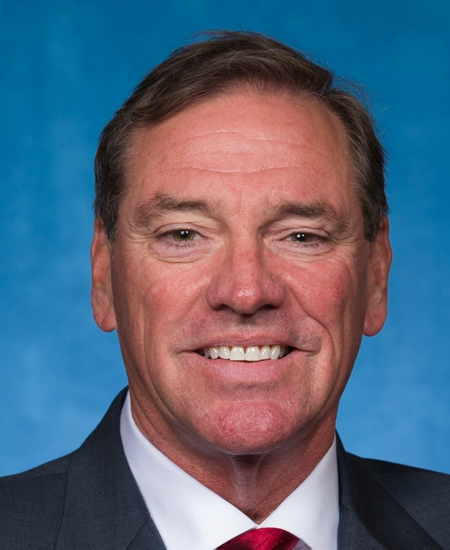
Photo of Neal P. Dunn
R United States House · District 2 · Florida

Rep. Neal P. Dunn

Compare
Total votes
2,837
all sessions
Attendance
94%
179 missed
Lower than 97% of chamber peers
With party
96%
of cast votes
Higher than 96% of chamber peers
Bipartisan score
2%
crosses aisle rarely
Lower than 99% of chamber peers
Sponsored
842
bills & resolutions
Near the chamber average
Committees
4
assignments
842 bills and resolutions

Sponsored bills

Total
842
Primary
61
Co-sponsor
781
This page
842
matching current filters
Co-sponsor HRES 1497
In committee · Ohio House · Co-sponsor
Commemorating the 13 United States servicemembers killed at Abbey Gate during and as a result of President Biden's disastrous Afghanistan withdrawal.

Maddy summaryH.Res. 1497 is a House resolution that commemorates the fifth anniversary of the Abbey Gate bombing, in which 13 U.S. servicemembers were killed during the withdrawal from Afghanistan. The bill lists the names of the fallen soldiers and formally condemns the Biden-Harris administration for what it describes as dereliction of duty and the forfeiture of military property to the Taliban. It asserts that the withdrawal was a disastrous failure that ignored security warnings and left Americans at risk, while also criticizing the lack of accountability from officials involved in the decision-making process.

In committee Aug 27, 2026 1 co-sponsor
Co-sponsor HRES 1451
In committee · Ohio House · Co-sponsor
Recognizing Charleston as the appropriate host city for the 2027 annual meeting of the Organization for Security and Cooperation in Europe Parliamentary Assembly.

Maddy summaryThis resolution expresses the sense of the House of Representatives that Charleston, South Carolina, should proceed with hosting the 2027 annual meeting of the Organization for Security and Cooperation in Europe Parliamentary Assembly. The bill cites Charleston's existing facilities as suitable for the event and notes that hosting the convention in South Carolina honors the legacy of late Senator Lindsey Olin Graham. It also highlights that the United States has not hosted this specific assembly since 2005. The measure does not change any laws or allocate funding but serves as a formal statement of support for the planned event.

In committee Jul 23, 2026 1 co-sponsor
Primary HR 9847
In committee · Ohio House · Lead sponsor
Improving CARE for Youth Act

Maddy summaryThe Improving CARE for Youth Act modifies Medicaid rules to allow payment for mental health, substance use disorder, and primary care services provided on the same day within the same clinic or health center. This change directly affects youth and adults receiving care by removing previous restrictions that often prevented billing for these combined visits. The bill defines "same-day qualifying services" to include scenarios where a patient sees both a primary care provider and a mental health specialist in one visit, or vice versa, at facilities like Federally qualified health centers or physician offices. By updating the Social Security Act, the legislation aims to streamline access to coordinated care without imposing new limitations on how these services are billed.

In committee Jul 22, 2026 0 co-sponsors
Co-sponsor HR 6213
In committee · Ohio House · Co-sponsor
Heat Workforce Standards Act of 2025

Maddy summaryHR 6213, the Heat Workforce Standards Act of 2025, prohibits the U.S. Department of Labor from finalizing, implementing, or enforcing OSHA's proposed "Heat Injury and Illness Prevention" standard (published August 30, 2024). This bill directly blocks the specific regulatory proposal targeting heat safety in both outdoor and indoor work settings. It does not create new requirements or affect workers; it solely prevents the implementation of the existing OSHA proposal. The bill is procedural, focusing on halting a regulatory action rather than establishing new policy.

In committee Jul 21, 2026 1 co-sponsor
Co-sponsor HR 3747
Passed · Ohio House · Co-sponsor
Accelerating Access to Dementia and Alzheimer’s Provider Training Act

Maddy summaryThe AADAPT Act reauthorizes and expands Project ECHO grants to improve Alzheimer’s and dementia care through technology-enabled training. It specifically funds grants for healthcare providers in rural, frontier, or medically underserved areas to enhance early diagnosis, quality care, and provider retention for dementia patients. The bill authorizes $1 million annually (2027-2032) for these dementia-focused training programs, requiring funds to supplement - not replace - existing resources. This directly supports primary care providers licensed to serve underserved communities, using collaborative online learning to address care gaps.

Passed Jul 21, 2026 1 co-sponsor
Co-sponsor HR 9693
In committee · Ohio House · Co-sponsor
Patients First Act of 2026

Maddy summaryThe Patients First Act of 2026 modifies how Medicare reimburses physicians and primary care providers to improve access and stabilize payments. It establishes a new hybrid payment model for primary care services from 2027 to 2031, which pays a monthly fee per patient to eligible independent practices while covering specific services like care management and telehealth without cost-sharing for patients. The bill also updates the formula for calculating reimbursement rates to account for high inflation years and requires more frequent updates to the costs used in calculating payments. Additionally, the legislation reforms the performance-based payment system by adding care efficiency measures, creating a task force to recommend new quality metrics, and adjusting penalties for providers who fail to report on certain data.

In committee Jul 15, 2026 1 co-sponsor
Co-sponsor HR 7184
In committee · Ohio House · Co-sponsor
PRESS Act

Maddy summaryHR 7184, the PRESS Act, targets equipment used to manufacture illegal drugs by making it unlawful to sell specific items like tableting machines, gelatin capsules, or related chemicals when the seller knows the equipment will be used to produce controlled substances for unlawful U.S. importation. It directly affects manufacturers and distributors of these drug-making tools who have knowledge or reasonable cause to believe their products will facilitate illegal drug trafficking. The bill adds new prohibitions to the Controlled Substances Act and increases potential prison sentences for violations, with penalties reaching up to 20 years for major offenses involving large quantities of equipment or chemicals. These changes aim to disrupt the supply chain for illicit synthetic drugs by holding equipment sellers accountable for their intended use.

In committee Jul 15, 2026 1 co-sponsor
Co-sponsor HR 3514
In committee · Ohio House · Co-sponsor
Improving Seniors’ Timely Access to Care Act of 2025

Maddy summaryThis bill requires Medicare Advantage plans to implement electronic pre-approval systems for medical services by 2028 and meet transparency reporting standards starting in 2027. Plans must publicly report data on approval/denial rates, appeal outcomes, response times, and technology use for pre-approval requests, including details on how denials relate to clinical criteria. It establishes a 24-hour response timeframe for certain requests and mandates annual reviews of pre-approval requirements based on data and input from seniors and providers. The law directly affects Medicare Advantage plans, seniors enrolled in these plans, and healthcare providers who submit pre-approval requests. These changes aim to make the pre-approval process faster, more transparent, and more accountable for seniors seeking covered medical services.

In committee Jul 15, 2026 1 co-sponsor
Co-sponsor HR 9211
In committee · Ohio House · Co-sponsor
Jewish American Security Act

Maddy summaryThe Jewish American Security Act aims to combat antisemitism by strengthening protections for Jewish students, securing Jewish communities, and increasing transparency regarding online hate speech. For educational institutions receiving federal funds, the bill mandates the creation of specific coordinators to handle discrimination complaints, requires annual training on handling antisemitism, and establishes a new federal clearinghouse to share best practices for campus safety. To support physical security, the legislation expands grant funding for nonprofit organizations and directs the Attorney General to provide resources for law enforcement agencies protecting houses of worship. Additionally, the act requires major online platforms with over 50 million monthly users to submit detailed reports to the Federal Trade Commission on how they detect, remove, and moderate antisemitic content.

In committee Jul 7, 2026 1 co-sponsor
Co-sponsor HR 9599
In committee · Ohio House · Co-sponsor
SECURE 340B Act

Maddy summaryThe SECURE 340B Act strengthens oversight of the drug discount program for safety-net health care providers by establishing clearer definitions for patients and prescribing providers, requiring detailed record-keeping to prove a legitimate patient relationship. The bill introduces strict rules for contract pharmacies, mandating that manufacturers cannot restrict discounts based on their use and requiring full transparency on where these drugs are dispensed. It also expands eligibility for child sites of covered entities while imposing a new community need standard based on geographic vulnerability scores to prevent abuse. To improve program integrity, the legislation creates a centralized data clearinghouse to track claims and prevent duplicate discounts, while simultaneously prohibiting discriminatory practices by insurance companies and pharmacy benefit managers against covered entities. Finally, the Act authorizes new user fees and additional funding for the Health Resources and Services Administration to support expanded audits and enforcement activities.

In committee Jul 6, 2026 1 co-sponsor
Showing 11 to 20 of 842 bills